Before leaving for vacation, most people have a familiar checklist.
Lock the doors.
Close the windows.
Take out the trash.
Turn off unnecessary lights.
Check the refrigerator.
Unplug electronics that don’t need to remain connected.
Then, just before walking out the door, there is one part of the house that is surprisingly easy to overlook:
The plumbing.
Sinks, showers, tubs, floor drains, and other fixtures may not seem important when you’re preparing to leave for several days. But if a plumbing fixture isn’t used for an extended period, changes can occur that you might notice only after returning home.
That’s where an unusual vacation trick comes into the conversation.
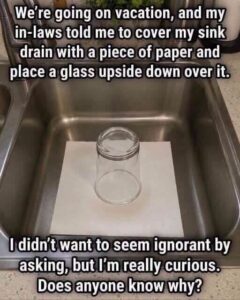
Some people place a piece of paper over or near a sink drain and position an upside-down glass over it before leaving.
It sounds peculiar.
But there is a practical idea behind the habit—although the glass itself isn’t a magical solution to plumbing problems.
Understanding what actually happens inside your drains is much more useful than simply copying the trick.
Why Can an Unused Sink Start Smelling?
Underneath many sinks is a curved section of plumbing known as a trap.
Its shape allows a small amount of water to remain inside the pipe.
That water serves an important purpose.
It creates a barrier between the drain opening inside your home and the drainage system beyond it. Among other things, this water seal helps reduce the movement of unpleasant sewer odors and gases back through the drain.
Whenever you use the sink, water passes through the trap and replenishes the water that has accumulated there.
That’s why an actively used sink generally maintains its water seal without any special attention.
The situation can be different when a fixture sits unused for a long period.
Water can gradually evaporate.
If enough water disappears, the trap may no longer maintain an effective water seal.
That’s when an unpleasant odor can potentially become noticeable.
You may return from vacation, open the front door, and immediately wonder why the house smells different.
The cause could be a dry or partially dry plumbing trap.
Warm Weather Can Increase Evaporation
Temperature and environmental conditions can influence how quickly water evaporates.
Warm or dry conditions can make evaporation more noticeable, particularly in fixtures that aren’t used regularly.
This can matter in vacation homes, guest bathrooms, utility areas, garages, basements, or other parts of a property where plumbing fixtures may sit unused for long periods.
However, it is important not to assume that every short vacation will result in a dry trap.
For many ordinary trips, especially those lasting only a few days, there may be no noticeable problem at all.
The concern becomes more relevant when a property will remain vacant for an extended period or when a particular drain is already rarely used.
What Does the Upside-Down Glass Actually Do?
This is where the internet version of the trick can sometimes become misleading.
The upside-down glass does not prevent water inside the plumbing trap from evaporating.
The glass isn’t connected to the trap.
It simply sits over the drain area as a temporary physical cover.
Depending on the design of the sink, it may help limit direct exposure of the drain opening to the surrounding air. A piece of paper placed underneath or around the glass may also make changes easier to notice.
For example, if the paper becomes disturbed, damp, or displaced, you may have a visible indication that something happened around the fixture while you were away.
But none of this makes the glass a substitute for proper plumbing maintenance.
It won’t repair a leaking trap.
It won’t prevent evaporation inside the plumbing indefinitely.
And it cannot guarantee that insects, odors, or gases will never enter the room.
Think of the glass as an optional temporary cover or reminder rather than a specialized plumbing device.
What Should You Actually Do Before Leaving?
If you’re going away for a few days, there’s usually no reason to become overly concerned about every drain in the house.
However, a few simple steps can make sense.
First, check rarely used fixtures.
If a guest bathroom hasn’t been used recently, run water through the sink.
Do the same with showers, tubs, and other fixtures that may have been sitting unused.
Allowing some fresh water to enter the traps helps maintain their water seals.
Floor drains can also deserve attention, particularly in areas that aren’t regularly used.
Don’t Forget the Toilet
Toilets have their own built-in water barrier.
The bowl normally contains water that helps prevent odors from the drainage system from entering the bathroom.
Before leaving for a longer period, make sure the toilet is functioning normally and isn’t showing signs of leakage.
If you’re going to be away for an unusually long time, additional preparation may be appropriate depending on the plumbing system and local conditions.
For an ordinary vacation, however, simply ensuring everything is functioning properly before departure is often the sensible approach.
What About Floor Drains?
Floor drains can be easier to forget than sinks.
They may be located in basements, laundry rooms, garages, utility rooms, or other areas where people don’t regularly look.
Because these fixtures may remain unused for long periods, their traps can be more susceptible to drying out.
If you notice an unpleasant smell coming from a floor drain after returning home, adding water may restore the water seal if evaporation was the cause.
If the smell continues, however, the issue may have another explanation.
Persistent Odors Deserve Attention
A drain that smells bad after a long period of inactivity isn’t necessarily a serious problem.
But persistent or unusually strong odors shouldn’t simply be covered up.
A dry trap is only one possible cause.
There could be a plumbing defect, a damaged trap, drainage problem, venting issue, buildup inside the drain, or another underlying condition.
If adding water doesn’t resolve the smell, or if multiple fixtures are affected, professional plumbing advice may be appropriate.
The important point is not to assume that an unusual odor automatically means sewer gas or a major plumbing failure.
Investigate rather than guess.
Other Vacation Preparations Matter More
The upside-down glass may be interesting, but there are other preparations that are generally more important when leaving your home unattended.
Make sure doors and windows are properly secured.
Check that appliances and electronics that don’t need to remain on are safely disconnected where appropriate.
Arrange for mail and packages to be handled.
Consider maintaining reasonable heating or cooling depending on the season and local conditions.
If you have plumbing in an area vulnerable to freezing temperatures, winter preparation becomes particularly important.
And if you’re leaving for a long period, someone you trust can periodically check the property for leaks, unusual odors, power problems, or other issues.
These measures address actual risks rather than relying on a single household trick.
So, Should You Use the Glass Trick?
You can, if you find it useful.
There is little mysterious about an upside-down glass placed over a sink drain.
It can act as a basic cover, and the paper may provide a simple visual indicator if something changes around the drain.
But don’t mistake it for a solution to evaporation.
The water inside the plumbing trap is what matters.
Before leaving, the more useful habit is to run water through fixtures that haven’t been used recently and make sure the plumbing is functioning normally.
If you’re leaving your home for an extended period, pay particular attention to rarely used sinks, showers, tubs, and floor drains.
A Small Habit With a Simple Explanation
The appeal of the upside-down glass trick comes from its simplicity.
It looks unusual enough to make people wonder whether there is some hidden household secret behind it.
The actual explanation is much less mysterious.
Unused plumbing fixtures can lose water from their traps through evaporation. If the water seal becomes ineffective, unpleasant odors can potentially make their way into the home.
The glass doesn’t solve that problem by itself.
The real preventative step is understanding how your plumbing works and making sure its water seals remain functional.
So before you leave for your next vacation, don’t worry about finding a special glass.
Run some water through rarely used fixtures.
Check for leaks.
Pay attention to floor drains.
And make sure everything is working normally before you lock the door.
If you still want to place an upside-down glass over a drain, that’s perfectly fine.
Just remember what it is: a simple household precaution, not a substitute for proper plumbing care.