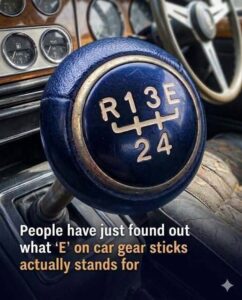
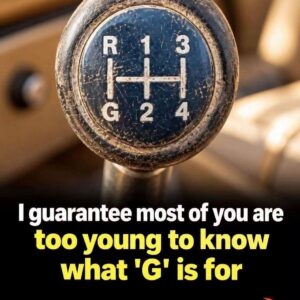
If you ever climbed into an older automatic car and noticed a strange “E” on the gear selector, you may have wondered what it meant.
Most drivers recognize the familiar letters.
P means Park.
R means Reverse.
N means Neutral.
D means Drive.
But what about E?
On certain older vehicles, particularly some models from the 1980s and 1990s, E could stand for Economy.
And unlike many features hidden behind modern electronic menus, selecting E was a physical decision made directly with the gear selector.
The idea was straightforward.
The transmission would operate differently in an attempt to improve fuel economy.
During an era when fuel prices and fuel consumption were major concerns for many drivers, manufacturers experimented with different ways to help motorists use less gasoline.
An Economy setting was one approach.
When selected, the transmission could be programmed to favor earlier upshifts and lower engine speeds.
Instead of holding a lower gear for longer, the car would generally move into a higher gear sooner under suitable driving conditions.
The result could be a calmer driving experience.
The engine might sound quieter because it was operating at lower revolutions per minute.
Acceleration could feel less aggressive.
The transmission could also be less eager to perform a kick-down shift when the driver pressed the accelerator.
For someone accustomed to modern cars, the difference might sound surprisingly subtle.
But drivers familiar with older automatic transmissions could often feel the change.
The car behaved differently because the transmission was following a different set of priorities.
In a normal driving mode, the transmission had to balance acceleration, smoothness, engine speed, and fuel consumption.
Economy mode shifted that balance toward efficiency.
That did not mean the car suddenly became dramatically more economical in every situation.
Driving style, road conditions, vehicle weight, engine design, tire pressure, traffic, and many other factors affected fuel consumption.
The Economy setting was simply one tool intended to encourage more efficient operation.
It also changed the way the driver interacted with the car.
Today, drivers may select an Eco mode using a button or touchscreen.
Some modern cars can adjust throttle response, transmission behavior, climate-control operation, and other systems automatically.
Older vehicles were much more mechanical and straightforward by comparison.
A physical position on the gear selector could directly tell the transmission how the driver wanted it to behave.
There was something remarkably simple about that.
You moved the selector.
You felt the difference.
There was no menu to open.
No screen to navigate.
No notification explaining what the computer was doing.
The car simply responded.
Another interesting feature of older Economy settings was their effect on acceleration.
When a transmission shifts into a higher gear earlier, the engine may operate at a lower speed.
That can help reduce unnecessary engine revving during gentle driving.
However, it can also make the vehicle feel less responsive.
If the driver suddenly demanded strong acceleration, the transmission might still need to downshift.
That is why Economy settings were generally better suited to relaxed driving rather than situations where immediate acceleration was needed.
The technology varied considerably between manufacturers and individual models.
Not every vehicle using an E position operated in exactly the same way.
Some systems changed shift points.
Others could alter how readily the transmission performed kick-downs.
Some may have used the setting for other transmission-management strategies as well.
So it is important not to assume that every old gear selector marked E worked identically.
The owner’s manual for a specific vehicle would provide the definitive explanation.
Still, the basic philosophy was usually easy to understand:
Use the transmission in a way that favors economy rather than maximum performance.
That philosophy remains very much alive today.
The letter may have disappeared from many gear selectors, but the concept did not.
Modern vehicles often have an Eco button or driving mode.
When activated, the vehicle’s computers can modify several systems at once.
Throttle response may become gentler.
The automatic transmission may favor lower engine speeds.
Air-conditioning operation may be adjusted.
Some vehicles may reduce the intensity of other energy-consuming systems.
The exact behavior depends on the manufacturer and model.
Modern cars can also monitor driving conditions continuously.
Computers can consider throttle position, vehicle speed, engine load, transmission temperature, road conditions, and many other factors.
That allows the car to make decisions automatically rather than relying on the driver to select a dedicated Economy gear position.
In other words, modern technology has largely automated an idea that older cars sometimes placed directly in the driver’s hands.
There is another reason the old E setting is interesting.
It reminds us how much automotive technology has changed.
Older drivers often had a much more direct relationship with their vehicles.
They learned what different sounds meant.
They paid attention to engine speed.
They could feel when a transmission shifted.
They sometimes understood the mechanical behavior of their vehicles simply because there were fewer electronic systems between the driver and the machine.
Modern cars are considerably more sophisticated.
That sophistication brings advantages, including improved efficiency, safety, emissions control, and convenience.
But it can also make the technology less visible.
A driver may press an Eco button today without ever knowing exactly what the vehicle is changing.
An older driver selecting E could often feel the difference immediately.
The engine became calmer.
The shifts changed.
The car felt different.
There was a physical connection between the driver’s decision and the machine’s behavior.
And that is perhaps why people who remember these vehicles still find the old E setting interesting.
It represents a period when automotive manufacturers were already searching for ways to reduce fuel consumption, but the solutions were often simpler and more visible.
Today, efficiency is built into almost every part of a modern vehicle.
Engine management systems continuously optimize combustion.
Transmissions can have many gears.
Hybrid systems recover energy during braking.
Electric vehicles can use regenerative braking to return some energy to the battery.
Aerodynamics have improved.
Tires have become more efficient.
Computer controls have become vastly more sophisticated.
The old E position may seem primitive by comparison.
But its underlying purpose was remarkably familiar.
Use less energy.
Avoid unnecessary engine speed.
Change driving behavior.
Make the vehicle more efficient.
That goal hasn’t disappeared.
Only the technology has changed.
So if you ever see an older automatic car with P, R, N, D—and E, don’t assume the unusual letter is mysterious or decorative.
In many cases, it represents a simple idea from an earlier generation of automotive engineering.
E meant Economy.
It was the driver’s way of telling the transmission:
Take it easy.
Shift efficiently.
Keep the engine relaxed.
And use fuel carefully.