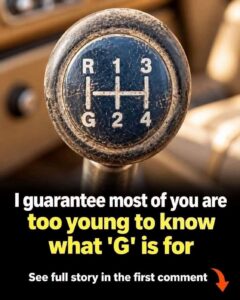
For generations, drivers have grown accustomed to the familiar arrangement of letters and numbers on their car gear sticks. Manual transmissions typically display numbered gears alongside an “R” for reverse, while automatic vehicles commonly feature “P,” “N,” “D,” and “R,” representing Park, Neutral, Drive, and Reverse. Some vehicles also include an “L” for low gear or other driving modes.
But what happens when drivers encounter a letter they do not recognize?
In certain older vehicles, the letter “E” appeared on the gear selector, leaving many modern motorists wondering what it meant. Unlike the familiar Drive or Reverse settings, this mysterious letter was associated with a feature designed to make driving more economical.
The answer is surprisingly simple: in some vehicles, “E” stood for Economy.
Although this setting was never universal across all cars, it provides an interesting glimpse into how manufacturers approached fuel efficiency before today’s sophisticated electronic systems became commonplace.
What Did the E on Older Gear Sticks Mean?
In certain older automatic vehicles, an “E” marking identified an Economy driving mode or selection. Its precise operation depended on the manufacturer and transmission design.
Rather than providing an additional conventional gear in the same sense as first, second, or third gear, the setting generally changed how the transmission operated.
Depending on the vehicle, Economy mode could encourage earlier upshifts, reduce unnecessary downshifting, or keep engine speeds lower during ordinary driving. These adjustments helped reduce fuel consumption under suitable conditions.
For example, when driving at a steady speed on a relatively flat road, an economy-oriented transmission setting could help the engine operate at lower revolutions per minute. Lower engine speeds can reduce fuel consumption when the engine is not required to produce substantial power.
However, lower engine speed does not automatically guarantee better efficiency in every situation. Climbing a steep hill, accelerating quickly, or towing a heavy load may require a lower gear and greater engine output.
The important distinction is that an “E” setting generally represented an economy-focused operating mode, not a universal gear with identical behavior across all manufacturers.
Why Did Car Manufacturers Introduce Economy Settings?
Fuel efficiency has been an important concern for motorists for decades. Fuel prices, household budgets, environmental considerations, and government regulations have all encouraged manufacturers to develop vehicles that travel farther using less fuel.
Older cars had fewer electronic systems available to manage engine performance and transmission behavior. Some relied on mechanical controls, hydraulic systems, and relatively basic electronic components.
As a result, manufacturers sometimes provided drivers with selectable settings that influenced how the transmission behaved.
An economy-oriented setting could help the car prioritize smooth, fuel-conscious driving over rapid acceleration. Depending on the design, this might mean keeping the transmission in higher gears for longer periods or reducing how readily it shifted into a lower gear.
These adjustments could be useful for everyday commuting and highway journeys, where consistent speeds and moderate engine loads often favor efficiency.
Drivers who understood their vehicles could use these settings to adapt the driving experience to their needs.
How Did Economy Mode Affect Driving?
Imagine driving an older automatic car through a quiet town before joining a highway.
In a conventional driving mode, the transmission might respond readily to changes in the accelerator pedal, downshifting when additional power was requested.
In an economy-oriented mode, the transmission might respond more gently, favoring smoother acceleration and earlier upshifts when conditions allowed.
The result could be a calmer driving experience with reduced fuel consumption during suitable journeys.
However, the trade-off was that acceleration might feel slower. When a driver needed extra power to overtake another vehicle or climb a hill, the economy setting could make the car feel less responsive.
This was not necessarily a defect. It reflected the different priorities of the selected operating mode.
Drivers were expected to understand that the most fuel-efficient setting was not always the most suitable choice for every road or driving situation.
The owner’s manual was therefore an important source of information, explaining how the specific vehicle’s transmission settings were intended to work.
Why Did the E Setting Disappear From Many Cars?
As automotive technology advanced, manufacturers developed increasingly sophisticated ways to manage fuel consumption.
Electronic engine management systems began monitoring information from sensors and adjusting fuel delivery, ignition timing, and other operating parameters. Automatic transmissions also became more advanced, gaining additional gear ratios and more precise electronic controls.
These improvements allowed vehicles to adapt their behavior without requiring drivers to select a separate economy-oriented gear position.
Modern automatic transmissions can choose an appropriate gear based on factors such as vehicle speed, engine load, accelerator input, and driving conditions. Some can also learn from driving patterns or use information from navigation systems.
Many contemporary vehicles offer a dedicated Eco driving mode, but it is usually activated through a button, touchscreen, or drive-mode selector rather than a traditional gear-stick position marked “E.”
Eco mode may adjust accelerator response, transmission shift points, climate-control operation, or other systems to improve efficiency. The exact changes depend on the model.
Consequently, the old-style “E” marking became less common as these functions were integrated into broader electronic control systems.
Does Modern Eco Mode Work the Same Way?
Not exactly.
Although older Economy selections and modern Eco modes share a fuel-saving objective, their implementations can differ significantly.
An older vehicle might use a dedicated transmission setting that changes shifting behavior. A newer vehicle may coordinate several electronic systems to encourage more economical operation.
For instance, a modern car could soften accelerator response so that pressing the pedal produces a more gradual increase in power. Its transmission might prioritize efficient gear choices, while the climate-control system could adjust its operation to reduce energy demand.
Some vehicles also provide dashboard feedback showing how efficiently the driver is accelerating or braking.
Hybrid vehicles may coordinate their gasoline engines and electric motors to optimize energy use, while fully electric vehicles manage battery power and regenerative braking.
These developments illustrate how the goal of improving efficiency has remained consistent even as the technology has changed.
It is worth remembering that selecting Eco mode does not guarantee a particular fuel saving. Results depend on the vehicle, traffic conditions, terrain, temperature, and driving habits.
What Does E Mean in Modern Cars?
Today, the letter “E” can appear in several automotive contexts, and its meaning depends on where it is displayed.
In some older vehicles, it can refer to Economy mode. In other contexts, it may identify an electric model, an electrified powertrain, or a particular manufacturer-specific feature.
Electric vehicles have transformed the way many people think about driving controls. Most use a simplified selector that allows drivers to choose forward motion, reverse, neutral, and parking functions without manually changing conventional gears.
Many electric cars have a single-speed transmission because electric motors can deliver useful torque across a broad range of rotational speeds. This eliminates the need for the multi-gear transmission commonly found in gasoline-powered vehicles.
Nevertheless, not every electric vehicle uses exactly the same controls, and the letter “E” does not have one universal meaning across the automotive industry.
When encountering an unfamiliar symbol, drivers should consult the owner’s manual rather than assume it refers to a particular feature.
A Small Reminder of Automotive History
The mysterious “E” marking illustrates how automotive design has evolved over time.
What once required a dedicated selector position can now be managed automatically by electronic systems. Drivers still benefit from fuel-saving technology, but much of the work happens behind the scenes.
Older vehicles remind us of a period when motorists had more direct involvement in choosing how their transmissions behaved. Modern vehicles increasingly make these decisions themselves, balancing efficiency, comfort, and performance according to changing conditions.
Neither approach tells the whole story of automotive progress. Mechanical ingenuity laid the groundwork for the sophisticated electronic systems found in today’s cars.
Final Thoughts
The letter “E” on certain older gear selectors generally stood for Economy, identifying a setting intended to help reduce fuel consumption through transmission behavior suited to efficient driving.
Its exact function varied by vehicle, and it was never a standard feature across every manufacturer.
As automatic transmissions and engine-management systems became more advanced, separate economy selections became less necessary. Modern vehicles often provide similar benefits through electronic controls and dedicated Eco modes.
So, if you discover an unfamiliar “E” on an older car’s gear stick, you may be looking at a small piece of automotive history: a reminder of how manufacturers once gave drivers a more direct way to prioritize fuel economy.
And if the symbol appears on a modern vehicle, check the owner’s manual. The meaning may be different, but understanding it can help you make better use of the technology built into your car.