-
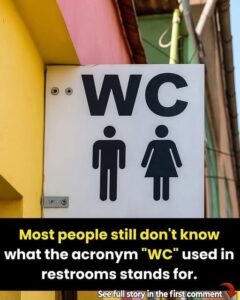
The next time you see a “WC” sign at a restaurant, train station, airport, or public building, you may look at those two letters differently. Although the abbreviation is familiar to millions of people, surprisingly few stop to wonder what it actually means.
The answer is “Water Closet.”
Today, the phrase may sound old-fashioned, but it has an interesting connection to the history of indoor plumbing and the way homes were designed more than a century ago.
What Does WC Stand For?
“WC” is an abbreviation for Water Closet, a term historically used to describe a small room containing a toilet.
The word “closet” originally referred to a small private room or enclosed space rather than the storage area we commonly associate with the word today. When toilets began being connected to indoor water systems, a small enclosed room with a flushing toilet could therefore be described as a water closet.
Over time, WC became a convenient abbreviation, particularly in Europe and other parts of the world.
Although the term is much less common in everyday English conversation today, the abbreviation remains visible on signs.
Why Was It Called a Water Closet?
To understand the term, it helps to look at how bathrooms developed.
Before modern plumbing became widespread, people did not simply turn on a faucet whenever they needed water. Water often had to be collected from wells, pumps, rivers, or other sources and then carried into the home.
Bathing was also very different from what people experience today. A household might have a bathtub or another container, but filling it required bringing water into the room manually.
The arrival of indoor plumbing changed daily life dramatically.
Once homes began receiving running water and toilets could be connected to plumbing systems, people needed suitable spaces for these new fixtures. A small private room containing a water-connected toilet became known as a water closet.
The name described its function: it was an enclosed space associated with a toilet that used water.
Why Don’t We Usually Say “Water Closet” Today?
Language changes over time.
Many words that were once common eventually become less popular as everyday habits change. “Water closet” is one example.
In modern American English, people are more likely to say bathroom, restroom, or toilet, depending on the situation and region.
In British English, toilet and loo are common terms, while “bathroom” can also be used in everyday conversation.
Yet the abbreviation WC survived.
That is why someone can encounter the letters repeatedly throughout their life without ever hearing the full phrase spoken.
Why Is WC Still Used on Signs?
One reason is simple: signs need to be understood quickly.
A short abbreviation takes up very little space and can be recognized without requiring a long explanation. In places visited by international travelers, a familiar symbol or abbreviation can also be more convenient than a word that may differ from one language to another.
As a result, WC signs remain common in many countries.
You may see them in hotels, restaurants, transportation hubs, shopping centers, museums, and other public spaces.
For travelers, the letters can become almost universally recognizable even if they do not know their historical meaning.
The Interesting Part Is How Long the Abbreviation Has Survived
What makes “WC” particularly interesting is its age.
The term belongs to an earlier period of plumbing history, yet the abbreviation continues to appear on modern signs.
In other words, every time someone follows a WC sign, they are using a piece of terminology that has survived long after the original phrase became less common in ordinary conversation.
It is a small example of how language preserves history.
We often continue using words and symbols without remembering why they were created in the first place.
Why Some People Are Only Learning This Now
The abbreviation is so familiar that many people never question it.
Imagine seeing “WC” on signs from childhood. You quickly learn that those letters indicate a toilet. Once you understand what the sign means, there is little reason to investigate further.
That can lead to a funny situation: someone may know exactly what a WC sign indicates while having no idea what the letters originally represented.
This is common with abbreviations in everyday life.
We recognize the symbol or initials long before we learn their history.
Social Media Helped Spark the Conversation
Questions about everyday abbreviations regularly appear on social media because people enjoy discovering that familiar things have unexpected explanations.
A person can use or see something for decades before suddenly asking, “What does that actually mean?”
The WC abbreviation is a perfect example.
Once people learn that it stands for “Water Closet,” the explanation can seem surprisingly obvious. The word “water” relates to the plumbing, while “closet” refers to the small enclosed room.
Yet without that explanation, the two letters can seem completely mysterious.
WC Is More Than Just a Toilet Sign
Today, most people do not think about plumbing history when they see the letters WC.
They simply understand the sign as an instruction telling them where to find a toilet.
But the abbreviation carries a small piece of history with it.
It reflects the period when indoor plumbing was becoming increasingly important and homes were being redesigned around running water and improved sanitation.
The terminology may sound old-fashioned, but the sign remains remarkably useful.
So the next time you walk through a train station, hotel, restaurant, or public building and see WC, you’ll know exactly what those letters mean.
They stand for Water Closet, an old term for a small room containing a water-connected toilet.
It’s a simple explanation for a familiar sign—but once you know the history behind it, those two letters suddenly become much more interesting.

Related Posts

Should You Cover Your Kitchen or Bathroom Sink Before Vacation? The Truth About Odors, Insects, and Plumbing
Before leaving for vacation, most people focus on packing their bags, arranging transportation, and making sure their doors and windows are secure. But there is another small…

Why Hotels Put a Narrow Strip of Fabric Across the Bed and What Travelers Should Know About Cleanliness
Have you ever checked into a hotel, pulled back the covers, and wondered why there is a narrow strip of fabric stretched across the foot of the…
If You See Purple Paint on Trees or Fences, Discover What It Means Before Entering Private Property
While walking through the countryside, hiking along a wooded trail, or driving past rural properties, you might notice something unusual: a purple stripe painted on a tree,…

Drivers Are Discovering What the Mysterious E on Older Car Gear Sticks Really Means and Why It Disappeared
For generations, drivers have grown accustomed to the familiar arrangement of letters and numbers on their car gear sticks. Manual transmissions typically display numbered gears alongside an…

Nine Dinners on a Small Fishing Boat Taught My Husband a Lesson About Love, Money, and Marriage
My husband, Rick, had just bought a fishing boat with the $11,012 I had saved for six years to renovate our kitchen. Every Friday, I put $40…
This Strange Wooden Kitchen Tool Looks Mysterious, But Its Surprisingly Practical Purpose Reveals a Forgotten Cooking Tradition
At first glance, this old wooden tool looks more like something from a workshop than a kitchen. Its unusual shape, smooth surface, and sturdy construction can make…