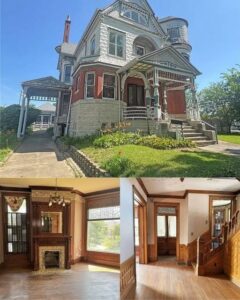
Standing before this 1887 Queen Anne Victorian in Decatur, Illinois, you immediately feel the character of a home built with remarkable craftsmanship. The exterior combines rustic stone masonry, red brick, fish-scale shingles, carved woodwork, a dramatic corner turret, and a covered porte-cochère. Spanning about 3,500 square feet across two main levels, the residence sits on a generous quarter-acre lot in the Decatur Historic District. Its aged exterior paint adds to its historic appearance, while the original masonry and architectural details remain remarkably impressive.
The broad front porch welcomes visitors with turned spindles and hand-carved brackets, while the high gables, turret, and arched upper balcony create a striking roofline. The property offers a rare combination of historic architecture and space close to the city center, preserving details that are difficult to find in modern homes.
Inside, the grand central foyer immediately showcases the home’s original craftsmanship. Gleaming oak floors, leaded glass transoms, carved woodwork, and an open staircase create an impressive entrance. Rich quarter-sawn oak wainscoting covers the walls, while oversized solid-wood pocket doors allow the rooms to be separated for privacy or opened for entertaining.
The formal living room features tall ceilings, thick crown molding, pine floors, and large windows that bring in plenty of natural light. Built-in pocket shutters remain inside the deep window casings, adding another distinctive historic detail. The adjoining great room measures approximately 18 by 15 feet and includes a second fireplace surrounded by tall double-hung windows overlooking the grounds.
Moving farther into the house reveals just how much space the original designers incorporated into the floor plan.
Historic Victorian homes were often designed around formal entertaining, and this property reflects that tradition. Large rooms connect through substantial doorways, while the pocket doors provide flexibility between open and private spaces. The arrangement allows the house to feel spacious without losing the distinct character of individual rooms.
The dining room is another space where the home’s age becomes especially apparent. Details such as substantial wood trim, high ceilings, and carefully crafted millwork create an atmosphere that would be difficult to reproduce in a modern construction project.
A home of this age can also reveal fascinating details in places that are easy to overlook.
Deep window casings, original hardware, decorative molding, stair components, and built-in features can all provide clues about how the house was constructed and how its rooms were used more than a century ago. Even areas that appear simple at first can contain craftsmanship that is rarely found in contemporary homes.
The staircase is particularly important to the home’s overall character. Rather than serving merely as a way to reach the second floor, the staircase becomes part of the architectural experience. Its open design draws attention from the foyer and creates a strong visual connection between the two levels.
Upstairs, the bedrooms provide a different atmosphere from the formal rooms below.
With four bedrooms, the house has enough flexibility for a family, guests, home offices, or hobby spaces. The large windows and generous proportions typical of Victorian construction can make these rooms feel considerably different from the compact bedrooms found in many newer houses.
The corner turret is one of the home’s most memorable features.
From the outside, it gives the house an unmistakable Queen Anne silhouette. Inside, turret spaces can create unusual rooms or alcoves that add personality to the floor plan. Curved or angled walls are not always easy to furnish, but they are exactly the kinds of details that make historic homes so distinctive.
The property also benefits from its quarter-acre lot.
In an established historic district, having a substantial amount of private outdoor space close to the city center can be a meaningful feature. The grounds provide room for landscaping, gardens, outdoor seating, or simply a quiet area around the house.
At the same time, the mature property would require ongoing maintenance.
Historic homes demand attention not only because of their age but because many of their original materials need specialized care. Exterior woodwork, masonry, windows, roofing, porches, and decorative details can all require maintenance that differs from ordinary modern construction.
The aged exterior paint immediately suggests that the property may benefit from restoration work. However, repainting a historic home is not necessarily as simple as choosing a new color and hiring a contractor. The underlying wood, masonry, and decorative elements should be examined first, particularly in a property located within a historic district.
Historic-district requirements may also influence exterior renovations. Depending on local regulations, changes to visible architectural elements may require approval before work begins. Anyone considering purchasing or restoring the home would therefore benefit from understanding the applicable preservation requirements.
The masonry deserves particular attention.
The combination of rustic stone and red brick creates one of the property’s strongest visual characteristics. Unlike modern decorative materials, historic masonry can require specialized repair techniques. Improper repairs can sometimes cause additional deterioration, making it important to use appropriate materials and methods.
The windows are another defining feature.
The tall double-hung windows allow natural light to reach the interior while preserving the home’s historic appearance. Where original windows survive, restoration may be worth considering rather than automatically replacing them. Original window frames and glass can contribute significantly to the character of a historic property.
The house’s fireplaces are equally evocative.
In a home built in 1887, fireplaces were important functional features rather than purely decorative ones. Today, they can serve as architectural focal points. Before using any historic fireplace or chimney, however, the system should be professionally evaluated for safety and condition.
What makes this property particularly interesting is the combination of scale and preservation.
At roughly 3,500 square feet, it provides considerably more space than the average historic house while retaining the architectural elements that give Victorian properties their identity.
The home does not need to look perfectly modern to be appealing.
In fact, much of its charm comes from the contrast between its aged appearance and the craftsmanship preserved underneath. The weathered exterior, original woodwork, historic floors, pocket doors, fireplaces, turret, and decorative masonry all tell the story of a house that has survived for generations.
A future owner could choose to restore it carefully while introducing modern conveniences where appropriate.
The challenge would be finding the right balance.
Modernization can improve comfort and efficiency, but removing too many original features can permanently change the character of a historic home. The most successful restoration projects often begin by identifying which elements are historically significant and protecting them before making cosmetic or functional changes.
For buyers who appreciate historic architecture, this Decatur property offers something increasingly difficult to find: a large, character-filled residence where the original craftsmanship remains central to the experience.
The house is more than four bedrooms and a quarter-acre lot.
It is a surviving example of late-19th-century residential design, complete with a dramatic turret, elaborate woodwork, historic masonry, tall windows, fireplaces, pocket doors, and carefully proportioned rooms.
Its future will depend on the care it receives.
With thoughtful maintenance and appropriate restoration, many of these architectural details could continue to define the home for decades to come. And for someone willing to embrace the responsibilities that come with owning a historic property, that may be the most remarkable opportunity of all.
Behind the weathered paint and aging exterior is a house filled with craftsmanship that modern construction rarely attempts to reproduce.
More than a century after it was built, this Queen Anne Victorian still has a story to tell.