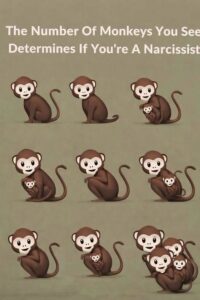
At first glance, the image looks like a simple cartoon illustration filled with rows of monkeys. But a bold caption makes the picture far more intriguing: “The number of monkeys you see determines if you’re a narcissist.”
Suddenly, what appears to be an ordinary visual puzzle becomes a personality test. Viewers are encouraged to count the monkeys, compare their answers with other people, and wonder whether the number they discover reveals something hidden about their character.
Some people immediately notice the most obvious monkey figures. Others spend more time examining the illustration, looking between overlapping shapes and searching for smaller faces that might initially go unnoticed. When people compare their answers, the differences can make the puzzle even more interesting.
But does seeing a particular number of monkeys really mean someone is narcissistic? Can a simple image reveal whether a person has a particular personality trait?
The answer is no. There is no established scientific evidence that the number of monkeys someone sees can determine whether they are a narcissist. The image is better understood as a visual challenge that encourages people to examine how they interpret what they see.
Still, the idea raises some interesting questions about visual perception, personality tests, and why these viral challenges attract so much attention online.
Why Do Different People See Different Numbers of Monkeys?
One of the most interesting aspects of optical illusions and hidden-picture puzzles is that people can look at the same image yet notice different things.
This happens partly because the human brain does not process every visual detail equally. Instead, it organizes incoming information, identifies patterns, and directs attention toward features that appear important.
When you first look at a crowded illustration, your brain may recognize the overall arrangement before you notice the smaller shapes within it. Once you begin searching for additional monkeys, details that seemed invisible at first may suddenly become easier to recognize.
The arrangement of the figures, the contrast between shapes, and the amount of time you spend looking can all influence what you notice.
For example, someone who focuses on the largest monkey faces may overlook smaller figures hidden between them. Another person who deliberately searches for overlapping outlines might discover additional monkeys because their attention is directed toward different parts of the image.
Neither person necessarily has a superior ability. They may simply be approaching the same visual information differently.
This is what makes hidden-picture challenges enjoyable. They encourage you to slow down, examine details, and reconsider what initially seemed obvious.
What Does the Number of Monkeys Supposedly Say About You?
The viral caption encourages viewers to believe that their answer corresponds to a personality characteristic. That promise is part of what makes the puzzle so appealing.
People naturally enjoy tests that offer quick insights into their behavior, relationships, and identity. A simple image seems to provide an easy way to discover something personal without completing a lengthy questionnaire.
Some online personality challenges attach labels to different answers, suggesting that the number of figures someone sees reveals whether they are self-centered, thoughtful, confident, or emotionally sensitive.
These interpretations can be entertaining, but they should not be confused with reliable psychological findings.
Unless a particular test has a clearly defined scoring method and credible scientific validation, there is no reliable basis for treating its result as a psychological assessment.
The number of monkeys someone identifies may reflect how they approached the image, how much time they spent looking, or how clearly the figures are drawn. It does not establish that the person is selfish, empathetic, confident, or narcissistic.
Even if thousands of people share their results online, popularity does not make the underlying claim scientifically valid.
What Is Narcissism, Really?
Narcissism is a term frequently used in everyday conversations, particularly when people discuss difficult relationships, arrogance, or someone who appears excessively focused on themselves.
In psychology, however, narcissism is more complex than simply thinking highly of yourself or enjoying attention.
Certain narcissistic traits can involve an exaggerated sense of self-importance, a strong desire for admiration, feelings of entitlement, or difficulties recognizing other people’s perspectives. These characteristics can vary considerably between individuals and situations.
It is also important to distinguish between narcissistic traits and narcissistic personality disorder, a clinical diagnosis involving persistent patterns of behavior and functioning that require professional assessment.
A person may be confident, ambitious, proud of their achievements, or interested in receiving recognition without having narcissistic personality disorder.
Likewise, a person who behaves selfishly in one situation cannot automatically be classified as a narcissist.
Personality is influenced by numerous factors, and understanding someone’s behavior requires looking at patterns over time rather than relying on a single observation.
No visual puzzle can establish a diagnosis or reliably measure a complex personality pattern. A proper psychological assessment requires substantially more information than a person’s answer to a cartoon-based challenge.
Why Are Viral Personality Tests So Popular?
The popularity of personality puzzles is not particularly surprising. They are quick, accessible, and easy to share with friends.
Unlike lengthy psychological questionnaires, a picture-based challenge requires very little effort. You simply look at an image, count the figures, and compare your answer with the interpretation provided.
The promise of discovering something hidden about yourself makes the experience even more engaging.
Social media also encourages people to compare their results. One person might claim to see six monkeys, while another insists there are nine. These disagreements prompt further discussion, with everyone looking again to determine who has spotted the most figures.
The word narcissist adds another layer of curiosity because it is frequently used in discussions about relationships and personality.
However, dramatic captions can make an ordinary puzzle seem more scientifically meaningful than it really is. A claim that promises to reveal a person’s deepest character traits may attract more attention than a simple invitation to count hidden shapes.
That does not mean every personality quiz is harmful. Many are designed purely for entertainment. The important distinction is whether the result is presented as a playful suggestion or as a reliable psychological conclusion.
Can an Optical Illusion Tell You Anything About Yourself?
Although the monkey puzzle cannot diagnose narcissism, visual challenges can still encourage useful habits.
They invite you to pay attention to details, consider alternative interpretations, and recognize that your first impression may not capture everything in front of you.
They can also remind you that people sometimes interpret the same situation differently. Two people may focus on different details without either deliberately ignoring the truth.
However, this observation should not be stretched into a claim that a particular visual result reveals intelligence, empathy, emotional maturity, or another complex personal quality.
If you want to understand your personality, more useful approaches include reflecting on your behavior across different situations, considering feedback from people you trust, and examining how you respond to challenges and relationships.
For a more formal understanding of personality, researchers use carefully developed assessment tools with defined methods and evidence supporting their reliability and validity.
Even those assessments must be interpreted appropriately and cannot tell the entire story of a person.
The monkey image is best enjoyed for what it is: a small challenge that encourages curiosity and observation.
Try the Challenge Yourself
Before reading other people’s answers, take another look at the illustration.
Start by counting the largest, most obvious monkey faces. Then examine the spaces between them. Look for overlapping outlines, partial faces, and shapes that might form additional figures.
Try scanning the image from left to right, moving systematically through each row. This can help you avoid counting the same monkey twice or overlooking a figure hidden near the edge.
If you are comparing answers with friends, remember that the image’s design and the definition of what counts as a separate monkey can affect the final total.
Without examining the original image closely, it would be impossible to confirm the correct number of monkeys or provide an accurate answer key.
Most importantly, whatever number you discover, do not treat it as a judgment about your character.
The Final Verdict: A Fun Puzzle, Not a Narcissism Test
The viral monkey personality challenge may look like a revealing psychological test, but its central claim is unsupported. Seeing a certain number of monkeys does not establish whether someone is narcissistic, empathetic, confident, or selfish.
Narcissism is a complex subject that cannot be accurately evaluated through a single image or an arbitrary counting exercise.
The real appeal of this challenge lies in its ability to capture attention, encourage careful observation, and spark conversations about how differently people see the same picture.
So, go ahead and count the monkeys. Challenge your friends, compare your answers, and enjoy the process of searching for hidden details.
Just remember that the number you find says far less about your personality than the viral caption would have you believe.
Now it’s your turn: How many monkeys can you see in the picture? Share your answer in the comments, and tell us whether you spotted them immediately or needed a second look!