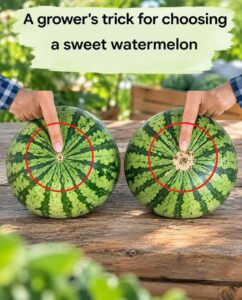
Choosing the right watermelon does not have to be a guessing game.
Every summer, shoppers pick up watermelon after watermelon, tap the rind, turn the fruit around, and hope they have found a sweet, juicy one. Sometimes they get lucky. Other times, they bring home a beautiful-looking melon only to discover that it is bland, underripe, watery, or lacking the crisp sweetness they expected.
Fortunately, there are several simple clues that can help you make a better choice.
No single trick can guarantee a perfect watermelon, but combining several signs can improve your chances considerably.
One of the first things to check is the field spot.
The field spot is the area where the watermelon rested against the ground while it was growing. Because that section did not receive the same sunlight as the rest of the rind, it develops a different color.
Look for a creamy yellow or golden-yellow patch.
A well-developed yellow field spot can be a useful indication that the watermelon remained on the plant long enough to mature. If the spot is very white or extremely pale, the fruit may have been harvested earlier.
The field spot is not an absolute guarantee of sweetness, but it is one of the easiest clues to check.
Next, pick up the watermelon.
This may sound obvious, but weight can tell you something useful.
Choose several watermelons that are approximately the same size and compare them. The one that feels heavier for its size may contain more water, which can be a good sign when you’re looking for a juicy melon.
Don’t simply choose the biggest watermelon in the pile.
Instead, compare similar-sized fruits and notice which one feels surprisingly heavy.
The rind is another area worth examining.
A good watermelon should feel firm and solid when you gently press it. Avoid melons with large soft areas, deep bruises, cracks, cuts, or obvious damage.
Small superficial marks are not necessarily a problem. Watermelons can develop minor scratches and imperfections while being transported or handled. What matters more is whether the fruit has significant damage or soft spots that could indicate deterioration.
You can also look at the overall appearance of the rind.
A mature watermelon may have a somewhat duller, less glossy appearance rather than looking extremely shiny. However, this is only one clue and should never be used by itself to judge the fruit.
The stem can provide another useful indication when it is still attached.
A dry, brownish stem may suggest that the watermelon had time to mature before being harvested. A very green stem can sometimes indicate that the fruit was picked earlier.
Again, this isn’t a perfect test.
Watermelons can be harvested, transported, and stored under different conditions, so the stem should be considered alongside the other signs.
One of the most common mistakes shoppers make is relying on just one trick.
For example, some people tap every watermelon they see and try to judge the sound. While people have different opinions about what a “good” watermelon should sound like, tapping alone isn’t a reliable guarantee of sweetness.
Instead, think of watermelon selection as putting several clues together.
Start with the field spot.
Is it creamy yellow or golden-yellow?
Then check the weight.
Does the watermelon feel heavy compared with others of a similar size?
Next, inspect the rind.
Is it firm and free from major bruises, cracks, and soft spots?
Finally, if the stem is visible, check whether it appears dry rather than freshly green.
When several of these signs point in the same direction, you may have found a promising watermelon.
There is another detail worth remembering: size isn’t everything.
A huge watermelon isn’t automatically sweeter than a smaller one. Varieties differ considerably, and growing conditions can affect the final fruit. Instead of judging quality by size alone, focus on the overall condition of the melon.
Shape can also provide a clue.
A watermelon that appears reasonably symmetrical and evenly developed may be preferable to one with significant irregularities or unusual soft areas. However, naturally occurring variations in shape don’t necessarily mean the fruit is bad.
Once you’ve chosen your watermelon, proper storage matters too.
If you plan to eat it soon, you can keep an intact watermelon at room temperature for a short period, depending on conditions. Once it has been cut, however, it should be refrigerated promptly and stored properly.
Chilling the watermelon before serving can make it especially refreshing.
When you’re ready to cut it, wash the outside first. Even though you don’t eat the rind, a knife can transfer material from the surface to the flesh as it passes through.
Then slice it and take a look at the inside.
The flesh should have a fresh appearance and a pleasant texture. If there are unusual odors, extensive mushiness, or obvious spoilage, it is better not to eat it.
For the best flavor, serve the watermelon cold.
And remember that sweetness can vary naturally from one fruit to another. Even a carefully selected watermelon isn’t guaranteed to be perfect because many factors influence flavor, including variety, growing conditions, maturity, harvesting, transportation, and storage.
Still, a few seconds of careful inspection at the market can make a difference.
Instead of grabbing the first watermelon that catches your eye, turn it over.
Find the field spot.
Compare its weight with similar-sized melons.
Check the rind for firmness and damage.
Look at the stem if one is present.
Then choose the fruit that combines the most promising signs.
The goal isn’t to find a magical visual clue that guarantees sweetness. It’s to make an informed choice using several pieces of evidence rather than relying entirely on luck.
So the next time you’re standing in front of a pile of watermelons, don’t just pick one at random.
Look for the yellow spot. Feel the weight. Check the rind. Examine the stem.
Those simple steps take only a few seconds.
And while they cannot promise a perfect watermelon every time, they can give you a better chance of bringing home the crisp, juicy, refreshing fruit you were hoping for.
No more disappointing watermelon slices.
Just a little more attention before you buy.