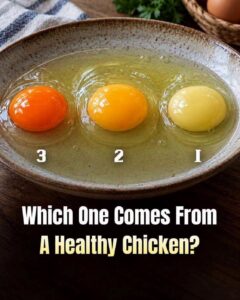
Look at the three eggs in front of you.
One has a pale-yellow yolk.
Another has a medium golden color.
The third has a deep, almost orange yolk.
If you had to choose the egg from the healthiest chicken, which one would you pick?
Egg 1, 2, or 3?
Take a moment before reading further.
Many people instinctively choose the egg with the darkest, richest-looking yolk. A bright orange yolk can look more nutritious, fresher, and somehow more natural. Some shoppers are even willing to pay more for eggs advertised as having deep-colored yolks.
But there’s an important detail that many people don’t realize:
Yolk color alone cannot tell you whether an egg came from a healthier chicken or whether it is more nutritious.
The color of an egg yolk is influenced primarily by what the hen eats.
Certain foods contain natural pigments called carotenoids. When hens consume feed containing these pigments, those compounds can influence the color of the yolk.
That’s why two perfectly normal eggs can have dramatically different yolk colors.
A hen whose diet contains ingredients such as corn, grass, alfalfa, or marigold petals may produce eggs with different shades of yellow or orange. Certain feed ingredients and approved additives can also influence pigmentation.
So if Egg 3 has the deepest orange yolk, that doesn’t automatically mean the hen was healthier.
It may simply mean the hen’s diet contained more pigment-producing ingredients.
And that changes the way we should look at this popular egg comparison.
The pale yolk isn’t necessarily bad.
The orange yolk isn’t necessarily better.
The medium-colored yolk isn’t automatically the perfect choice either.
In fact, if the only information you have is the yolk color, there isn’t enough evidence to identify which egg came from the healthiest chicken.
That’s the real answer.
The appearance of the yolk can tell you something about the hen’s diet, but it cannot provide a complete picture of the hen’s health, living conditions, or the nutritional quality of the egg.
Think about it this way.
Imagine three hens.
The first eats feed that produces pale-yellow yolks.
The second eats a diet that produces golden yolks.
The third eats feed rich in carotenoids and produces deep-orange yolks.
Looking only at their eggs, you might assume the third hen is the healthiest.
But you wouldn’t actually know that.
Yolk pigmentation is not a health score.
This is one reason the popular belief that “orange yolks are always healthier” can be misleading.
Eggs are nutritious foods regardless of whether their yolks are pale or deeply colored. They provide protein and a range of vitamins and minerals, including vitamin B12, vitamin D, selenium, and choline.
The exact nutritional composition can vary depending on several factors, including the hen’s diet and other production conditions.
But color alone cannot tell you the entire nutritional story.
So what should you consider instead?
Start with the information provided on the packaging.
Depending on where you live, labels may provide information about how the hens were raised, the type of feed used, production standards, or other characteristics. Understanding what those terms actually mean can be more useful than judging an egg simply by its yolk color.
Freshness is another important consideration.
Eggs should be stored properly and handled safely. Check dates and storage recommendations where applicable, and keep eggs refrigerated when required.
The condition of the shell also matters.
Avoid eggs with cracked or visibly damaged shells, particularly when there is a risk that contamination could have entered the egg.
And don’t forget the source.
If you’re buying eggs from a local farm or producer, you may be able to learn more about how the hens are fed and raised. Asking questions can provide information that looking at yolk color simply cannot.
There’s nothing wrong with preferring a darker yolk.
In fact, many people enjoy the appearance and flavor of eggs with richly colored yolks. A deep orange yolk can make a fried egg, omelet, or breakfast plate look especially appealing.
But appearance and nutritional superiority are not the same thing.
A beautiful orange yolk may simply reflect the ingredients in the hen’s feed.
This also explains why yolk color can change even when eggs come from the same producer.
If the composition of the feed changes, the pigments available to the hen can change too. The resulting yolks may become lighter or darker without necessarily indicating that something is wrong.
So, if you chose Egg 3 because it had the darkest orange yolk, don’t feel bad.
You simply followed a very common assumption.
But now you know the bigger picture.
The healthiest chicken cannot be identified from yolk color alone.
Egg 1 might have come from a healthy hen.
Egg 2 might have come from a healthy hen.
Egg 3 might have come from a healthy hen.
Without additional information, there is no reliable way to determine which chicken was healthiest simply by looking at the yolks.
That is what makes this puzzle a little different from an ordinary “spot the difference” challenge.
The answer isn’t hidden in the color.
It’s hidden in what the color actually means.
A deep-orange yolk can be visually impressive, but it doesn’t automatically indicate a healthier hen, a more nutritious egg, or a superior product.
A pale-yellow yolk isn’t automatically inferior either.
Instead of judging an egg by its color, consider the bigger picture: the hen’s diet, production conditions, freshness, storage, handling, and the information provided by the producer.
So the next time you crack an egg and see a surprisingly pale yolk, don’t immediately assume you’ve received an inferior egg.
And when you see a beautiful orange yolk, enjoy it—but don’t assume the color proves that it is healthier.
The most colorful yolk may simply be the result of what the hen ate.
So, which egg is from the healthiest chicken?
There is no way to tell from yolk color alone.
That’s the answer.
And perhaps the most useful lesson is this: when judging food quality, what you see isn’t always the whole story.