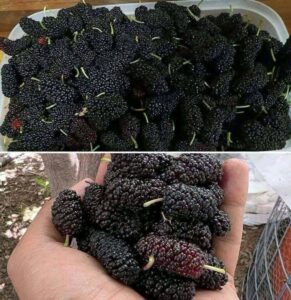
At first glance, a handful of dark purple-black fruits can be surprisingly difficult to identify.
They look familiar.
Their deep color resembles ripe blackberries, and their surfaces are covered with dozens of tiny rounded sections packed closely together.
So it’s easy to look at them and immediately think:
Blackberries.
But take another look.
The shape may be slightly different.
The texture may be much softer.
And the most important clue might not be the fruit at all.
It may be the plant.
If those dark fruits are hanging from the branches of a tree rather than growing on a bramble, you may actually be looking at mulberries.
That small observation can completely change the identification.
Mulberries and Blackberries Can Look Surprisingly Similar
It’s easy to understand why people confuse the two.
Both fruits can become extremely dark when ripe.
Both have surfaces made up of numerous small sections.
Both can produce intensely colored juice.
And both can leave purple-red stains on your fingers.
But place a ripe mulberry beside a blackberry and several differences become easier to notice.
Mulberries are often more elongated.
Blackberries tend to have a rounder, more compact appearance.
A ripe mulberry can sometimes look almost cylindrical or stretched compared with the more rounded shape of a typical blackberry.
However, shape alone isn’t always enough.
Natural variation exists in both plants, and fruit can look different depending on its species, variety, growing conditions, and stage of ripeness.
That’s why the plant itself is often the strongest clue.
Look at What the Fruit Is Growing On
This is perhaps the easiest way to distinguish the two.
Blackberries grow on brambles.
Depending on the species and variety, those plants may have upright, arching, or trailing canes.
Some have prominent thorns, while cultivated varieties can be thornless.
Mulberries are completely different.
They grow on trees belonging to the genus Morus.
So if you see dark fruits hanging from branches several feet above the ground, you’re already looking at an important clue.
A blackberry plant doesn’t suddenly become a tree.
If the fruit is growing directly from a woody tree, the possibility of mulberries becomes much stronger.
The surrounding plant can therefore tell you more than the color of the fruit itself.
Mulberries Don’t All Look the Same
Another reason identification can be confusing is that mulberries aren’t limited to one appearance.
Depending on the species and variety, the fruit can be pale, pink, red, purple, or nearly black.
Some varieties change dramatically as they mature.
A developing fruit may begin relatively light.
As it ripens, it can turn reddish.
Eventually, it may become so dark that it looks almost black.
This means color alone isn’t a dependable identification method.
A very dark fruit isn’t automatically a blackberry.
And a reddish fruit isn’t automatically unripe.
The stage of development matters.
Look at the Shape
A ripe mulberry frequently has an elongated form.
Instead of appearing like a compact cluster, it may look longer and narrower.
The many small structures on its surface create the bumpy appearance associated with blackberries, but the overall silhouette can be noticeably different.
Some mulberries are relatively short.
Others can become considerably longer.
Don’t expect every fruit from the same tree to look perfectly identical.
Natural variation is normal.
This is one of the differences between real fruit growing outdoors and the highly uniform appearance people often see in supermarket packaging.
Then Notice the Texture
One of the most noticeable characteristics of ripe mulberries is their delicate texture.
When fully ripe, they can become extremely soft.
Handle them roughly and they may crush easily.
Pick several from a productive tree and your fingers may quickly become stained with dark purple juice.
That softness is also one reason fresh mulberries aren’t encountered as commonly in supermarkets as sturdier fruits.
Commercial produce needs to survive harvesting, transportation, storage, and handling.
Very delicate fruit presents additional challenges at every stage.
For someone lucky enough to have access to a mulberry tree, however, that fragility simply means the fruit is best handled carefully.
Why Are Dark Mulberries So Intensely Colored?
The deep red, purple, and black shades found in many ripe mulberries come partly from naturally occurring pigments called anthocyanins.
Anthocyanins are responsible for many of the red, purple, and blue colors found throughout the plant world.
They’re part of a broader group of plant compounds known as polyphenols.
Researchers have studied these compounds extensively because of their chemical properties and potential biological effects.
But it’s important not to turn that information into exaggerated health claims.
A colorful fruit doesn’t automatically become a miracle food.
Mulberries Are Nutritious—But They Aren’t Magic
Search online for almost any colorful fruit and you’ll find extraordinary claims.
One food supposedly “detoxes” the body.
Another supposedly “melts fat.”
Another is promoted as though it can prevent or reverse serious illnesses.
Those claims often go considerably further than the available evidence supports.
Mulberries don’t need exaggerated promises to be worth eating.
They’re simply a fruit that can contribute useful nutrients to a balanced diet.
Whole fruits provide water, carbohydrates, fiber, vitamins, minerals, and numerous naturally occurring plant compounds.
That’s already plenty.
Good nutrition isn’t built around discovering one magical food.
It’s built from the overall pattern of what you eat.
They Provide Dietary Fiber
Whole mulberries contain dietary fiber.
Fiber contributes to normal digestive function and can help with feelings of fullness as part of an overall balanced diet.
This is one reason whole fruit isn’t nutritionally identical to fruit juice.
When you eat the intact fruit, you’re consuming its natural structure and fiber.
Juice processing can substantially change that structure.
So if you’re enjoying mulberries, eating them whole is a simple way to include them as part of a varied diet.
You don’t need to turn them into a supplement or search for an extraordinary health benefit.
They’re fruit.
Enjoying them as fruit is enough.
They Also Provide Vitamin C and Other Nutrients
Mulberries can contribute vitamin C and minerals such as potassium.
Their exact nutritional composition can vary depending on the species, growing conditions, ripeness, storage, and preparation.
That’s another reason it’s better to think of nutritional information in broad terms rather than assuming every mulberry has exactly the same composition.
A handful of fruit isn’t going to transform someone’s health overnight.
That’s not how nutrition works.
The benefits of a healthy eating pattern accumulate over time.
Mulberries can simply be one colorful, flavorful part of that pattern.
Fresh Mulberries Need Very Little Preparation
Once you’ve correctly identified an edible mulberry and confirmed that it has been grown in a suitable environment, there are many simple ways to enjoy it.
Fresh mulberries can be eaten on their own.
Their natural sweetness often means they don’t need additional sugar.
You can add them to oatmeal.
Spoon them over plain yogurt.
Mix them into a fruit salad.
Blend them into a smoothie.
Use them in baked goods.
Or simply eat a handful as a seasonal snack.
Their flavor can vary considerably, with ripe fruit often becoming pleasantly sweet.
Their Fragility Is Also Their Biggest Challenge
The same softness that makes ripe mulberries delicious can make them difficult to store.
Freshly picked fruit can bruise easily.
Damaged areas may deteriorate more quickly.
That’s why gentle handling matters.
Refrigeration can help slow deterioration.
It’s also sensible to remove visibly spoiled or badly damaged fruit rather than leaving it mixed with the rest.
If you’re storing fresh berries, avoiding unnecessary moisture can also help preserve their quality.
And, as with other fresh produce, wash them appropriately before eating.
What If You Pick Too Many?
A productive mulberry tree can produce an astonishing amount of fruit.
Sometimes far more than one household can eat immediately.
Fortunately, freezing is an easy option.
After preparing the fruit appropriately, you can arrange the berries in a single layer for initial freezing.
Once they’re frozen, transfer them to a suitable freezer container.
This approach can help keep the individual fruits from becoming one enormous frozen mass.
Frozen mulberries may lose some of their fresh texture after thawing.
But that doesn’t make them useless.
They can still work beautifully in smoothies, sauces, baking, oatmeal, and other recipes where texture isn’t as important.
Dried Mulberries Are Different
You may also see dried mulberries sold in stores.
The biggest difference is obvious:
Most of the water has been removed.
That makes the fruit much more concentrated by weight.
A small portion of dried fruit can therefore contain substantially more calories and naturally occurring sugars than an equivalent weight of fresh fruit.
That doesn’t automatically make dried mulberries unhealthy.
It simply means portion sizes can be easier to underestimate.
Packaged products may also contain added sweeteners, so checking the ingredient list can be useful if you’re trying to limit added sugar.
Fresh and dried fruit can both have a place in a balanced diet.
They’re simply different products.
There’s Something Fascinating About the Fruit Itself
What appears to be one simple berry is actually a more complicated botanical structure.
The visible surface is made up of numerous tiny fruit structures clustered together.
That’s what produces the familiar bumpy appearance.
Once you understand this, the resemblance to blackberries becomes much easier to explain.
They’re not identical fruits, but their overall appearance can make them surprisingly easy to confuse.
And that is exactly why looking at the plant is so helpful.
Don’t just examine the fruit.
Examine the branch.
The Tree Can Tell You More Than the Berry
If the fruit is hanging from a tree, pay attention to the leaves and overall growth pattern.
Mulberry trees have distinctive leaves, although their shapes can vary.
Some leaves may be relatively simple and heart-shaped, while others can have lobed edges.
The bark, branches, and overall structure can also provide useful clues.
When identifying a plant, it’s generally better to consider several characteristics together rather than relying on a single visual feature.
Fruit color alone can mislead you.
Fruit shape can help.
Leaf shape can help.
Growth habit can help.
And the location where the fruit is growing can be one of the strongest clues of all.
One Rule Matters More Than Every Visual Clue
If you’re uncertain about the identity of a wild or unfamiliar fruit, don’t eat it simply because it resembles something familiar.
Visual similarity isn’t enough to establish that a plant is edible.
Many fruits can resemble one another, particularly when they’re photographed from a distance or viewed at an unusual stage of ripeness.
When foraging, accurate identification should come from reliable botanical information or an experienced local expert rather than a guess based on color alone.
And if a fruit has been exposed to pesticides, roadside contamination, animal waste, or other potential contaminants, that is another reason to avoid eating it.
The Real Difference Is Easier Than You Think
The next time you see a handful of dark purple-black fruits and think, “Those look like blackberries,” pause for a moment.
Ask where they came from.
If they’re growing on thorny or thornless canes close to the ground, blackberries may be the likely answer.
If they’re hanging from the branches of a tree, you may be looking at mulberries.
Then examine the shape.
Is the fruit elongated?
Does it look softer and more delicate?
Does the color range from reddish purple to nearly black?
Those clues can help you distinguish the two.
The most important lesson is that identification isn’t about finding one magical feature.
It’s about putting several clues together.
A Small Fruit With a Surprisingly Interesting Story
Mulberries may not have the same supermarket presence as blackberries, but they have a fascinating combination of characteristics.
They’re visually similar to other dark berries.
They grow on trees rather than brambles.
They can range dramatically in color.
They become extremely soft when ripe.
They can stain your fingers with vivid purple juice.
And they’re perfectly capable of being enjoyed as an ordinary whole fruit without exaggerated health claims.
So the next time you encounter those tiny dark fruits, don’t judge them by color alone.
Look at the plant.
Look at the shape.
Look at the texture.
And most importantly, make sure you’ve correctly identified the fruit before eating it.
Because sometimes what looks like an ordinary blackberry isn’t growing on a bush at all.