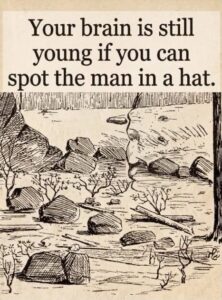
At first glance, there seems to be nothing unusual about the picture.
You see a peaceful landscape stretching beneath an open sky. Large rocks sit across the foreground, patches of dry earth cover the ground, and trees rise in the distance. Near the water, a canoe carries two people across what appears to be a quiet river or lake.
It looks like an ordinary vintage illustration.
But somewhere inside that peaceful scene is another image.
A man wearing a hat.
The challenge sounds simple: find him.
Yet many people look directly at the picture for several minutes without seeing anything unusual. The reason is that the hidden figure isn’t drawn in the way a normal person would be drawn.
There is no obvious outline around his face.
There are no bright colors pointing toward him.
There isn’t a tiny character tucked behind a tree.
Instead, the artist has used the existing landscape to construct another image.
The man’s face is hidden within the larger shapes of the scene.
That means your brain has to do something unusual.
It has to stop interpreting the picture as a landscape and start interpreting the same lines, shadows, and spaces as parts of a human face.
This is an example of figure-ground perception, a principle in visual perception in which the brain separates a main subject, or “figure,” from its surrounding background.
Usually, this happens automatically.
When you look at a tree, you recognize the tree as the object and the sky as the background.
When you look at a person standing in front of a wall, your brain separates the person from the wall.
But optical illusions can deliberately interfere with that process.
The artist can arrange shapes so that something that appears to be background suddenly becomes the main figure.
That’s what makes this puzzle so interesting.
The rocks may not simply be rocks.
A shadow may not simply be a shadow.
An empty space between objects may become part of a forehead, nose, or chin when you look at the entire image differently.
If you have been staring at the picture and seeing nothing, don’t immediately assume that you have missed a tiny detail.
Instead, change the way you are looking.
Start by moving your eyes away from individual objects.
Don’t concentrate too heavily on the canoe.
Don’t spend too much time examining the trees.
Don’t try to inspect every rock separately.
Take in the entire image.
Imagine that the landscape has been turned into a giant portrait.
Look for a broad shape resembling the outline of a head.
Then consider where the man’s hat might be.
The hat is an important clue because it changes the silhouette of the hidden figure. Once you recognize the hat, the rest of the face may become easier to identify.
Another useful trick is to move farther away from your screen.
If you’re looking at the image on a phone, hold it at arm’s length.
If you’re using a computer, lean back in your chair.
You can also slightly narrow your eyes.
This reduces the importance of tiny details and makes larger shapes easier to recognize.
Some viewers may notice the hidden man almost immediately.
Others may stare at the image for several minutes before suddenly seeing him.
And that’s the strange thing about visual illusions.
There is often a moment when the image changes completely.
One second, you’re looking at rocks, trees, water, and a canoe.
The next second, you’re looking at a face.
Once your brain recognizes the hidden image, it can become extremely difficult to unsee it.
That’s because your brain has created a new interpretation of the same visual information.
Nothing in the picture has actually changed.
The lines haven’t moved.
The rocks haven’t disappeared.
The landscape remains exactly as it was.
Only your perception has changed.
This is one reason optical illusions are so fascinating.
They demonstrate that seeing isn’t simply a matter of receiving information through your eyes.
Your brain constantly interprets that information.
It uses shapes, patterns, previous experience, contrast, distance, and context to decide what you’re looking at.
When an artist deliberately creates ambiguity, the brain can briefly choose the wrong interpretation—or, more accurately, an interpretation that wasn’t obvious at first.
That’s why these puzzles can feel almost magical.
The challenge also explains why people sometimes disagree about what they see.
One person may identify the man’s face immediately.
Another may see only a collection of rocks.
Someone else may notice the hidden image only after another viewer points out the general location.
Once you know where to look, however, the illusion often becomes much easier.
So before giving up, try one more time.
Look at the entire picture rather than its individual parts.
Move your eyes toward the large formations in the foreground.
Pay attention to the spaces between the shapes.
Imagine a human head rather than a landscape.
Look for the curve of a forehead.
Then a nose.
Then the lower part of the face.
Finally, look for the shape of the hat.
Don’t rush.
The goal isn’t simply to find a tiny hidden object.
The real challenge is to make your brain switch from one interpretation to another.
And that is why the puzzle can be so satisfying.
When you finally see the man, you may wonder how you missed him.
He wasn’t added afterward.
He wasn’t hiding behind the trees.
He wasn’t floating somewhere in the distance.
He was there from the beginning, carefully constructed from the shapes that you had already been looking at.
The landscape was never just a landscape.
It was also a portrait waiting to be discovered.
So, can you see the man in the hat?
Take another look.
Relax your eyes.
Step back.
Focus on the larger shapes.
And give your brain a chance to see the picture in a completely different way.
Because sometimes the hardest thing about a visual puzzle isn’t finding what’s hidden.
It’s realizing that you’ve been looking at it all along.