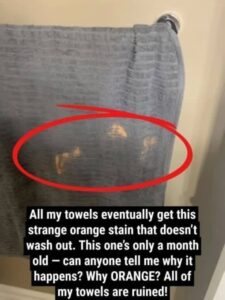
Have you ever pulled a dark towel out of the laundry and noticed something strange?
A pale orange patch.
A yellow mark.
Maybe even a pinkish area that seems to have appeared out of nowhere.
You wash the towel again.
Nothing changes.
You try detergent.
Still there.
You might assume the towel was stained by makeup, rust, cleaning products, or something in the washing machine.
But there is another surprisingly common explanation hiding in many bathrooms.
Your acne treatment may be responsible.
More specifically, the culprit can be benzoyl peroxide, an ingredient found in many acne and blemish treatments.
If you’ve ever wondered why a perfectly clean dark towel suddenly looks as though someone splashed bleach on it, benzoyl peroxide may provide the answer.
It Isn’t Really a Stain
The most frustrating part is that these marks don’t behave like ordinary stains.
A normal stain is something sitting on or inside the fabric.
Coffee can leave a brown mark.
Makeup can leave a colored residue.
Food can leave behind oils or pigments.
Those substances may sometimes be removed with the right cleaning method.
Benzoyl peroxide is different.
When it comes into contact with dyed fabric, it can chemically alter the dye itself.
Instead of placing a new color onto the towel, it can remove or change the original color.
That’s why the affected area can look strangely pale even after the towel has gone through the washing machine.
You aren’t looking at dirt that needs to be removed.
You’re looking at fabric whose original color has been chemically changed.
Why Does It Look Orange or Pink?
This can be particularly confusing when it happens to dark towels.
You might expect a bleaching chemical to create a simple white spot.
Instead, the damaged area can appear orange, yellow, peach, pink, or reddish depending on the original dye and the fabric.
A navy towel might develop a rusty-looking patch.
A black towel might develop an orange or reddish area.
A dark blue washcloth may suddenly have pale pink sections.
The exact appearance depends on the dyes used to create the original color.
That’s why people sometimes spend considerable time trying to identify the mysterious “stain” when the real issue is that the color itself has been altered.
How Does It Get Onto Your Towel?
The transfer can happen surprisingly easily.
You apply an acne treatment to your face.
You wash your hands.
You dry your hands on a towel.
Or perhaps you apply the product before bed and later use a towel to wipe your face.
Even small amounts of product can come into contact with fabric.
Repeated exposure can eventually create noticeable discoloration.
The same thing can happen with washcloths, pillowcases, bath towels, and other textiles that regularly touch treated skin.
You might not notice anything immediately.
The discoloration can become obvious only after repeated use.
That delayed appearance is one reason people often assume something happened during laundry.
But the chemical interaction may have happened much earlier.
Washing Doesn’t Necessarily Prevent It
You might think that simply washing the towel after every use should solve the problem.
Unfortunately, washing isn’t a guaranteed solution.
Once benzoyl peroxide has reacted with the fabric dye, the original color may already be permanently altered.
The washing machine can remove ordinary residue, but it cannot simply restore dye that has been chemically changed.
This is why you may notice the same pale patch after washing the towel several times.
The towel is clean.
The color is simply different.
Don’t Keep Treating It Like a Stain
One of the biggest mistakes is repeatedly attacking the discolored area with increasingly strong cleaning products.
If the problem is chemical damage to the dye, additional stain removers aren’t going to recreate the original color.
In some cases, aggressive cleaning can cause additional wear or discoloration.
Instead, identify the likely source.
Think about what skincare products you use.
Check whether benzoyl peroxide appears among the active ingredients.
Then consider whether the affected towel regularly comes into contact with your face, hands, or bathroom counter.
The pattern can provide a useful clue.
If only the towels you use after applying your acne treatment have developed the discoloration, the connection becomes much easier to recognize.
The Easiest Prevention Trick
There is a remarkably simple way to avoid worrying about this problem.
Use white towels.
White fabric can still undergo a chemical reaction, but there is no dark dye for the chemical to visibly strip away.
That means you won’t end up with those unmistakable orange or pink patches.
Many people who regularly use benzoyl peroxide intentionally keep separate white washcloths and towels for their skincare routine.
It’s a small change that can save your favorite dark towels.
Be Careful With Pillowcases, Too
Towels aren’t the only fabric that can be affected.
Think about what happens after your nighttime skincare routine.
You apply your treatment.
You go to bed.
Your face rests against a pillowcase for hours.
Repeated contact can potentially affect dyed bedding as well.
If you notice unexplained light patches on your pillowcase, especially around the area where your face rests, consider whether a peroxide-containing skincare product could be involved.
White pillowcases can be a practical choice if this is a recurring issue.
Rinse Your Hands Thoroughly
Another simple precaution is to pay attention to your hands.
After applying an acne treatment, wash your hands thoroughly according to the product’s instructions.
Then rinse away any remaining product before reaching for your favorite dark towel.
This can reduce the amount transferred to the fabric.
You don’t necessarily have to redesign your entire bathroom routine.
Sometimes a small change in what towel you use or how carefully you rinse your hands can prevent repeated discoloration.
What If Your Towel Is Already Damaged?
This is the disappointing part.
If benzoyl peroxide has permanently changed the dye, there may be no practical way to return the towel to its original color.
More detergent won’t restore it.
Stain remover won’t restore it.
Repeated washing won’t restore it.
The problem isn’t a substance that needs to be lifted out.
The original color has been altered.
But that doesn’t mean the towel has to go into the trash.
A towel with a few discolored patches can still be extremely useful.
Turn it into a cleaning cloth.
Use it for wiping counters.
Keep it for cleaning the bathroom.
Use it for messy household projects.
Save it for washing the car or cleaning outdoor equipment.
Its appearance may be ruined, but its usefulness doesn’t have to be.
A Small Mystery With a Simple Explanation
The next time you find a strange orange, yellow, or pink patch on a dark towel, don’t immediately blame the washing machine.
Think about what has been happening in your bathroom.
Have you recently started using an acne treatment?
Does it contain benzoyl peroxide?
Does the affected towel regularly touch your face or hands?
If the answer is yes, you may have solved the mystery.
What looks like a stubborn stain may actually be a chemical reaction between a skincare ingredient and the dye in your towel.
And once you understand what’s happening, prevention becomes much easier.
Keep white towels for your skincare routine.
Rinse your hands thoroughly.
Be mindful of pillowcases and other dark fabrics.
And if a favorite towel has already developed those unmistakable pale patches, don’t waste hours trying to scrub them away.
The towel isn’t dirty.
The color has simply changed.
Sometimes the strangest household mysteries have surprisingly ordinary explanations—and in this case, the culprit may have been sitting on your bathroom shelf the entire time.