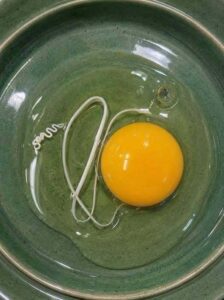
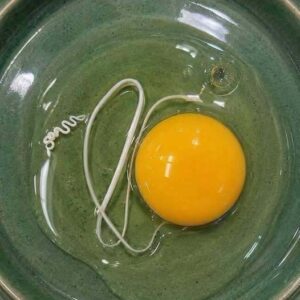
I woke up one morning craving a simple breakfast. I walked into the kitchen, took a few eggs out of the refrigerator, and prepared to make fried eggs as I had done countless times before. Everything seemed perfectly ordinary until I cracked one egg into the pan and noticed something unusual.
A thin, twisted white strand was attached to the yolk.
At first, I had no idea what I was looking at. It resembled a tiny piece of string or something that had accidentally found its way inside the egg. For a moment, I wondered whether the egg was contaminated or whether something was wrong with it.
I stopped cooking and examined the egg more closely. The strange strand appeared to be part of the egg itself, but I had never paid much attention to it before. I checked the other eggs in the carton, wondering whether I might discover the same thing.
Finding nothing unusual at first only made me more curious.
Before throwing the eggs away, I decided to look for an explanation. What I discovered was surprisingly simple: the mysterious white strand was a natural part of an egg called the chalaza.
And despite its unusual appearance, it is completely normal.
What Is the Strange White String Inside an Egg?
The white, twisted strand sometimes visible beside an egg yolk is called the chalaza. It is a natural structure made primarily of egg-white proteins that helps hold the yolk in position inside the egg.
An egg is more complex than it might appear when you crack one open. Beneath the shell are several structures that protect the developing contents and help maintain their arrangement.
The yolk is surrounded by a thin membrane and suspended within the egg white. The chalaza consists of twisted strands of this protein-rich material, with one generally extending toward each end of the yolk.
These strands help stabilize the yolk and keep it from moving freely inside the egg.
Think of them as tiny anchors that help hold the yolk near the center. Without these structures, the yolk would be less securely positioned within the egg white.
Although the chalaza may resemble a foreign object, it is not an invading organism, a worm, or a parasite. It is simply one of the egg’s natural components.
Why Does the White Strand Look So Strange?
One reason the chalaza attracts attention is its unusual shape.
Unlike the smooth, transparent egg white surrounding it, the chalaza often appears thicker, twisted, and slightly rope-like. Its texture can make it look unfamiliar, especially to someone who has never noticed it before.
The strand may be particularly visible when an egg is cracked onto a plate or into a frying pan. Depending on the angle, lighting, and condition of the egg, it may stand out against the yellow yolk and clear egg white.
Sometimes, the chalaza is thick and easy to identify. In other eggs, it may be so small or inconspicuous that you barely notice it.
This variation is completely normal.
The chalaza can also be more noticeable in fresh eggs. As eggs age, the egg white gradually changes in consistency, and the chalaza may become less prominent. Its appearance can therefore provide some information about the egg’s condition, although it should never be used as the only test of freshness or safety.
In other words, seeing a thick white strand is generally not a reason to panic. It is often a sign that you are simply looking closely at a structure that has always been there.
Is the Chalaza Safe to Eat?
Yes. The chalaza is edible and does not need to be removed before cooking.
Because it is made primarily of proteins found in the egg white, it is a normal part of the egg’s composition. Eating it does not present a special health risk when the egg itself is safe and properly cooked.
If you are preparing fried eggs, scrambled eggs, omelets, or other everyday dishes, you can leave the strand exactly where it is.
Once the egg cooks, the chalaza becomes part of the cooked egg white. Most people will not notice it in the finished dish.
However, some cooks prefer to remove it when preparing recipes that require an especially smooth consistency. For example, someone making delicate custards, certain sauces, or finely textured egg mixtures may choose to strain the eggs or remove prominent chalaza strands during preparation.
This is a matter of preference and recipe technique, not a food-safety requirement.
If you find the strand visually unpleasant, you can remove it with a clean utensil before cooking. But there is no nutritional or safety reason to discard an otherwise good egg simply because the chalaza is visible.
Does a White Strand Mean the Egg Is Fresh?
The appearance of the chalaza can offer a clue about an egg’s condition, but it is important not to draw conclusions from this feature alone.
A prominent chalaza is often associated with fresher eggs because the egg white tends to be firmer and better able to maintain its structure soon after the egg is laid.
As time passes, changes occur inside the egg. Moisture and carbon dioxide gradually escape through the shell, and the egg white becomes thinner. The yolk membrane may also weaken as the egg ages.
These changes can make the chalaza less noticeable.
Nevertheless, a visible chalaza does not prove that an egg is fresh, and an inconspicuous chalaza does not automatically mean that an egg has spoiled.
Egg safety depends on several factors, including how the eggs were handled, how they were stored, whether their shells are intact, and whether they are cooked appropriately.
The safest approach is to store eggs according to the guidance on their packaging, keep refrigerated eggs at a consistent safe temperature, and avoid using eggs with cracked or damaged shells.
How Can You Tell Whether an Egg Has Gone Bad?
The chalaza itself is not a sign of spoilage, but other warning signs deserve attention.
When cracking an egg, look for unusual discoloration, an unpleasant rotten smell, or other obvious signs that something may be wrong. If the egg smells foul or appears suspicious, discard it.
However, appearance and smell cannot reliably detect every harmful microorganism. An egg may contain bacteria that cause foodborne illness without looking or smelling unusual.
That is why proper storage and cooking remain essential.
Keep eggs refrigerated when required, wash your hands after handling raw eggs, clean utensils and surfaces that come into contact with them, and cook eggs thoroughly. For dishes containing eggs that will not be fully cooked, pasteurized eggs are a safer choice, particularly for people at greater risk of severe foodborne illness.
Never taste a raw egg to determine whether it is safe.
These precautions are much more important than worrying about a harmless white strand.
Why Learning About Everyday Food Matters
The experience taught me something simple: familiar foods can contain structures that look unusual when we finally take the time to examine them.
Most of us crack eggs without studying their contents. We focus on the yolk, the egg white, and the meal we are preparing. As a result, natural features such as the chalaza can go unnoticed for years.
When we finally see one, it is easy to assume that something has gone wrong.
But understanding how an egg is structured helps explain why these features exist and why they are not necessarily a cause for concern.
The same curiosity can help us make better decisions in the kitchen. Instead of automatically throwing away food because it looks unfamiliar, we can learn to distinguish normal characteristics from genuine warning signs.
Of course, caution is still important. Knowing what a chalaza is does not mean ignoring signs of spoilage or neglecting safe food-handling practices.
It simply means understanding the difference between something unusual-looking and something genuinely dangerous.
The Next Time You Crack an Egg, Remember This
That mysterious white string inside your egg has a name, a purpose, and a perfectly natural explanation.
The chalaza helps keep the yolk positioned within the egg white. It is made primarily of protein, is safe to eat when the egg is safe and properly cooked, and usually requires no special treatment before cooking.
You can remove it if you prefer a smoother texture, but there is no need to throw away an egg just because you see one.
The next time you prepare breakfast and notice a twisted white strand beside the yolk, you will know that it is not a parasite or a strange contaminant. It is simply part of the egg’s natural design.