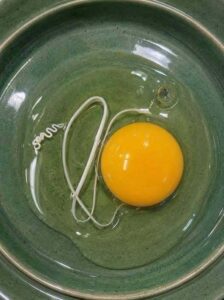
I woke up one morning, walked into the kitchen, and decided to make a simple breakfast. Fried eggs seemed like the perfect choice. I grabbed a carton from the refrigerator, heated a pan, and cracked the first egg, expecting to hear the familiar sizzle as it hit the hot surface.
But something caught my attention before I could start cooking.
Floating beside the bright yellow yolk was a strange, twisted white strand. It looked almost like a tiny piece of string, and its unusual shape made me pause. For a moment, I wondered whether something had gone wrong with the egg.
Was it a sign of spoilage? Could it be a parasite? Or had something unusual developed inside the shell?
I examined the egg more closely, hoping to find an obvious answer. When I checked the rest of the carton, I noticed that some eggs had similar strands, although they were not always equally visible.
Instead of throwing everything away, I decided to investigate.
What I discovered was surprisingly simple: the strange white strand was a completely natural part of the egg. It even had a scientific name.
And once I understood its purpose, something that initially looked alarming became much less mysterious.
What Is That Strange White String Inside an Egg?
The unusual strand is called the chalaza, and it is a normal structure found inside an egg.
Chalazae are twisted, rope-like strands made primarily of proteins. They extend through the egg white and help hold the yolk in position within the egg.
Most chicken eggs contain two chalazae, positioned on opposite sides of the yolk. Their twisted appearance can make them look like little cords, especially when an egg is freshly cracked into a bowl.
Although the strands might resemble something foreign at first glance, they are not worms, parasites, or pieces of string accidentally trapped inside the egg.
They are part of the egg’s natural structure.
The next time you crack an egg and notice a white strand attached to the yolk, there is usually no reason to panic. In a normal egg, the chalaza is expected and can be safely eaten when the egg is properly handled and cooked.
Understanding what it is can save you from discarding perfectly good breakfast ingredients simply because they look unfamiliar.
Why Does an Egg Need a Chalaza?
To understand why this structure exists, it helps to consider how an egg is organized.
Inside the shell, the yolk is surrounded by egg white, also known as albumen. The yolk contains nutrients that support the development of an embryo in a fertilized egg, while the albumen provides water, proteins, and additional protection.
The chalaza helps maintain the yolk’s position within this arrangement.
Its twisted strands act somewhat like anchors, connecting the yolk to the surrounding egg white and helping keep it centered.
This positioning is useful because the yolk is the central nutrient-rich part of the egg. Maintaining its position helps preserve the egg’s internal organization.
When you crack an egg into a bowl, you may notice that the yolk remains relatively centered while the thicker egg white surrounds it.
The chalaza contributes to this arrangement, although the egg’s overall structure and the properties of the albumen also play important roles.
It is a small feature with a practical biological purpose.
Nature often produces structures that appear unusual when viewed outside their normal context. The chalaza is a good example of how something that looks strange to us can serve an important function.
Why Is the White Strand More Visible in Some Eggs?
One of the most interesting things about chalazae is that they are not equally noticeable in every egg.
Sometimes, the strand appears thick, twisted, and clearly attached to the yolk. In other eggs, it may be difficult to see at all.
This variation is normal.
Fresh eggs often have firmer, thicker egg whites, making the chalazae easier to distinguish. As eggs age, their internal structure gradually changes, and the albumen becomes thinner.
These changes can make the chalaza less prominent.
However, the visibility of the strand is not a complete test of freshness. An egg’s storage conditions, handling history, and overall quality must also be considered.
You should not assume that every egg with a prominent chalaza is exceptionally fresh or that an egg with a less visible strand is necessarily old.
The chalaza is simply one feature of the egg’s natural structure.
If you notice the strand in one egg but barely see it in another, that difference alone is generally not a reason for concern.
Is the Chalaza a Sign That the Egg Is Bad?
This is one of the most common questions people ask after discovering the white strand.
The short answer is no: a visible chalaza does not, by itself, mean an egg is spoiled.
Because the structure is a normal part of an egg, its presence is not evidence of contamination or decay.
However, it is important to distinguish between a harmless internal structure and other warning signs that may indicate a problem.
For example, an egg with a cracked or leaking shell may have been exposed to bacteria. An unpleasant or rotten smell when the egg is opened is another reason to discard it.
Changes in appearance can sometimes provide useful information, but not every unusual-looking egg is unsafe, and not every contaminated egg will have an obvious smell or appearance.
That is why safe handling matters.
Keep eggs refrigerated when required by local food-safety guidance, avoid using eggs with damaged shells, and wash your hands after handling raw eggs. Prevent raw egg contents from contaminating ready-to-eat foods and kitchen surfaces.
For dishes containing eggs, cooking them thoroughly is an important way to reduce the risk of foodborne illness.
The chalaza itself is harmless, but its presence should never be used as the sole test of whether an egg is safe to eat.
Should You Remove the Chalaza Before Cooking?
For most everyday meals, there is no need to remove it.
If you are making fried eggs, scrambled eggs, omelets, or a simple breakfast sandwich, the chalaza can remain in place.
It is edible and generally blends into the cooked egg without creating any safety concerns.
Some people prefer to remove the strand because they dislike its texture or appearance. Others barely notice it once the egg is cooked.
In certain delicate recipes, removing the chalaza may be useful.
For example, some cooks strain eggs when preparing custards, smooth sauces, or other recipes that benefit from a particularly uniform texture. Removing visible strands can help create a more consistent mixture.
To remove one, you can use a clean fork or spoon to lift the strand away from the yolk before mixing the egg.
However, this step is optional rather than necessary.
There is no general health benefit to removing a normal chalaza, and leaving it in the egg does not make the dish less nutritious.
Unless a recipe specifically calls for straining the eggs, you can usually proceed with cooking as normal.
Does the Chalaza Contain Anything Beneficial?
Because the chalaza is composed primarily of proteins, it is part of the egg’s edible protein-containing material.
It does not need to be removed to make an egg healthier, nor is it a special nutritional supplement.
The main nutritional benefits of an egg come from the egg as a whole, including its proteins, fats, vitamins, and minerals.
The yolk contains many of the egg’s fat-soluble vitamins and other nutrients, while the white provides a substantial amount of its protein.
The chalaza’s main significance is structural rather than nutritional. Its purpose is to help maintain the yolk’s position, not to provide a separate health benefit.
Still, knowing that it is a natural component of the egg can make it easier to understand why it appears so frequently in freshly cracked eggs.
It is not an unwanted object that needs to be removed. It is simply one of the structures that make an egg function as it does.
A Simple Way to Check Eggs Before Cooking
Although discovering a chalaza is usually nothing to worry about, it is still sensible to examine eggs before using them.
Here are a few practical precautions:
- Check the shell. Avoid eggs that are cracked, leaking, or visibly contaminated in ways that cannot be safely managed.
- Open eggs carefully. Cracking each egg into a separate clean bowl before adding it to a larger mixture can help prevent one spoiled egg from ruining the entire recipe.
- Pay attention to the smell. A distinctly unpleasant or rotten odor is a reason to discard the egg.
- Store eggs properly. Follow the storage instructions on the carton and keep eggs refrigerated when appropriate.
- Cook them thoroughly. Proper cooking helps reduce the risk of foodborne illness. Use pasteurized eggs for recipes that call for raw or undercooked eggs, especially when serving people at higher risk of serious illness.
These precautions are far more useful than worrying about the presence of a normal white strand.
The Surprising Truth Behind That Strange White Strand
What began as an ordinary breakfast quickly turned into a small lesson in food science.
The twisted white strand floating beside the yolk was not a parasite, a sign of contamination, or a mysterious foreign object. It was the chalaza, a natural structure that helps keep the yolk positioned inside the egg.
Its appearance can vary, and it may be more noticeable in some eggs than in others. For most cooking purposes, there is no need to remove it.
The important thing is to understand the difference between an ordinary feature and genuine warning signs, such as a damaged shell or an unpleasant odor.
Sometimes, the things that look most alarming in everyday life have the simplest explanations.
So, the next time you crack an egg and notice a tiny white cord beside the yolk, you will know what you are looking at. Instead of immediately reaching for the trash can, take a moment to recognize this small example of nature’s design.
Then prepare your breakfast, follow sensible food-safety practices, and enjoy your meal without worrying about a perfectly normal part of the egg.