In the vast landscape of everyday objects, some designs are so familiar that they become invisible. We use them, rely on them, and carry them through daily routines without ever questioning their structure. A spoon, a pen, a zipper, a toothbrush—all are so commonplace that their design often fades into the background of awareness. Among these quiet examples of functional design is the nail clipper, a tool so small and universal that it rarely invites scrutiny.
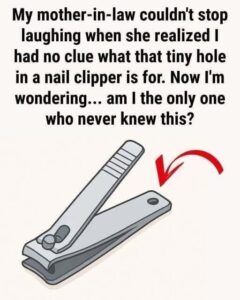
Yet hidden within its compact metal frame is a detail most people never think about: a small circular hole at the end of its lever.
At first glance, it seems insignificant. Perhaps even accidental. But in reality, this tiny feature represents a long history of practical engineering decisions, evolving user needs, and thoughtful manufacturing considerations. It is a reminder that even the simplest tools are shaped by layers of human intention.
To understand why this small hole exists—and why it has persisted for more than a century—we have to look beyond the object itself and into the broader story of design, behavior, and function.
The Overlooked Detail in a Universal Tool
The nail clipper is one of the most widely used personal care tools in the world. Found in homes, travel kits, office drawers, and bathrooms across cultures, its function is simple: to trim nails efficiently and safely.
Most modern versions consist of two levers, a cutting edge, and a small internal mechanism that translates pressure into a clean cutting motion. But at the end of the upper lever, there is often a small circular hole.
It is easy to overlook. In fact, many users go their entire lives without considering its purpose.
But design rarely includes unnecessary elements, especially in compact mechanical tools. Every cut, curve, and opening serves a function—even if that function is not immediately obvious.
Function One: Portability and Everyday Carry
One of the most practical purposes of the hole is portability.
Before modern storage solutions became common, small personal items were often carried rather than stored. Keys, pocket knives, sewing tools, and grooming instruments were frequently attached to chains, hooks, or cords for easy access.
The hole in the nail clipper allows exactly that.
By threading a ring, cord, or small chain through it, the clipper becomes:
- Easily attachable to keychains
- Securely stored in travel kits
- Conveniently hung in bathrooms or grooming areas
- Less likely to be lost in drawers or bags
This transforms the clipper from a loose object into a connected item within a larger system of everyday carry tools.
In a modern context, this may seem minor. But historically, it solved a very real problem: small tools were easy to misplace. The hole provided a simple, mechanical solution that required no additional parts or complexity.
Function Two: Ergonomics and User Control
Beyond portability, the hole also contributes to usability.
While nail clippers are generally easy to operate, they still require precise hand positioning and pressure. For some users, particularly those with reduced grip strength or fine motor challenges, maintaining control can be difficult.
The hole offers an additional point of interaction.
A finger can be placed through it to:
- Stabilize the tool during use
- Improve leverage when cutting thicker nails
- Reduce slipping during operation
- Enhance precision in controlled trimming
This subtle ergonomic benefit demonstrates an important principle of industrial design: good tools adapt to human variation.
Not all users have the same strength, dexterity, or comfort level. The hole does not force a specific use—it provides optional assistance when needed.
This flexibility is part of what makes the design so enduring.
Function Three: Manufacturing Efficiency
While users benefit from the hole, manufacturers do as well.
In mass production, even small design features can serve practical purposes during assembly and processing. The hole can assist with:
- Hanging components during coating or finishing
- Aligning parts during assembly
- Holding pieces securely during machining
- Reducing material weight without compromising strength
Metal tools often require multiple stages of processing—cutting, shaping, polishing, and coating. A small opening makes it easier to suspend parts on hooks or racks throughout these stages.
This improves consistency and efficiency in production lines.
In other words, the hole is not only useful after manufacturing—it is useful during manufacturing.
That dual-purpose nature is one of the reasons it has remained unchanged for so long.
A Design Rooted in History
To fully understand the hole’s presence, it helps to consider the historical context of personal grooming tools.
In the late 19th and early 20th centuries, everyday carry culture was very different from today. People relied heavily on compact, multifunctional tools that could be transported easily. Items like pocket watches, folding knives, and grooming instruments were commonly attached to chains or carried on the body.
In that environment, the nail clipper needed to be:
- Portable
- Accessible
- Durable
- Compatible with carrying systems
The hole made this possible.
It allowed nail clippers to be attached to watch chains or small carrying sets, ensuring they were always within reach.
As society evolved and home storage became more common, the need for constant portability decreased. But the feature remained.
Why?
Because it still worked.
Why Good Design Rarely Disappears
One of the most interesting aspects of industrial design is that successful features often outlive the conditions that created them.
When something is:
- Simple
- Cheap to produce
- Useful in multiple contexts
- Compatible with existing systems
…it tends to persist, even if its original purpose becomes less important.
The hole in the nail clipper is a perfect example.
Even as lifestyles changed, it remained:
- A convenient attachment point
- A manufacturing aid
- A structural non-issue (it does not weaken the tool significantly)
There was no strong reason to remove it.
And in design, absence of reason is often enough to preserve something.
The Psychology of Invisible Design
One of the most fascinating aspects of the nail clipper hole is not what it does—but how little attention it receives.
This is an example of what designers sometimes call “invisible functionality.”
When a feature works well:
- It does not interrupt the user
- It does not require explanation
- It blends into normal behavior
Users rarely notice it because it never creates friction.
This is the highest form of design success: when something is so effective that it disappears from conscious thought.
The hole does not demand attention. It simply supports function quietly in the background.
Simplicity as a Form of Intelligence
In modern design culture, complexity is often associated with innovation. Digital interfaces, smart devices, and multifunctional systems dominate attention.
But the nail clipper represents a different philosophy.
It shows that:
- Simplicity can be highly engineered
- Small features can have multiple purposes
- Durability matters more than novelty
- Design success often comes from restraint
The hole is not flashy. It is not technologically advanced. But it is deeply efficient.
It exists because it solves more than one problem at once without introducing new ones.
That balance is rare.
The Relationship Between Form and Behavior
Another important aspect of the nail clipper hole is how it influences human behavior without forcing it.
Design can shape habits in subtle ways. In this case, the hole encourages:
- Organization (by enabling attachment)
- Accessibility (by allowing hanging storage)
- Careful handling (by providing grip options)
But it never demands any of these behaviors.
It simply makes them easier.
This kind of passive influence is a hallmark of effective everyday design.
Why We Rarely Notice These Details
Most people never consciously think about the hole because:
- It does not interfere with function
- It does not require interaction
- It blends into the object’s silhouette
- It has no obvious visual emphasis
In cognitive terms, it is filtered out as “non-essential information.”
Our brains prioritize function over structure in familiar objects. If something works, we stop analyzing how it works.
This is why so many well-designed features remain unnoticed.
The Nail Clipper as a Design Philosophy
When examined closely, the nail clipper becomes more than a grooming tool. It becomes a case study in industrial design principles:
- Multi-functionality without complexity
- Durability through simplicity
- Efficiency in production and use
- Adaptability across time and culture
The hole is a small expression of all these principles combined.
It is not just a physical opening—it is a design decision that has survived generations of technological change.
Conclusion: The Intelligence in Small Things
The small hole in a nail clipper may seem trivial, but it reflects something much larger about how human-made objects evolve.
It shows that:
- Even the simplest tools carry history
- Design often serves multiple unseen purposes
- Effective solutions tend to persist quietly
- Everyday objects are shaped by decades of refinement
In a world increasingly defined by complex technology, it is easy to overlook these small examples of thoughtful engineering.
But sometimes, the most meaningful design is not the one that stands out.
It is the one that disappears into everyday life so completely that we forget it was ever designed at all.
And in that sense, the tiny hole in a nail clipper is not just a feature.
It is a reminder that intelligence in design is often measured not by how much we notice it—but by how effortlessly it works without needing to be noticed at all.