For most drivers, the gear stick has always felt like a familiar and almost universal language. Whether you learned to drive in an old manual car with a stiff clutch or in a modern automatic with smooth electronic shifting, the basic idea remains consistent: gears control movement, and simple labels guide behavior. Park, Reverse, Neutral, Drive—these symbols became so standardized that they feel almost invisible in daily driving.
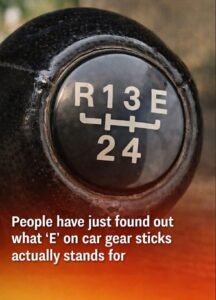
That is exactly why the sudden appearance of a mysterious “E” on certain older gear sticks caused so much confusion. For many drivers encountering it today—especially younger ones—it looks like an error, a forgotten symbol, or something that was never fully explained. It does not match the clean modern alphabet of transmission design, and it sits awkwardly beside familiar markings like “D” or “R.”
Yet that single letter carries a surprisingly rich history rooted in early automotive engineering, fuel efficiency experimentation, and a very different era of driving behavior.
The Confusion Around a Single Letter
When images of gear sticks with an “E” began circulating online, the reactions were predictable. Some assumed it meant “Electric,” especially in a world now dominated by electric vehicles. Others guessed “Emergency,” believing it might activate a special driving mode. A few even thought it was a manufacturing defect or regional variation.
What made the confusion more interesting was how confidently people speculated without historical context. The letter seemed modern enough to feel relevant, but unfamiliar enough to feel suspicious. That combination is what fuels viral curiosity in automotive discussions.
Eventually, experienced drivers and mechanics from older generations stepped in with clarification: the “E” did not stand for electric or emergency. It stood for Economy.
And suddenly, the mystery shifted from confusion to curiosity about why such a feature ever existed in the first place.
What “Economy Mode” Actually Did
The original purpose of the “E” gear was simple but meaningful for its time: improve fuel efficiency.
In earlier automatic transmission systems—particularly in older European and Japanese vehicles—drivers had fewer electronic aids to manage fuel consumption. Engines were less efficient, and fuel prices made driving habits significantly more important than they are today.
When the driver selected “E,” the vehicle adjusted its behavior in subtle but important ways:
- The transmission shifted earlier into higher gears
- Engine RPMs were kept lower during acceleration
- Throttle response became less aggressive
- Power delivery prioritized smoothness over performance
In practice, this meant the car avoided “revving hard” unless absolutely necessary. It behaved more gently, almost as if it was deliberately trying to conserve fuel at every opportunity.
On highways, this mode was especially effective. Instead of holding lower gears longer for responsiveness, the car would quickly settle into higher gears and maintain steady, low-rev cruising.
To modern drivers accustomed to automated fuel efficiency systems, this may sound primitive. But at the time, it was an elegant mechanical solution to a very real economic concern.
Why It Disappeared from Modern Cars
Like many early engineering features, the “E” gear did not vanish because it was useless—it disappeared because it became unnecessary.
Automotive technology evolved rapidly in several key ways:
1. Smarter transmissions
Modern automatic transmissions use adaptive logic. They analyze driving style, road conditions, and throttle input in real time. Instead of needing a separate “Economy” mode, the system adjusts continuously.
2. Engine management computers
Electronic control units (ECUs) now regulate fuel injection, air intake, and ignition timing with extreme precision. Efficiency is no longer dependent on a driver selecting a mode—it is built into the system.
3. Multiple driving modes replaced single-purpose gears
Instead of a simple “E,” modern vehicles offer selectable modes like Eco, Sport, Comfort, or Individual, each adjusting dozens of parameters simultaneously.
4. Automatic fuel optimization
Even without driver input, cars now constantly optimize fuel consumption based on speed, terrain, and traffic.
Because of these advancements, the idea of manually locking a transmission into an economy-focused behavior became redundant. The “E” gear did not disappear due to failure—it disappeared because technology absorbed its function.
The Psychological Side of the Mystery
One of the most interesting aspects of the “E” gear confusion is not mechanical, but psychological.
Drivers tend to assume that every symbol on a vehicle must have a modern, logical explanation. In today’s digital environment, we expect interfaces to be self-explanatory. When something does not fit that expectation, we interpret it as either an error or a hidden feature.
The “E” disrupts that assumption. It belongs to a transitional era of automotive design—one where mechanical systems were still being refined, and driver input played a larger role in efficiency.
That is why it feels strange today. It is not actually outdated in concept—it is simply out of context.
A Forgotten Stage of Driver-Controlled Efficiency
To understand the importance of the “E” gear, it helps to remember how driving used to work before modern automation.
In earlier decades:
- Drivers manually compensated for fuel consumption
- Transmission behavior was less adaptive
- Long-distance efficiency depended heavily on driving discipline
- Vehicles responded more directly to mechanical input
In that environment, “Economy mode” was a useful bridge between full manual control and early automation.
It allowed drivers to influence fuel efficiency without needing advanced technical knowledge. In a way, it democratized efficiency before computers took over the role entirely.
The Unexpected Return of “E” in a New Form
Interestingly, while the original “E” gear disappeared, the concept behind it never truly went away.
Today, the letter “E” has returned to the automotive world—but with a completely different identity.
In modern vehicles, “E” is far more likely to stand for:
- Electric (in EV branding and dashboards)
- Eco mode indicators
- Energy flow systems in hybrid vehicles
Electric vehicles, in particular, have redefined what efficiency means. Instead of shifting gears to control fuel use, EVs manage energy through software, battery optimization, and regenerative braking systems.
In this context, the spirit of the old “Economy mode” still exists—it has simply evolved into a more advanced system that no longer requires driver activation.
From Mechanical Control to Digital Intelligence
The shift from the “E” gear to modern EV systems represents a larger transformation in automotive design philosophy.
Older systems trusted the driver to make efficiency decisions. New systems assume responsibility for those decisions entirely.
Where once you had:
- A physical gear labeled “E”
- A direct mechanical change in transmission behavior
- A noticeable difference in driving response
You now have:
- Invisible software adjustments
- Continuous energy optimization
- Automated driving behavior adaptation
The control has not disappeared—it has simply moved from human hands into algorithms.
Why the “E” Still Fascinates Drivers Today
Despite being obsolete in most vehicles, the “E” gear continues to attract attention whenever it appears in older cars or online discussions.
There are several reasons for this:
- It feels mysterious in a modern context
- It represents a lost era of driving simplicity
- It highlights how much vehicles have changed
- It triggers curiosity about forgotten design choices
In many ways, it acts as a small time capsule—reminding drivers that cars were once more mechanically expressive machines, where even fuel-saving required a physical switch.
Conclusion: A Letter That Outlived Its Purpose
The forgotten “E” on gear sticks is more than a confusing marking. It is a reflection of automotive history, a snapshot of a time when efficiency required awareness rather than automation.
It once helped drivers save fuel through simple mechanical adjustment. It disappeared as technology advanced and intelligence moved into software. And now, in the age of electric vehicles, the same letter has reappeared—reborn with a new meaning entirely unrelated to its original purpose.
What makes it remarkable is not just what it did, but what it represents: the constant evolution of driving itself.
A single letter, quietly embedded in a gear stick, tells a story of transition—from manual control to automation, from fuel economy to electric efficiency, and from visible engineering to invisible intelligence.
And that is why something so small continues to capture attention long after its original function has faded away.