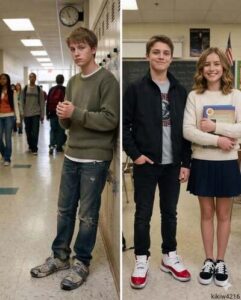
It began, as many life-changing moments often do, without any awareness that anything important was happening at all.
Emma didn’t think of herself as special. She wasn’t the loudest student in school, nor the most outgoing. She moved through her days quietly, observing more than she spoke, noticing details other people often missed. That was how she first noticed Caleb.
He sat two rows ahead in class, always slightly hunched over his desk as if trying to take up less space in the world. He spoke rarely, and when he did, it was in short, careful sentences. Most people didn’t think much of him. Some didn’t think of him at all.
But Emma noticed everything.
It started with his shoes.
They were worn down almost beyond repair. The soles had begun to separate from the upper fabric, held together by strips of duct tape wrapped carefully, almost deliberately, as if he had tried to make them last just a little longer each time they failed him. He walked differently because of them—carefully, cautiously, as if each step required calculation.
At first, Emma told herself it wasn’t her business. Everyone has struggles, she thought. Everyone has something going on behind the surface. And yet, the image stayed with her longer than she expected.
It followed her home that day. It came back the next morning. And slowly, without any dramatic decision or sudden inspiration, it turned into something else: concern.
She didn’t approach him immediately. Emma was not impulsive. Instead, she began observing more carefully, trying to understand whether what she thought she saw was real or just her imagination filling in gaps.
But over time, the pattern became undeniable.
Caleb never joined group conversations unless directly addressed. He avoided eye contact when possible. He never participated in anything that might draw attention to himself. And always, always, the same worn shoes.
That was the point where observation turned into intention.
Emma didn’t have much money. Nothing unusual for a teenager. She wasn’t wealthy, but she wasn’t deprived either. Still, she began making small choices that no one else noticed. She skipped snacks. She saved lunch money. She avoided spending on small things that didn’t matter in the long run.
At first, she didn’t know what she was saving for.
She just knew she was saving.
Weeks passed like that, quietly accumulating small sacrifices that felt insignificant individually but meaningful in combination. No one commented on it. No one noticed anything different. And that was exactly how she wanted it.
Eventually, she had enough.
Enough for something simple, but meaningful.
A pair of shoes.
Not expensive. Not flashy. Just new, clean, functional shoes—something that would allow someone to walk without thinking about every step.
She bought them in secret.
Carried them home in a plain shoebox.
And for two days, she didn’t touch them again. She placed them in her room and stared at them sometimes, wondering if she was doing the right thing or overstepping a boundary she didn’t fully understand.
She wasn’t used to helping people in ways that felt so direct. Kindness, for her, had always been abstract—smiles, polite gestures, small courtesies. This felt different. More physical. More real. More irreversible.
On the third day, she brought them to school.
She waited until lunch, when the hallways were loud and crowded and attention was scattered everywhere. That felt safer somehow—less exposed.
Caleb was sitting alone, as usual.
Emma approached slowly, shoebox in hand, heart beating faster than she wanted it to.
For a moment, she thought about turning around.
But then she didn’t.
She placed the box on the table in front of him.
He looked up, confused at first, as if unsure whether it was meant for him.
“It’s for you,” she said quietly.
He didn’t open it immediately.
He just stared at her.
“Why?” he asked.
Emma hesitated. The question was harder than she expected.
Then she said the simplest truth she could find.
“Because everyone deserves to walk without hurting.”
That was it.
No speech. No explanation beyond that.
Caleb opened the box slowly, almost cautiously, like he was afraid it might disappear if handled too quickly. When he saw the shoes, his expression changed—but not dramatically. It wasn’t instant joy. It was something more complicated. Something guarded.
“Thank you,” he said.
And then, after a pause:
“I don’t know what to say.”
“You don’t have to say anything,” Emma replied.
She walked away before the moment could become too heavy.
What she didn’t know was that someone had recorded it.
A student nearby, half-distracted, had filmed the interaction without thinking much of it at the time. A short clip. A quiet gesture. Nothing that seemed particularly important in the moment.
Until it was shared.
And then shared again.
And again.
By evening, it had left the school entirely.
By morning, it had reached far beyond anything Emma could have imagined.
But even that wasn’t the part that would change everything.
The real shift came later.
At home, Emma’s mother received a call from the school requesting her presence. There was no urgency in the tone, nothing that suggested anything unusual. Just a meeting.
She assumed it was routine.
Maybe attendance. Maybe paperwork. Maybe something involving grades or scheduling.
She had no reason to expect anything else.
That assumption would not last long.
Because when she arrived at the school, she wasn’t led into an office filled with papers or administrative calm.
She was led into something else entirely.
Something that didn’t make sense at first.
Something she thought must be a mistake.
Because standing there—after five years of absence, after grief, after burial, after acceptance—was a man she had already lost.
Her husband.
Emma’s father.
Alive.