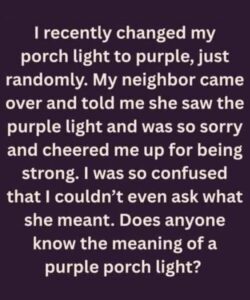
The Meaning Behind Purple Porch Lights
Introduction: When Light Becomes a Message
Walking through a neighborhood at dusk, most porch lights feel familiar—warm whites, soft yellows, occasionally a cool blue. But every so often, one house stands out. A soft purple glow spills onto the porch, subtle but unmistakable, immediately raising questions.
It does not feel accidental. It feels intentional.
And increasingly, it is.
Across many communities, purple porch lights have become more than decoration. They function as quiet symbols of awareness, compassion, and solidarity. While they may appear simple, their meaning is layered, emotional, and deeply tied to real-world struggles that often remain invisible behind closed doors.
One of the most recognized associations is with Domestic Violence Awareness Month, but the symbolism extends beyond a single cause.
Why Purple?
To understand why purple is used, it helps to look at how color communicates meaning without words.
Purple sits between two powerful emotional extremes:
- The calm stability of blue
- The intensity of red
This combination creates a color that feels both soothing and serious. Historically, purple dye was rare and expensive, often associated with royalty, dignity, and importance. Over time, it also became connected with introspection, healing, and emotional depth.
Because of this balance, purple has become a natural choice for causes that involve:
- Reflection
- Memory
- Awareness
- Emotional resilience
Unlike brighter warning colors, purple does not demand urgency. Instead, it invites attention gently.
Domestic Violence Awareness: A Hidden Reality
One of the most important meanings behind purple porch lights is awareness of domestic violence.
Domestic violence is uniquely difficult to address because it often happens in private spaces, away from public view. Survivors may feel isolated, trapped, or unable to speak openly due to fear, emotional pressure, or safety concerns.
This is where symbolism becomes powerful.
During Domestic Violence Awareness Month, many individuals and organizations use purple lighting to:
- Show solidarity with survivors
- Raise visibility of a hidden issue
- Encourage conversation in communities
- Signal emotional support without confrontation
A purple porch light does not expose personal stories. Instead, it communicates something quieter but deeply meaningful: you are not alone.
The Psychology of Visibility
Human beings are highly sensitive to visual cues in their environment. When something stands out—like a purple light in a row of white ones—it naturally prompts curiosity.
That curiosity becomes an opening.
A neighbor might ask about it. A visitor might notice and reflect. Even a passing stranger might briefly pause and think.
These small moments matter because they create opportunities for awareness where none existed before.
For survivors, seeing that symbol in their own neighborhood can be profoundly validating. It suggests that support exists nearby—even if it is not spoken aloud.
Beyond Domestic Violence: Expanding Meanings
While domestic violence awareness is the most widely recognized meaning, purple lighting has also been adopted for other causes.
One of these is epilepsy awareness, often associated with campaigns encouraging public understanding of neurological conditions. In many communities, purple lighting is used to support people living with epilepsy, especially during awareness initiatives tied to global health campaigns.
Purple is also associated with Alzheimer’s and dementia awareness, connected to efforts supporting families and patients affected by memory-related diseases. These conditions often involve long-term emotional and caregiving challenges, making symbolic support especially meaningful.
Additionally, purple is sometimes linked to honoring military service, particularly in reference to the Purple Heart, which recognizes those wounded or killed in service.
Because of these overlapping meanings, a purple porch light is not always tied to one single cause—it can represent awareness more broadly.
When Symbols Become Personal
For some households, purple lighting is not just about public awareness—it is deeply personal.
A family may have:
- Experienced domestic violence directly
- Supported a survivor
- Lost a loved one
- Or participated in advocacy work
In these cases, the light becomes a quiet form of storytelling.
It does not explain everything, but it acknowledges something important.
The home becomes part of a larger emotional landscape where healing, remembrance, and solidarity coexist.
The Power of Silent Support
One of the most striking aspects of purple porch lights is their silence.
They do not speak.
They do not demand attention.
They do not explain themselves.
And yet they communicate clearly to those who understand them.
This kind of silent signaling is powerful because it respects boundaries. It does not force conversation—it allows it to happen naturally.
For people affected by trauma or sensitive experiences, this is especially important. Support is visible, but not intrusive.
Community Impact: When Streets Begin to Glow
When multiple homes adopt purple lighting, something interesting happens: individual gestures become collective expression.
A single light may be noticed.
A row of them becomes meaningful.
Entire neighborhoods glowing softly in purple can represent:
- Shared awareness
- Collective empathy
- Community unity
- Visible acknowledgment of hidden struggles
This transformation turns private gestures into public culture.
It creates an environment where awareness is not isolated, but shared.
The Role of Awareness Campaigns
Awareness movements have played a major role in spreading the use of purple lighting.
Organizations and public health initiatives encourage symbolic participation because it is accessible. Not everyone can attend events, donate large sums, or volunteer extensively—but almost anyone can change a light bulb.
That simplicity is part of its strength.
A purple light becomes:
- A low-barrier form of participation
- A visual reminder of ongoing issues
- A way to stay engaged without direct involvement
This makes awareness more inclusive.
Misinterpretations and Everyday Confusion
Not everyone immediately understands what a purple porch light means.
Some people assume:
- It is seasonal decoration
- It is related to Halloween
- It is purely aesthetic choice
- Or part of random lighting trends
Because of this, the meaning often depends on context.
This ambiguity is not necessarily a weakness. In fact, it allows the symbol to function on multiple levels—personal for some, educational for others.
Over time, repeated exposure helps communities gradually recognize its significance.
Color as Emotional Language
Color has always been a form of nonverbal communication. Long before written language, humans used visual cues to signal emotion, status, and meaning.
Purple, in particular, carries emotional depth:
- It feels reflective rather than aggressive
- It suggests awareness rather than alarm
- It implies seriousness without fear
This makes it uniquely suited for topics involving emotional complexity.
It does not overwhelm the senses—it invites contemplation.
The Quiet Strength of Small Actions
One of the most important ideas behind purple porch lights is that small actions can carry large meaning when shared collectively.
Changing a bulb may seem insignificant. But when multiplied across homes, neighborhoods, and cities, it becomes a visible cultural statement.
It shows that:
- Awareness does not always require noise
- Support does not always require words
- Change can begin in ordinary spaces
A porch light is one of the simplest parts of a home—but it can also become one of the most meaningful.
Why These Symbols Matter Today
In a world filled with constant digital noise, symbolic physical gestures have become even more important.
They bring awareness into everyday space—not just online, but into streets people walk through and live in.
Purple porch lights remind us that:
- Many struggles are invisible
- Many people need support
- And awareness can exist quietly but consistently
They bridge the gap between private experience and public understanding.
Conclusion: Light as Connection
A purple porch light is not just a design choice or decorative trend. It is a message—subtle, steady, and human.
It speaks about awareness without shouting. It offers solidarity without intrusion. It transforms ordinary homes into quiet signals of compassion.
Whether connected to Domestic Violence Awareness Month, epilepsy awareness, Alzheimer’s support, or personal meaning, the message remains fundamentally the same:
Someone sees. Someone cares. Someone remembers.
And in that quiet glow, neighborhoods become something more than collections of houses—they become shared spaces of understanding, reflection, and silent support that continues long after the light switches on.