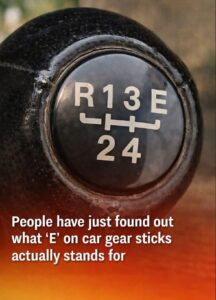
For many drivers, especially those who grew up around modern automatic or electric vehicles, the gear selector has always looked fairly simple and predictable. Park, Reverse, Neutral, Drive—sometimes a Low or Sport mode—these labels form a familiar pattern that most people can operate without even thinking. Yet in older vehicles, particularly some automatic transmissions from past decades, drivers occasionally encountered something unusual: a letter “E” on the gear stick or selector panel.
To those unfamiliar with older automotive design, the symbol often looked confusing, even suspicious. It didn’t fit the standard sequence. It didn’t clearly describe a driving action. And unlike modern indicators such as “S” for Sport or “B” for Brake in electric vehicles, it wasn’t widely explained in driver education today. As a result, many younger drivers assumed it was either a manufacturing quirk, a forgotten setting, or something unrelated to normal driving behavior.
Over time, curiosity about this small letter spread through forums, car communities, and social media discussions, where people debated its meaning. Some guessed it stood for “extra gear,” others thought it might indicate “emergency mode,” while a few assumed it was linked to early electronic systems. But the real explanation is both simpler and more interesting: in most cases, the “E” stood for “Economy.”
That single word opens a window into a completely different era of driving, one where efficiency was not managed by computers but by driver behavior and mechanical assistance systems designed to encourage fuel savings.
In earlier generations of automatic transmissions, especially those developed during the late 1970s through the 1990s in certain European and Japanese models, fuel efficiency was a major engineering concern. At the time, rising fuel prices and growing environmental awareness pushed manufacturers to explore ways of reducing consumption without sacrificing usability. Unlike today’s vehicles, which rely heavily on electronic control units to optimize performance, those earlier systems were far more mechanical in nature.
The “Economy” mode represented one of those early attempts at intelligent efficiency. When a driver selected the “E” position or engaged an economy setting, the transmission would adjust its shifting behavior. Instead of allowing the engine to rev higher before changing gears, it would shift earlier, keeping engine speeds lower. This had a direct effect on fuel consumption: lower revolutions per minute meant less fuel injected per cycle, resulting in improved mileage under normal driving conditions.
In many vehicles, the change was subtle but noticeable. Acceleration became smoother and less aggressive. The car felt calmer, especially during city driving or steady highway cruising. While performance enthusiasts often preferred standard or power-oriented modes, economy mode was ideal for daily commuting, long-distance travel, or situations where efficiency mattered more than speed.
Some systems went even further, combining economy mode with changes in throttle response. Pressing the accelerator would not immediately translate into rapid engine power. Instead, the system would gradually increase output, encouraging gentler driving habits. In effect, the car was “teaching” the driver to prioritize efficiency.
This approach made sense in an era when transmissions were less adaptive than they are today. Unlike modern automatic gearboxes, which use complex algorithms to constantly adjust shifting patterns based on speed, load, terrain, and driving style, older systems relied on preset modes. The “E” setting was essentially a manual shortcut to an efficiency-focused calibration.
However, as automotive technology advanced, the need for a dedicated economy gear began to disappear. The shift was gradual but inevitable. By the late 1990s and early 2000s, electronic transmission control units became increasingly sophisticated. These onboard computers could monitor dozens of variables in real time, including throttle input, road gradient, vehicle load, engine temperature, and even driving history.
This allowed manufacturers to build adaptive transmissions that no longer required a separate economy setting. Instead, efficiency became built into the system itself. A car could now decide when to shift early or late without the driver selecting a specific mode. The concept of a dedicated “E” position became redundant, replaced by intelligent automatic behavior that adjusted seamlessly in the background.
At the same time, fuel injection systems replaced older carburetors, improving combustion efficiency across all driving conditions. Engine design itself evolved toward smaller, turbocharged units that delivered power more efficiently. Aerodynamics improved, rolling resistance decreased, and overall vehicle efficiency increased dramatically.
As a result, the visible “E” on gear sticks began to vanish. Newer vehicles either removed the option entirely or absorbed its function into general driving logic. What once required a physical selector became a software-driven process hidden inside the vehicle’s control systems.
For many drivers who grew up during the transition period, the disappearance of the “E” symbol marked a subtle but meaningful change. It reflected a broader shift in the relationship between humans and machines. Driving was becoming less about manual optimization and more about trusting automated systems to make decisions.
In older cars, understanding how to drive efficiently required awareness and intention. Drivers learned to shift early, avoid unnecessary acceleration, and use modes like “E” when available. In modern vehicles, much of that responsibility has been transferred to the car itself. The system quietly manages efficiency in the background, often without the driver even noticing.
Interestingly, while the original “E” for Economy faded from most vehicles, the letter itself never disappeared from automotive culture. It simply changed meaning.
In today’s automotive world, especially with the rise of electric vehicles, “E” is far more likely to stand for “Electric.” This new interpretation reflects one of the biggest transformations in transportation history: the shift from internal combustion engines to electric powertrains.
Electric vehicles do not rely on traditional multi-gear transmissions in most cases. Instead, they typically use single-speed systems because electric motors produce instant torque across a wide range of speeds. This eliminates the need for frequent gear changes entirely. As a result, gear selectors themselves are often simplified or redesigned completely.
Instead of physical gear sticks, many electric vehicles use rotary dials, buttons, or digital interfaces. Some even remove traditional gear selection hardware altogether, replacing it with touchscreen controls or automatic drive engagement systems. In this new environment, the letter “E” has evolved from a mechanical efficiency mode into a symbol of an entirely different propulsion philosophy.
Where “E” once meant optimizing fuel consumption in combustion engines, it now represents a shift away from fuel altogether. The irony is subtle but significant: both meanings are rooted in efficiency, but they belong to completely different technological eras.
This evolution highlights a broader theme in automotive history. Features that once required manual input gradually become automated, and eventually, replaced entirely. The “E” gear is a perfect example of this progression. It began as a practical tool for conserving fuel, became obsolete as automation improved, and reemerged symbolically in a world that no longer depends on fuel at all.
For enthusiasts of classic cars, the old “E” mode represents a nostalgic reminder of a time when driving was more interactive. It was a period when understanding your vehicle mattered more directly, and when small mechanical choices had visible effects on performance and efficiency. There was a certain satisfaction in engaging economy mode during a long drive and watching fuel consumption improve.
For newer generations, however, the absence of such features is often unnoticed. Modern vehicles handle efficiency automatically, leaving drivers free to focus more on navigation, comfort, and convenience. The trade-off is clear: less manual control in exchange for greater simplicity and consistency.
Yet the legacy of the “E” gear remains important. It reflects an early attempt to bridge human behavior and machine optimization. Even though the feature itself has largely disappeared, its underlying philosophy continues to shape automotive design. Today’s adaptive cruise control systems, eco-driving modes, and AI-assisted energy management systems are all descendants of the same idea.
They simply operate on a more advanced and invisible level.
Ultimately, the story of the “E” on gear sticks is not just about a forgotten symbol. It is about the continuous evolution of driving technology and the changing relationship between drivers and their vehicles. What once required a simple physical setting now exists as complex digital logic. What was once visible and tactile has become hidden and automated.
And yet, the purpose remains the same: to move more efficiently, whether by saving fuel or optimizing electric energy use.
The next time someone mentions the mysterious “E” on older gear sticks, it is worth remembering that it was never a mistake or a random marking. It was a reflection of its time—a practical solution to a real problem, designed for an era when efficiency depended on the driver as much as the machine.
Today, that responsibility has shifted into the background. But the idea behind it never disappeared. It simply evolved, just like the cars themselves.