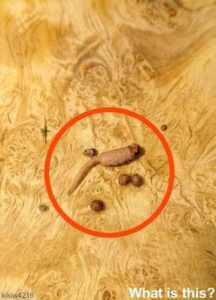
Discovering an unfamiliar creature inside a home can be unsettling, especially when the organism appears strange enough to resemble something from science fiction. Few household encounters trigger curiosity and alarm quite like the sight of a soft pink, worm-like creature dragging a thin tail-like extension across a floor, wall, sink, or countertop. Its appearance often sparks immediate concern. Some people assume it is a parasite, while others fear it may be venomous, invasive, or connected to unsanitary conditions. Social media images and online speculation frequently intensify these fears, turning harmless organisms into subjects of exaggerated rumors and alarming misunderstandings.
In many cases, however, this mysterious organism is neither dangerous nor rare. It is usually the larval stage of a hoverfly, commonly known as a rat-tailed maggot. Despite its unusual name and appearance, this creature is harmless to humans and pets and actually plays a valuable role in natural ecosystems. Its presence indoors may seem disturbing at first glance, but understanding what it truly is reveals a fascinating story about insect adaptation, decomposition, ecological balance, and the hidden biodiversity that exists even in ordinary human environments.
The rat-tailed maggot is most commonly associated with the species Eristalis tenax, a type of hoverfly found across much of the world. Adult hoverflies are often mistaken for bees or wasps because of their striped coloring and hovering flight patterns, yet they are harmless flies that cannot sting. They are important pollinators and contribute positively to both natural ecosystems and agriculture. The bizarre larval stage, however, looks completely different from the graceful adult insect it eventually becomes.
At first glance, the rat-tailed maggot hardly resembles a fly larva at all. Its body is elongated, cylindrical, and soft, often appearing pale pink, cream-colored, or slightly translucent. The skin may look smooth and moist, giving it a gelatinous appearance that many people find unfamiliar and unsettling. The most striking feature is the long, narrow extension protruding from one end of the body. This appendage resembles a tail, which is how the creature earned its common name.
Despite appearances, the “tail” is not a tail in the traditional sense. It is actually a respiratory siphon, a specialized breathing tube that functions like a snorkel. This remarkable adaptation allows the larva to survive in oxygen-poor aquatic environments by extending the siphon to the surface while the rest of the body remains submerged. In essence, the rat-tailed maggot breathes air from above the water while feeding below it.
This unusual respiratory system is one of nature’s most fascinating survival adaptations. Many organisms cannot survive in stagnant or heavily polluted water because oxygen levels are too low. Rat-tailed maggots, however, thrive in such environments precisely because of their siphon. They are commonly found in standing water rich in organic material, including ponds, manure pits, compost runoff, clogged drains, sewage areas, and decaying vegetation.
The darker end of the larva contains its head and feeding structures. Using these mouthparts, the maggot filters microorganisms, bacteria, and decaying organic matter from the surrounding environment. In doing so, it acts as a decomposer, helping break down waste and recycle nutrients back into ecosystems. Though its appearance may seem unpleasant, its ecological role is actually beneficial.
People who discover these larvae indoors often notice tiny dark pellets nearby and mistakenly assume they are eggs or parasites. In reality, these small particles are usually frass, which is insect waste, or debris carried from the larva’s feeding habitat. The creature itself is not reproducing inside the home, nor is it attempting to infest human living spaces.
One reason rat-tailed maggots cause such strong reactions is because they appear in places where people do not expect to encounter aquatic larvae. Since most people associate worms or maggots with decay or infestation, seeing one crawling across a dry floor can immediately trigger concern. Yet the larva’s appearance indoors is usually accidental and temporary.
Rat-tailed maggots require moist or semi-aquatic conditions to survive. They cannot thrive in dry indoor environments for long periods. When one appears inside a home, it is often because it has wandered away from its original habitat during a transitional stage of its life cycle. Sometimes they emerge from drains connected to stagnant organic buildup. Other times they may be carried inside on outdoor equipment, flowerpots, containers, or wet materials. In some cases, heavy rain or flooding can displace them from outdoor habitats and bring them closer to homes.
One particularly common source is neglected plumbing or drainage systems. Organic buildup inside drains creates a moist environment where hoverflies may lay eggs. Once the larvae mature, they sometimes crawl away in search of a dry location where they can pupate and transform into adult flies. Discovering one on a bathroom floor or near a sink often means it has already left the environment where it developed.
Understanding the hoverfly life cycle helps explain why this happens. Like many insects, hoverflies undergo complete metamorphosis, meaning they pass through four distinct developmental stages: egg, larva, pupa, and adult.
The cycle begins when an adult hoverfly lays eggs near a suitable moist environment rich in organic material. Once the eggs hatch, the larvae begin feeding immediately. During this stage, the rat-tailed maggot grows rapidly while submerged in water or sludge-like material. Its respiratory siphon allows it to survive in conditions that would suffocate many other organisms.
As the larva matures, it eventually leaves the water and searches for a relatively dry location. There it forms a pupa, creating a hardened protective casing around itself. Inside this casing, one of nature’s most extraordinary transformations occurs. The worm-like aquatic larva reorganizes its body structure completely and emerges later as an adult hoverfly.
The adult hoverfly bears almost no resemblance to the larva. It has wings, compound eyes, striped coloration, and the ability to hover in midair with remarkable precision. Many species mimic bees or wasps as a form of protective camouflage, discouraging predators despite being harmless themselves.
This dramatic transformation is one reason the rat-tailed maggot fascinates entomologists and naturalists. It demonstrates how different stages of an insect’s life can evolve to occupy entirely different ecological roles. The larva specializes in decomposition and nutrient recycling in wet environments, while the adult specializes in pollination and reproduction among flowers.
Hoverflies themselves are highly valuable insects. As adults, they feed on nectar and pollen, transferring pollen between plants in the process. In agricultural environments, hoverflies contribute significantly to pollination, supporting crop production and biodiversity. Some hoverfly species also help control pests because their larvae consume aphids and other plant-damaging insects.
The species associated with rat-tailed maggots, Eristalis tenax, is particularly widespread and adaptable. Adult drone flies, as they are sometimes called, are common around gardens, farms, wetlands, and urban areas. Their ability to exploit a variety of aquatic breeding habitats has contributed to their success across many regions of the world.
Despite these ecological benefits, the larval form continues to be misunderstood. Online discussions frequently include dramatic claims suggesting that rat-tailed maggots are parasitic worms or dangerous invaders. Some social media posts incorrectly identify them as alien-like organisms, mutated creatures, or health threats. Such misinformation spreads quickly because the larva’s appearance is genuinely unusual.
In reality, rat-tailed maggots do not bite, sting, or attack humans. They do not infest skin or tissues, nor do they seek out people or pets. They are not aggressive and pose no direct threat to household structures. Their presence is usually more of an environmental clue than a medical concern. Finding one may simply indicate nearby standing water, organic buildup, or drainage conditions suitable for hoverfly larvae.
There are rare documented cases of accidental ingestion leading to intestinal survival for short periods, but such events are extremely uncommon and generally associated with severely contaminated food or water. For ordinary household encounters, the larvae pose no meaningful health risk.
Human reactions to creatures like rat-tailed maggots reveal an interesting aspect of psychology. People tend to fear organisms they cannot easily categorize. Creatures that resemble familiar animals are often less alarming than those with unusual forms or behaviors. Since rat-tailed maggots do not fit common expectations for insects or worms, they trigger discomfort rooted in unfamiliarity rather than actual danger.
This response is amplified by the fact that many people encounter them unexpectedly indoors. Homes are generally viewed as controlled environments, so the sudden appearance of a strange organism disrupts that sense of predictability. The combination of surprise and unfamiliar appearance encourages assumptions of danger even when none exists.
Social media further intensifies these reactions. Photos and videos of unusual creatures spread rapidly online, often accompanied by sensational captions or misleading explanations. Algorithms tend to favor content that provokes emotional responses, meaning strange-looking organisms frequently become viral subjects of fear and speculation. Unfortunately, accurate biological information rarely spreads as quickly as dramatic misinformation.
Education plays an important role in correcting these misunderstandings. Learning about organisms like rat-tailed maggots helps replace fear with curiosity and encourages a more balanced understanding of nature. Instead of viewing every unfamiliar insect as a threat, people can begin recognizing the ecological roles these organisms play.
If someone encounters a rat-tailed maggot indoors, the appropriate response is simple and calm. The larva can be removed using a tissue, paper towel, or container and disposed of outside or in the trash. The surrounding area may be cleaned with ordinary household cleaners if desired, though no special disinfection is necessary.
More importantly, it can be helpful to inspect the surrounding environment for conditions that may support larval development. Common preventative measures include cleaning drains regularly, removing standing water, maintaining gutters, emptying neglected containers, and preventing the accumulation of decaying organic material.
Because rat-tailed maggots cannot establish long-term infestations in dry indoor environments, aggressive pest control measures are usually unnecessary. Pesticides are generally not recommended since the issue is environmental rather than invasive. Addressing moisture and organic buildup is typically enough to prevent future appearances.
Beyond the immediate household encounter, the existence of creatures like rat-tailed maggots offers a reminder of how much hidden life surrounds us every day. Urban and suburban environments are filled with organisms carrying out essential ecological processes largely unnoticed by humans. Decomposition, nutrient recycling, pollination, and waste breakdown occur constantly in the background of daily life.
Insects in particular play foundational roles in ecosystems. Although they are often overlooked or disliked, they contribute to soil health, food webs, plant reproduction, and waste management. The rat-tailed maggot, despite its strange appearance, is part of this broader ecological network.
Its respiratory siphon alone represents an extraordinary example of evolutionary adaptation. Over countless generations, natural selection shaped this organism to survive in conditions that would be lethal to many others. The siphon allows access to oxygen while feeding in stagnant organic material, enabling the larva to exploit ecological niches unavailable to competing species.
This specialization highlights one of evolution’s central principles: organisms adapt not toward beauty or familiarity, but toward survival efficiency within specific environments. To human eyes, the rat-tailed maggot may appear bizarre or unsettling. From an evolutionary perspective, however, it is highly successful.
The transformation from larva to hoverfly also demonstrates the remarkable complexity of insect metamorphosis. During pupation, tissues are reorganized, body structures are rebuilt, and entirely different lifestyles emerge from a single organism. The aquatic decomposer becomes an airborne pollinator. Few natural processes illustrate biological transformation more dramatically.
For scientists, hoverflies and their larvae provide valuable insight into ecology, environmental monitoring, and adaptation. In some wastewater systems, the presence of rat-tailed maggots can even indicate specific oxygen conditions or levels of organic pollution. Their resilience makes them useful biological indicators in certain habitats.
For the average homeowner, however, the most important message is much simpler: the strange pink “tail” creature is not dangerous. It is not evidence of infestation, poisoning, or parasitic invasion. It is simply a specialized fly larva temporarily out of place.
Encounters with organisms like this also offer an opportunity to rethink humanity’s relationship with the natural world. Modern life often creates the illusion that human environments exist separately from nature, yet countless species continue adapting to and interacting with our homes, cities, and infrastructure. Drains, gutters, gardens, compost bins, and water containers become miniature ecosystems supporting diverse forms of life.
Most of these organisms remain unnoticed until they appear in unexpected ways. When they do, fear is often the first reaction. But curiosity can be far more rewarding. Understanding the biology behind unusual encounters transforms confusion into appreciation and reveals the hidden complexity of ordinary environments.
The rat-tailed maggot serves as a perfect example of this hidden complexity. What initially appears grotesque or alarming becomes, upon closer examination, an elegant product of adaptation and ecological necessity. Its snorkel-like breathing tube, decomposition role, and metamorphosis into a pollinating hoverfly tell a story far more interesting than the fear it initially inspires.
Ultimately, the strange pink creature with the long “tail” is not a household menace but a harmless stage in the life of an important insect. Its appearance indoors is usually temporary and accidental, reflecting nearby moisture or organic material rather than danger. While its unusual form may provoke surprise, understanding its biology reveals an organism uniquely adapted to a specific ecological role.
Rather than symbolizing contamination or threat, the rat-tailed maggot represents the remarkable diversity of life quietly existing around us. Even in the most ordinary settings, evolution continues shaping organisms in extraordinary ways. Recognizing that truth can transform unsettling encounters into moments of scientific curiosity and appreciation for the hidden systems supporting the natural world every day.