From the moment a person snaps together their first LEGO brick, something remarkable begins to happen. The experience feels simple at first—just small plastic pieces connecting with a satisfying click—but beneath that simplicity lies something far more profound. LEGO is not merely a toy designed to entertain children for a few hours. It is a system of creativity, a tool for learning, and a reflection of something deeply rooted in human nature: the instinct to build, explore, solve problems, and transform imagination into reality.
The appeal of LEGO crosses generations, cultures, and languages because it speaks to universal human instincts. Children see possibility in a pile of bricks before they fully understand architecture, engineering, storytelling, or design. Adults rediscover creativity through it after years spent navigating structured routines and responsibilities. Entire communities form around it, connected not by age or background, but by the shared joy of constructing something meaningful piece by piece.
At its core, LEGO represents far more than entertainment. It symbolizes curiosity, experimentation, resilience, collaboration, and the belief that even the most complex ideas can emerge from simple foundations.
The origins of LEGO help explain why it resonates so deeply around the world. The company was founded in Denmark by Ole Kirk Kristiansen during a period marked by economic hardship and uncertainty. Originally a carpenter, Kristiansen began creating wooden toys after losing much of his business during the Great Depression. From the beginning, his philosophy emphasized quality, durability, and thoughtful design. His famous belief that “only the best is good enough” became more than a slogan—it became the foundation of the company’s identity.
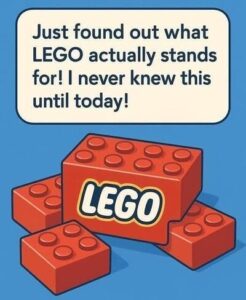
The name LEGO itself comes from the Danish phrase “leg godt,” meaning “play well.” That phrase contains an important idea often overlooked in modern society: play is not separate from learning or growth. In many ways, play is one of the most important forms of learning humans experience. Through play, children test ideas, experiment with systems, explore consequences, and develop confidence. LEGO embraces this philosophy completely by turning imagination into an active process rather than passive entertainment.
The transition from wooden toys to interlocking plastic bricks changed everything. What emerged was not simply a new toy but an entirely new creative system. LEGO bricks introduced the concept of modular creativity, where small standardized components could combine endlessly to produce structures limited only by imagination.
This idea appears deceptively simple, yet it reflects something deeply connected to how humans understand the world itself. Knowledge, innovation, language, science, and even civilization are built modularly. Ideas connect to previous ideas. Discoveries expand upon older discoveries. New systems emerge from combinations of smaller elements. LEGO mirrors this process physically and visually.
One of the most remarkable aspects of LEGO design is compatibility across generations. Bricks produced decades apart can still connect perfectly. A child today can build with pieces created before their parents were born. This continuity reinforces a subtle but powerful message: progress does not erase the past—it builds upon it. Human advancement works the same way. New inventions, technologies, and ideas rarely emerge from nothing. They evolve from existing foundations.
As LEGO spread internationally, its significance expanded far beyond the toy industry. Parents quickly noticed that children naturally learned while building, even without formal instruction. Through experimentation, children begin understanding balance, proportion, geometry, symmetry, and cause-and-effect relationships.
A tower collapses because its base is weak.
A bridge fails because weight distribution is uneven.
A vehicle rolls because wheels reduce friction.
These lessons are not delivered through lectures or memorization. They are discovered through direct experience.
This is one reason LEGO remains so powerful educationally. It transforms abstract concepts into tangible realities. Instead of simply hearing about structure or design, children experience those ideas physically. They test theories with their hands, observe results immediately, and adjust accordingly.
In many ways, LEGO quietly introduces the principles behind the Scientific Method itself.
Hypothesis.
Experiment.
Observation.
Adjustment.
Repetition.
When a child rebuilds a collapsed structure stronger than before, they are engaging in the same fundamental process scientists and engineers use throughout the real world.
Importantly, failure inside LEGO play carries no shame. A collapsed structure is not viewed as personal inadequacy. It is simply information—a signal that another approach might work better. This creates an environment where resilience develops naturally. Children learn persistence because trying again feels rewarding rather than humiliating.
That lesson extends far beyond childhood.
Many adults spend years fearing mistakes because failure in school, work, or society often carries emotional consequences. LEGO offers a different perspective: mistakes are part of creation itself. Every builder encounters collapse, instability, or imperfect design. Progress happens through revision rather than perfection.
This mindset helps explain why LEGO continues appealing to adults as much as children.
For adults, LEGO often becomes something entirely different from childhood play. It evolves into a form of mindfulness, artistic expression, stress relief, and even emotional restoration. In a world dominated by screens, notifications, and constant digital stimulation, the physical act of building offers something increasingly rare: focused attention.
Many adult builders describe assembling LEGO sets as meditative. Sorting pieces, following patterns, and constructing something gradually by hand creates a calming rhythm. The experience slows mental noise and encourages concentration in a way modern life rarely allows.
Others use LEGO as an artistic medium. Massive sculptures, detailed architectural recreations, functioning mechanical systems, and intricate city models demonstrate how sophisticated LEGO building has become. What began as a children’s toy now appears in museums, engineering workshops, classrooms, therapy sessions, and professional design studios.
The growth of adult LEGO communities also reflects a broader cultural shift. Creativity is no longer viewed solely as the domain of artists or children. Increasingly, people recognize creativity as a fundamental human capacity valuable across all stages of life.
LEGO supports this idea because it does not impose a single purpose. It offers tools rather than fixed outcomes. A single collection of bricks can become a spaceship, a castle, a robot, or an abstract sculpture depending entirely on the builder’s imagination.
This open-ended nature distinguishes LEGO from many modern toys and forms of entertainment. Much of contemporary media provides predetermined experiences with limited room for interpretation. LEGO, by contrast, begins with possibility rather than conclusion.
That freedom matters psychologically.
When people create something themselves, they experience agency. Their ideas become visible and tangible. This process builds confidence because it reinforces the connection between imagination and action. The builder learns that thoughts can become reality through effort and experimentation.
In educational settings, LEGO has become an especially valuable teaching tool because it bridges abstract thinking with physical understanding. Mathematical concepts become visible through patterns and symmetry. Engineering principles emerge through structural experimentation. Robotics kits introduce programming and logic in accessible, interactive ways.
Students who struggle with purely theoretical instruction often thrive when learning becomes tactile and visual. LEGO allows complex concepts to feel approachable because learners can manipulate ideas physically instead of only imagining them mentally.
This educational value extends beyond technical subjects.
LEGO also encourages communication and collaboration. When multiple people build together, they must share ideas, negotiate decisions, solve disagreements, and coordinate actions. The bricks become a kind of social language understood across cultures and age groups.
Families often experience this directly. Parents and children building together engage in cooperation naturally. Conversations emerge organically around shared goals rather than forced interaction. In classrooms, collaborative LEGO projects help students develop teamwork and problem-solving skills simultaneously.
In therapeutic environments, LEGO has proven equally meaningful. Therapists sometimes use LEGO-based activities to help individuals express emotions, process experiences, and develop communication skills. Because building provides a nonverbal form of expression, it can help people articulate thoughts or feelings that are difficult to explain directly.
For some children, especially those experiencing anxiety or developmental challenges, LEGO creates a structured yet flexible environment where emotional safety and creativity coexist. Building something external can help organize internal thoughts. The process restores a sense of control, clarity, and accomplishment.
At a deeper philosophical level, LEGO represents something important about human creativity itself: the power of constraints.
At first glance, constraints might seem limiting. LEGO pieces come in specific shapes, sizes, and connection systems. Builders cannot simply create anything instantly. They must work within the rules of the system.
Yet paradoxically, those limitations often enhance creativity rather than restrict it.
Because resources are finite, builders must think critically and adaptively. They invent solutions using available components. They reinterpret pieces creatively. They discover unexpected possibilities precisely because the system imposes boundaries.
This reflects a broader truth about innovation throughout history.
Many important breakthroughs emerge not from unlimited freedom, but from working creatively within constraints. Architects design around physical laws. Writers shape stories through language limitations. Engineers solve problems using available materials and technologies.
LEGO teaches this lesson intuitively. Complexity can emerge from simplicity. Extraordinary structures can arise from small, consistent elements combined thoughtfully over time.
In an increasingly digital world, LEGO’s physical nature becomes even more significant. Modern life often disconnects thinking from making. Ideas exist virtually through screens, simulations, and abstract systems. LEGO reconnects thought with action.
Builders feel the pieces.
They test stability physically.
They manipulate space directly.
This tactile engagement activates different forms of understanding than purely digital interaction. It reminds people that creation is not only conceptual—it is physical, iterative, and grounded in reality.
Ironically, even as digital entertainment dominates global culture, LEGO has remained remarkably relevant by adapting without abandoning its core identity. The company expanded into films, video games, robotics, and digital experiences while preserving the central principle of creative construction.
The LEGO movies themselves captured this philosophy beautifully by celebrating imagination, individuality, and collaborative problem-solving. Their message resonated across generations because it reflected the deeper cultural meaning LEGO had already acquired over decades.
LEGO also occupies a unique place in modern nostalgia. For many adults, the bricks symbolize childhood creativity untouched by pressure or judgment. Revisiting LEGO becomes a way of reconnecting with curiosity and imagination often suppressed by adult responsibilities.
Yet nostalgia alone cannot explain LEGO’s enduring success.
The deeper reason is that LEGO aligns with something fundamental about being human.
Humans are builders by nature.
We build homes, languages, systems, relationships, technologies, stories, and civilizations. We organize chaos into structure. We take fragments and combine them into meaning.
LEGO provides a miniature version of this universal process.
Each brick represents possibility.
Each connection represents progress.
Each completed structure reflects imagination transformed into reality through patience and experimentation.
This symbolism becomes especially powerful during uncertain times. In a world that often feels overwhelming or fragmented, LEGO offers a reassuring principle: large and complex things can be built gradually from small manageable pieces.
That lesson applies far beyond toys.
Careers are built skill by skill.
Relationships are built conversation by conversation.
Knowledge is built idea by idea.
Recovery is built step by step.
LEGO quietly reinforces this truth every time someone begins constructing something from scattered pieces.
Its cultural influence now extends into architecture, engineering, design, education, psychology, and art. Yet despite this expansion, LEGO’s core experience remains beautifully simple. A person sits before a pile of pieces and begins imagining what could exist.
That simplicity is part of its genius.
It does not demand expertise before creativity begins.
It welcomes experimentation immediately.
There is no single correct way to build.
No universal definition of success.
A child stacking random bricks experiences the same essential creative process as an engineer designing a functioning robotic system.
Both are exploring possibilities.
Both are learning through construction.
Both are participating in the deeply human act of transforming imagination into form.
Ultimately, LEGO endures because it trusts the builder.
It provides structure without eliminating freedom.
Guidance without limitation.
Tools without predetermined meaning.
That trust is profoundly empowering.
It suggests creativity is not rare or reserved for a gifted few. It belongs to everyone willing to experiment, adapt, and build.
In a society often obsessed with speed, perfection, and instant results, LEGO offers a quieter and more enduring philosophy. Meaningful things take time. Structures require foundations. Failure is part of learning. Creativity grows through exploration rather than certainty.
Perhaps that is why LEGO continues resonating across generations despite enormous cultural and technological change.
It reminds people of something essential.
That humans are not merely consumers of the world around them.
We are creators within it.
And sometimes all it takes to begin building something meaningful is a handful of simple pieces, an open imagination, and the willingness to connect one brick to another until an idea becomes real.