The Viral Cow Math Puzzle Explained: Why the Answer Is Actually $400
At first glance, the viral “cow math puzzle” looks like one of those simple brain teasers designed to test basic arithmetic. It spreads quickly across social media because it feels intuitive—just a few numbers, a couple of transactions, and what seems like a straightforward question about profit.
But the moment people start calculating, something strange happens: disagreement.
Some confidently say the answer is $200. Others argue it is $0. A few overthink it entirely and end up with inconsistent results. The confusion is not because the math is difficult, but because the structure of the problem subtly disrupts how most people naturally track transactions.
This puzzle is less about computation and more about organization of logic.
Let’s break it down carefully.
The Puzzle
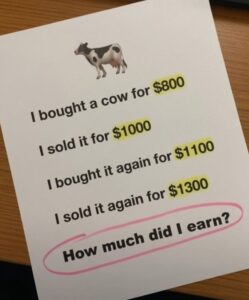
You are given the following sequence:
- You buy a cow for $800
- You sell the cow for $1,000
- You buy the cow back for $1,100
- You sell the cow again for $1,300
The question is simple:
What is your total profit?
Why People Get Confused
The main reason this puzzle spreads confusion is because most people try to track the cow as a single continuous object instead of treating each transaction independently.
When the price changes multiple times, the brain tends to merge events together and assume earlier profit might be “canceled out” by later costs.
In particular, the second purchase at $1,100 often misleads people. It feels like you are “losing” money at that point, so many assume it reduces or erases earlier gains.
But that interpretation is incorrect.
Profit is not cumulative on ownership—it is calculated per completed transaction.
Step 1: First Transaction
You buy the cow for $800
You sell it for $1,000
Profit calculation:
1000 − 800 = 200
So after the first cycle, you have made $200 profit.
Nothing else matters yet. The second purchase has not happened.
Step 2: Second Transaction
Now you buy the cow again, but this time for $1,100
Then you sell it for $1,300
Profit calculation:
1300 − 1100 = 200
So the second cycle also produces a $200 profit.
Step 3: Combine Both Transactions
Now we simply add both independent profits:
200 + 200 = 400
So the total profit is:
👉 $400
The Clean Mathematical View (Cash Flow Method)
Another way to verify the answer is to ignore “ownership” entirely and track total money in and out.
Total money spent:
- $800
- $1,100
Total spent =
800 + 1100 = 1900
Total money received:
- $1,000
- $1,300
Total received =
1000 + 1300 = 2300
Final calculation:
2300 − 1900 = 400
Again, the result is:
👉 $400 profit
Why the Puzzle Feels Tricky
This puzzle works because it exploits a common mental shortcut: people try to treat the cow as a single asset whose value should be tracked continuously.
But in reality, each buy-sell pair is a separate financial event.
The key misunderstanding usually comes from the second purchase:
- People see $1,100 and think: “That cancels the earlier $200 gain”
- But in accounting terms, it is simply the cost of a new transaction cycle
Once you separate the events, the confusion disappears.
The Real Lesson Behind the Puzzle
Beyond the numbers, this puzzle spreads so widely because it highlights something important about human thinking:
People are very good at arithmetic, but less reliable when it comes to structuring multi-step logic under pressure.
Even highly skilled individuals often:
- Merge separate events incorrectly
- Overweight recent numbers
- Assume hidden tricks exist when none do
- Skip step-by-step verification
This leads to disagreement even in simple problems.
Why the Answer Is Always $400
The key insight is this:
Every complete buy-and-sell cycle must be treated independently.
You had two cycles:
- Buy $800 → Sell $1,000 = +$200
- Buy $1,100 → Sell $1,300 = +$200
So:
Total profit = $200 + $200 = $400
No hidden logic. No trick. Just disciplined accounting.
Final Thought
The viral cow puzzle is popular not because it is difficult, but because it reveals how easily the mind can become misled by structure rather than numbers.
When broken down properly, the problem is simple:
Each transaction tells its own story.
And when you read both stories clearly, the answer becomes obvious.
👉 Final Answer: $400 profit