The Iron Guardians of the Dead: How Mortsafes, Grave Robbers, and the Rise of Modern Medicine Created One of History’s Strangest Burial Traditions
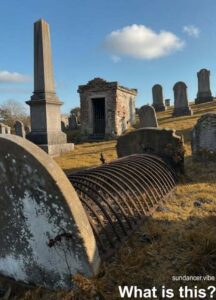
Across old churchyards in parts of Europe, especially throughout Scotland and northern England, visitors sometimes notice strange iron structures resting above centuries-old graves. At first glance, they appear unsettling—like cages abandoned by another era or fragments of forgotten machinery slowly surrendering to rust and time. Some resemble heavy iron grills laid across the earth, while others look like locked metal vaults built directly over burial plots. To modern eyes, these structures can seem mysterious, even frightening. Yet they were once considered necessary protections in a world gripped by fear, scientific transformation, and an underground trade involving the dead.
These objects were known as mortsafes.
Far from decorative monuments, mortsafes served a practical and deeply emotional purpose. They were designed to stop grave robbers from stealing newly buried bodies. During the late eighteenth and early nineteenth centuries, grave robbing became one of the most alarming social problems in many European communities. Families feared that loved ones buried with prayers and dignity might be dug up only days later and sold illegally to medical schools for anatomical study.
The existence of mortsafes reveals far more than an unusual burial custom. They tell the story of a society caught between scientific progress and moral outrage, between the growing needs of medicine and the ancient human belief that the dead deserved peace.
Medicine, progress, and the demand for bodies
By the eighteenth century, medicine in Europe was undergoing rapid transformation. Universities in places like Edinburgh, London, and Dublin were expanding anatomical study. Physicians increasingly relied on direct observation of the human body to improve surgical techniques and medical understanding.
However, legal access to cadavers was extremely limited. In Britain, only executed criminals could be legally dissected. As medical schools expanded, this supply became hopelessly insufficient. The result was a growing demand that law could not satisfy.
This gap between medical need and legal supply created the conditions for a disturbing underground trade.
The rise of the resurrectionists
Grave robbers—often called “resurrectionists”—began exhuming freshly buried bodies and selling them to anatomists. These operations became increasingly organized. Groups worked at night, targeting cemeteries near medical schools where demand was highest.
In cities such as Edinburgh, the trade became so active that entire networks developed around it. Bodies were extracted quickly, often with disturbing efficiency. Families lived in fear that graves would not remain undisturbed even for a few days after burial.
The emotional impact on communities was profound. Burial was not simply practical; it was sacred. The idea that a loved one could be dug up and dissected after burial created widespread outrage and anxiety.
Why mortsafes were created
Communities eventually responded with defensive measures. One of the most striking was the mortsafe.
A mortsafe was an iron protective structure placed over a grave immediately after burial. Its purpose was simple: prevent access to the coffin during the period when a body was most valuable to grave robbers.
Designs varied. Some were heavy iron plates locked in place, while others formed cage-like frameworks anchored into stone. Their weight and complexity made quick removal nearly impossible without tools and time—two things grave robbers could not risk.
These devices were usually temporary. Once decomposition progressed and the body lost value for anatomical study, the mortsafe could be removed and reused elsewhere.
Community defense and shared protection
Because iron was expensive, mortsafes were often shared within communities. Churches and burial associations managed them, rotating their use among new graves. This collective system reflected how widespread fear had become.
In addition to mortsafes, some cemeteries employed night watchmen, constructed guard houses, or installed alarm systems. In extreme cases, armed patrols and dogs were used to deter intruders.
The dead had become something communities actively defended.
Social inequality in death
Protection from grave robbing was not evenly distributed. Wealthier families could afford stronger coffins, mausoleums, or private burial grounds. Poorer communities, by contrast, were far more vulnerable.
This inequality meant that bodies taken for medical study often came disproportionately from the poor. This fueled resentment toward medical institutions, which were sometimes seen as benefiting from exploitation.
The Burke and Hare scandal
Public fear reached a peak during the infamous murders committed by Burke and Hare in Edinburgh. Unlike traditional resurrectionists, they murdered individuals and sold the bodies directly for anatomical study.
The case exposed the extreme demand for cadavers and intensified public outrage. It also highlighted the moral crisis created by the shortage of legal bodies.
Reform and the decline of mortsafes
Pressure eventually led to legal reform. The Anatomy Act of 1832 in the United Kingdom expanded legal access to unclaimed bodies from hospitals and workhouses. While controversial, it reduced reliance on grave robbing.
As legal supply improved, the resurrectionist trade declined. Cemeteries became safer, and mortsafes gradually fell out of use. Many were dismantled or left to rust in churchyards.
What mortsafes represent today
Surviving mortsafes remain scattered across historic burial grounds, particularly in Scotland. They now stand as historical artifacts rather than active defenses.
They represent a time when science advanced faster than society’s ethical frameworks could adapt. Medicine needed bodies for progress, but communities demanded respect for the dead.
This tension between progress and dignity remains relevant even today in debates about medical ethics, consent, and scientific responsibility.
A legacy of fear, protection, and change
Mortsafes are more than iron structures. They are physical expressions of grief, fear, and communal protection. They reveal how deeply people valued the dignity of burial and how far they were willing to go to preserve it.
They also show how innovation can create unintended consequences when ethical systems lag behind scientific need.
Standing in an old churchyard, a mortsafe feels like a silent witness to a vanished world—one where the dead required guarding, and where communities turned iron into a shield against uncertainty.
Though the era of resurrectionists has long passed, the questions it raised remain: how do societies balance knowledge with ethics, and progress with respect?
The answers are still being written.