The Ancient Hand Gesture That Once Silently Said “No,” Defied Authority, and Protected Against Evil: The Forgotten Story of “Making a Fig”
In a world where communication happens instantly through screens, emojis, and short text reactions, it is easy to forget that humans once relied entirely on the body to express meaning. Long before written language was widespread, and long before even standardized gestures were globally understood, people developed subtle physical signals to communicate refusal, humor, defiance, protection, and belief.
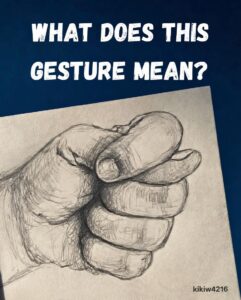
One of the most fascinating and least understood of these gestures is known as “making a fig.” At first glance, it appears simple: a closed fist with the thumb tucked between the index and middle fingers. Yet behind this seemingly ordinary hand position lies a rich cultural history stretching back thousands of years, spanning ancient Rome, medieval Europe, and folk traditions that survived well into the modern era.
This gesture was never just a movement of the hand. It was a message, a symbol, and in many cases, a form of silent resistance.
What Exactly Is the “Fig” Gesture?
The fig gesture, known in Latin as manus fica, is formed by placing the thumb between the index and middle fingers while making a fist. To someone unfamiliar with its meaning, it may look like a childish hand position or a meaningless variation of a fist.
But historically, this gesture carried layered meanings depending on context, region, and time period.
It could mean:
- A refusal or rejection (“no” without words)
- A protective charm against evil forces
- A playful insult or teasing signal
- A symbol of fertility and life energy
- A silent act of defiance against authority
Unlike modern standardized gestures such as a thumbs-up or peace sign, the fig was fluid in meaning. Its interpretation depended heavily on who was using it and who was witnessing it.
Origins in Ancient Rome: Protection, Superstition, and Power
The earliest documented cultural associations of the fig gesture trace back to ancient Roman society. In Roman tradition, gestures were not casual—they were deeply tied to religion, superstition, and social structure.
During certain religious festivals, especially those involving ancestral spirits, household heads were believed to use protective gestures to ward off harmful supernatural forces. One of these was the fig.
Romans believed in the concept of evil eye—a destructive force caused by envy or malicious attention. To protect against it, people used amulets, rituals, and gestures. The fig gesture became one of these protective tools.
Its shape was symbolic. Some scholars suggest it represented fertility and life, while others argue it mimicked human anatomy in a stylized form. In both interpretations, the gesture carried a sense of life-affirming energy meant to counteract negativity.
Physical charms shaped like the fig hand were also created from materials such as coral, silver, and bronze. These were worn around the neck or carried as personal talismans, especially for children and travelers.
Thus, from its earliest known roots, the fig was not just communication—it was protection.
The Fig as a Symbol of Hidden Resistance
Beyond superstition, the fig gesture also served a social function in Roman and later European societies: silent refusal.
In environments where direct confrontation could be dangerous—whether with employers, officials, or authority figures—people needed non-verbal ways to express disagreement.
The fig provided that outlet.
A subtle hand movement behind the body or under a cloak could signal:
- “I refuse.”
- “I do not agree.”
- “You have no power over me.”
This made the gesture especially valuable in hierarchical societies where speaking openly could lead to punishment or social consequences.
Unlike shouting or arguing, the fig allowed resistance without escalation. It was private rebellion expressed in public spaces.
Medieval Europe: Everyday Communication and Folk Expression
As Europe transitioned into the medieval period, the fig gesture did not disappear. Instead, it evolved.
In villages, towns, and marketplaces, communication was often loud, chaotic, and multilingual. Written language was not accessible to everyone, so physical gestures remained essential.
During this time, the fig became more playful and social. It was used in:
- Market bargaining
- Family disputes
- Friendly teasing
- Children’s games
- Superstitious rituals
Parents sometimes taught children the gesture as a harmless way to respond to insults. In this context, it functioned similarly to a modern “sassy comeback” or playful refusal.
However, its protective meaning remained strong in rural traditions. Many communities still believed in the evil eye, and gestures like the fig were used to shield individuals from harm during travel, childbirth, or illness.
In Mediterranean and Balkan regions especially, the gesture became deeply embedded in folk culture. It was passed down orally, often alongside stories about spirits, curses, and protective charms.
The Dual Nature of the Fig: Humor and Offense
One of the most interesting aspects of the fig gesture is its dual meaning.
Depending on context, it could be:
- Protective and sacred
- Or mildly insulting and mocking
This duality is common in ancient symbolic systems, where gestures often carried both spiritual and social meanings simultaneously.
In some regions, the fig was considered a humorous insult, similar in function to modern rude hand gestures. In others, it was more defensive and protective, used quietly rather than aggressively.
This flexibility allowed the gesture to survive across centuries, adapting to different cultural needs.
Renaissance and Early Modern Europe: Subtle Defiance in Changing Societies
By the Renaissance period, Europe was undergoing significant cultural and political change. Cities were growing, trade networks expanding, and literacy increasing.
Yet even as written communication became more common, gestures like the fig remained in use.
In courtly environments, marketplaces, and rural communities alike, the fig persisted as a subtle form of expression.
Historical accounts suggest it was still used to:
- Signal disagreement discreetly
- Express skepticism without confrontation
- Protect against bad luck or envy
- Engage in playful social exchange
Its meaning, however, began to shift more toward folklore than daily necessity. As centralized governments strengthened, overt superstition slowly declined in educated circles, but persisted among rural populations.
Decline in the Modern Era
The Industrial Revolution marked a turning point in human communication.
As societies modernized, several factors contributed to the decline of the fig gesture:
- Increased literacy
- Urbanization
- Standardized education systems
- Reduced reliance on superstition
- Rise of verbal and written communication technologies
By the 20th century, the gesture had largely faded from mainstream use.
Telephones replaced face-to-face signaling. Later, digital communication replaced even that. Gestures that once carried layered meaning were no longer necessary in daily life.
The fig survived only in fragments—folk traditions, regional memories, and historical references.
Modern Interpretation: Forgotten, Misunderstood, or Replaced?
Today, most people would not recognize the fig gesture at all. If seen, it might be mistaken for a random hand position or confused with other modern signals.
However, in academic and cultural studies, it remains a fascinating example of pre-digital communication.
It raises important questions:
- How do humans communicate without language?
- Why do gestures evolve or disappear?
- What cultural meanings are lost in modernization?
In a way, modern emojis have replaced many functions once served by gestures like the fig. A single icon can now express refusal, humor, sarcasm, or protection in seconds—functions that once required physical movement and cultural understanding.
The Psychological Power of Silent Gestures
One reason gestures like the fig endured for so long is psychological.
Humans are highly responsive to body language. Before spoken language, non-verbal communication was essential for survival. Even today, body language often conveys more meaning than words.
The fig gesture combined:
- Physical symbolism
- Emotional expression
- Social communication
- Spiritual belief
This made it extremely powerful in its time.
It was not just a gesture—it was an experience of meaning without speech.
Cultural Legacy and What It Teaches Us Today
Although the fig gesture has largely disappeared from modern life, its legacy remains important.
It teaches us that:
- Communication is not limited to words
- Cultures evolve, but symbols persist
- Humans constantly create new ways to express emotion
- Even simple gestures can carry deep meaning
It also highlights how much of human history is invisible in everyday life. Behind the gestures we no longer use lies a world of belief systems, fears, humor, and creativity.
Conclusion: A Forgotten Language of the Hand
The fig gesture stands as a quiet reminder of humanity’s long and complex journey in communication. Once used to ward off evil, resist authority, or simply say “no” without speaking, it now survives mostly in historical texts and cultural memory.
Yet its story is far from irrelevant.
In a world dominated by digital communication, the fig reminds us of something essential: meaning does not depend on words alone. A single hand movement, shaped by belief and tradition, once carried entire worlds of expression.
And while the gesture itself may have faded, the human need behind it— to protect, to resist, to express, and to connect—remains exactly the same today as it was thousands of years ago.