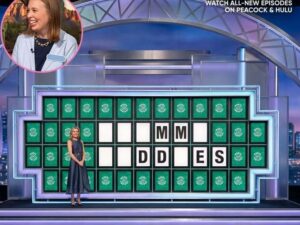
‘Chummy Buddies’ Wheel of Fortune Bonus Round Sparks Fierce Backlash
What was expected to be a routine Bonus Round on Wheel of Fortune quickly escalated into one of the most talked-about moments of the season after contestant Ally Metcalf failed to solve a puzzle that revealed the phrase “Chummy Buddies.” The loss cost her a major prize, including a car, and immediately triggered widespread debate about fairness, puzzle design, and the pressure of timed gameplay.
A Strong Game Leading Into a Tough Final Round
Metcalf entered the Bonus Round after an impressive run, having accumulated $19,200 in winnings during the main game. Her performance throughout the episode was steady and confident, with correct guesses and controlled gameplay that suggested she was well-prepared for the final challenge.
By the time she reached the Bonus Round, expectations were high—not only from viewers, but from her own momentum.
She selected the category “People,” a category that often includes familiar phrases or recognizable word pairings. That expectation, however, quickly shifted once the puzzle board was revealed.
The Puzzle That Divided Viewers
The partially revealed structure:
_ _ MM _ _DD_ES
gave limited entry points for solving the phrase. While she was able to identify “buddies,” the first word remained elusive under time pressure.
When the timer expired, the full answer was revealed:
“Chummy Buddies.”
Almost immediately, reaction split into two opposing camps.
Why Viewers Found It Controversial
For many viewers, the issue wasn’t grammatical correctness—it was naturalness.
Critics argued:
- The phrase sounds unusual in everyday speech
- “Chummy” is not commonly used in modern conversation
- The combination feels forced rather than organic
- Bonus Round puzzles should reflect more familiar language patterns
To these viewers, the puzzle didn’t feel impossible—it felt unnatural, which created frustration.
Some fans also felt that once “buddies” was visible, the remaining word still did not logically lead to a clear solution under pressure.
Defenders Say: That’s the Point of the Bonus Round
Others strongly disagreed with the backlash.
Supporters of the show argued:
- The Bonus Round is intentionally high difficulty
- Success depends on pattern recognition, not common usage frequency
- Unusual phrasing is part of the challenge design
- Contestants are expected to work quickly with incomplete information
From this perspective, “Chummy Buddies” was difficult—but still fair within the rules of the format.
This disagreement reflects a long-standing tension in game show design: should puzzles prioritize familiarity or unpredictability?
The Pressure Factor Most Viewers Forget
One of the most overlooked aspects of the moment is timing.
In the Bonus Round, contestants have only seconds to:
- Interpret incomplete letters
- Mentally test word combinations
- Manage pressure and audience presence
- Speak a final answer confidently
Even familiar words can become difficult under those conditions.
Psychologically, stress reduces recall speed, meaning phrases that would normally be easy can feel unreachable in the moment.
The Role of Prize Stakes
The emotional intensity of the moment increased significantly because of what was on the line.
Metcalf did not just miss a puzzle—she missed:
- A car
- A major Bonus Round prize
- A potential life-changing win
While she still left with her earlier winnings, viewers noted the visible emotional shift after the reveal.
This amplified audience sympathy and fueled online discussion about whether the puzzle outcome felt “too costly” for such a phrase.
Ryan Seacrest’s On-Air Reaction
Host Ryan Seacrest briefly acknowledged the difficulty of the puzzle, calling it “not an easy one.” Though standard in tone, the comment became part of the online debate.
Some viewers interpreted it as subtle validation that the puzzle was unusually hard, while others saw it as routine hosting commentary without deeper meaning.
Social Media Reaction Turns the Phrase Viral
Within hours, “Chummy Buddies” became a trending topic.
Online discussion focused on:
- Whether the phrase is naturally used in English
- Whether Bonus Round puzzles should avoid awkward combinations
- How much luck versus skill determines outcomes
- Whether the puzzle was “fair but frustrating” or “unfairly constructed”
Clips of the moment circulated widely, with viewers replaying the guesses and analyzing the letter pattern.
The Larger Debate About Game Design
Beyond this single episode, the controversy reignited a broader question about Wheel of Fortune:
Should puzzles prioritize:
- Real-world conversational phrases
or - Creative, less predictable word combinations?
Game designers aim to balance:
- Difficulty
- Variety
- Fairness
- Entertainment value
But that balance is subjective—and often depends on viewer perspective.
Why Moments Like This Go Viral
Part of why this moment spread so quickly is because it sits at the intersection of:
- High emotional stakes
- Simple language debate
- Viewer participation (“I would have guessed it!” reactions)
- Perceived fairness questions
Game shows are uniquely suited to viral discourse because audiences naturally imagine themselves in the contestant’s place.
Respect for the Contestant’s Performance
Despite the controversy, most viewers agreed on one central point: Ally Metcalf played an excellent game.
Her Bonus Round loss does not reflect lack of skill. Instead, it highlights:
- The unpredictability of timed puzzles
- The narrow margins of success
- The influence of pressure on decision-making
In many ways, her performance reinforced how unforgiving Bonus Round gameplay can be—even for strong contestants.
Final Reflection
The “Chummy Buddies” moment became more than a missed puzzle. It became a conversation about language, fairness, and how entertainment systems handle unpredictability under pressure.
For some, it was simply a tough but valid challenge.
For others, it was an awkward phrase that exposed flaws in puzzle design philosophy.
But for everyone watching, it delivered what great game show moments often do: a split-second outcome that sparks debate long after the episode ends.
And in that sense, “Chummy Buddies” succeeded—whether intentionally or not—in becoming unforgettable.