I never expected that cleaning out my grandmother’s closet would feel like stepping into another century. I thought it would be a practical task, something I could complete in an afternoon with a few boxes, some trash bags, and a clear head. Instead, it became something else entirely—a slow unfolding of memory, emotion, and a life I had only partially understood.
The house had grown quieter since her passing. Not silent exactly, but muted, as if every room was holding its breath. The closet in her bedroom still carried her presence more strongly than anywhere else. The faint scent of lavender lingered in the fabric of her coats. The hangers were aligned with almost ritual precision. Even the dust seemed hesitant to settle, as if respecting her habits.
I had been postponing this moment for weeks. There is a strange kind of avoidance that comes with sorting through someone’s belongings. You tell yourself it is just organizing. Just practical work. But deep down, you know you are not only sorting objects—you are sorting a life.
Eventually, avoidance turns into necessity.
So I began.
At first, it was simple. Fold sweaters. Stack scarves. Separate donation items. Pack away things I thought I already understood. My grandmother had always been private, but in a familiar way—reserved, structured, steady. I expected her closet to reflect that simplicity.
But as I moved deeper into the space, I realized I was wrong.
Behind a row of winter coats, tucked into the farthest corner of the shelf, my hand brushed against something unexpected. A small cardboard box. Plain. Unlabeled. Almost hidden on purpose, though not carelessly so. It felt deliberately placed, like something meant to be forgotten but not discarded.
I pulled it out slowly.
It was lighter than I expected.
For a moment, I just held it, unsure why it felt different from everything else in the closet. It wasn’t ornate or sentimental on the surface. It didn’t announce its importance. And yet, something about it demanded attention.
I sat down on the bedroom floor and opened it.
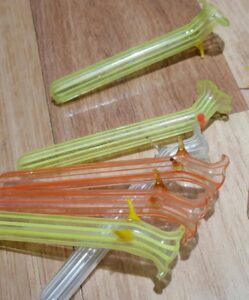
Inside, wrapped carefully in aged tissue paper, were small glass objects. At first, I thought they were decorative pieces—perhaps ornaments, or parts of a broken set of jewelry. But as I lifted one into the light, I realized they were too deliberate for that. Too refined. Too unusual.
Each piece was a slender glass tube, no longer than a finger. Some were shaped like tiny vials, others like curved droplets. They shimmered faintly when they caught the light, as though they were holding onto colors that did not fully belong to them. Blues softened into greens. Pinks dissolved into amber tones. Each one was different.
Attached to each was a small metal hook—worn, slightly tarnished, but carefully crafted.
There were twelve in total.
And none of them were broken.
I turned one over in my hand, trying to understand its purpose. It was delicate, almost impossibly so. Not decorative in a modern sense, not functional in any obvious way. It felt like something from a world that no longer existed—an object created for a ritual I had never been taught.
I carried the box into the living room and placed it on the coffee table. It felt strangely formal there, like it belonged in a display rather than a home.
I tried to imagine explanations.
Art pieces? Old perfume vials? Scientific tools? Handmade ornaments from a forgotten hobby?
Nothing fit.
The mystery stayed with me for hours.
Eventually, I called my great-aunt.
If anyone would know, it would be her.
She arrived the next afternoon, moving slowly but with a sharpness in her eyes that age had not dulled. I placed one of the glass pieces into her hand. She didn’t speak immediately. She simply looked at it.
And then something changed in her expression.
Recognition.
“Oh my,” she whispered. “I haven’t seen one of these in decades.”
That single sentence shifted everything.
“What is it?” I asked.
She smiled faintly, almost nostalgically.
“They’re pocket vases,” she said.
I blinked. “Pocket… vases?”
She nodded. “Men used to carry them. In their suit pockets. They’d place a single flower stem inside.”
I tried to process that image. A glass vase in a jacket pocket. A flower carried through daily life.
It sounded almost impossible.
She continued before I could interrupt.
“It was a gesture,” she said. “A small one. Elegant. Romantic. A way of saying something without speaking it.”
She explained that in an earlier era—one shaped by more deliberate social rituals—small details mattered in ways they often don’t today. A single flower wasn’t decoration. It was intention. It was presence. It was meaning carried quietly into the world.
Men would place a flower into these tiny vases before leaving home. Some did it for love. Some for style. Some simply because they believed beauty should be carried, not left behind.
I looked at the fragile glass in her hands differently now.
It was no longer an object.
It was a message.
Then she said something that made the room feel still.
“Your grandfather used to wear them.”
The words didn’t immediately make sense.
My grandfather had died long before I was born. He existed only in photographs and half-told stories. I had never imagined him as someone who would carry something so delicate, so expressive.
“He wore them every Sunday,” she continued. “Always a fresh flower. Always for your grandmother.”
I felt something shift inside me—not shock exactly, but realization slowly forming shape.
She watched my reaction and added softly, “He wasn’t a loud man. But he believed in beauty.”
That sentence stayed with me.
Because suddenly, I could see him.
Not as a static photograph, but as someone alive in motion. Walking beside my grandmother. Adjusting a flower in his pocket before stepping out the door. Choosing it carefully. Treating it as something meaningful rather than decorative.
A quiet kind of devotion.
My great-aunt went on to explain more. He wasn’t wealthy or dramatic. He didn’t make grand public gestures. Instead, he built a language of small, repeated acts. A flower on Sundays. A note tucked into books. A habit of noticing things others overlooked.
And my grandmother, she said, kept the vases after he died.
All of them.
Not because they were valuable.
But because they were him.
That evening, after my great-aunt left, I sat alone with the box again. But everything had changed. What I was holding was no longer just glass. It was memory, preserved in physical form.
Over the next few days, I returned to the closet with a different kind of attention. What had once seemed like ordinary clothing now felt like fragments of a life I had only partially seen.
A scarf wasn’t just fabric—it was a winter walked through together.
A coat wasn’t just clothing—it was warmth shared on cold afternoons.
And the pocket vases were something deeper still.
They were evidence of a private world.
A world where love was not declared loudly, but carried gently. Repeated quietly. Protected carefully.
I began noticing things I had overlooked before. My grandmother’s habit of placing a single flower in a small glass on the kitchen table every Sunday. Her preference for handwritten notes over phone calls. The way she paused for just a moment longer than necessary when looking at old photographs.
None of it had been random.
It had all been connected.
Inside the closet, I found a second item hidden beneath folded linens: a small notebook. Inside were pressed flowers, carefully flattened between fragile pages. Each one labeled with a date.
Some I recognized. Birthdays. Holidays. Anniversaries.
Others I did not.
Private moments. Quiet memories. Things she never explained.
It felt like reading a diary written in petals instead of words.
As I worked through everything, I began to understand something I had never considered before.
My grandmother had not been distant.
She had been preserving something.
Not just grief.
Not just memory.
But a relationship that continued long after one of its voices had gone silent.
When I finally finished sorting everything, I didn’t feel closure.
I felt continuity.
I brought the box of pocket vases home with me. I placed one on a shelf where I could see it every day. Inside it, I placed a single fresh flower.
Not as decoration.
But as continuation.
And in that quiet moment, I realized something simple but lasting:
Love does not always disappear when people do.
Sometimes it stays behind in glass.
Waiting to be found.