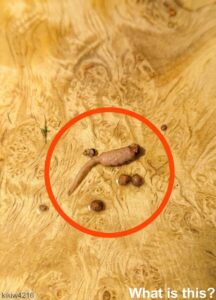
At first glance, the strange pink creature lying motionless on the ornate wooden surface appears almost impossible to identify. Its elongated body, unusual translucent coloration, and especially the extremely long tail-like appendage extending from one end immediately provoke alarm and confusion. To many viewers, it resembles a parasitic worm, an alien-like organism, or perhaps some dangerous invasive species that has mysteriously appeared inside the home. Scattered around it are tiny brown pellets that only deepen the mystery, leading some observers to imagine eggs, droppings, or signs of infestation. Yet despite its unsettling appearance, the creature in the image is not dangerous at all. In reality, it is one of the most fascinating and misunderstood insect larvae commonly encountered around damp environments: the rat-tailed maggot.
The rat-tailed maggot is the aquatic larval stage of a hoverfly, most often the species Eristalis tenax, commonly known as the drone fly. Although the name sounds unpleasant, the organism itself is harmless to humans, pets, and homes. Its bizarre appearance is actually the result of highly specialized evolutionary adaptations that allow it to survive in some of the harshest low-oxygen aquatic environments imaginable. What many mistake for a tail is not a tail at all, but an extraordinary breathing tube known as a respiratory siphon.
This siphon is the defining characteristic of the rat-tailed maggot. It can extend several times longer than the larva’s body and functions essentially like a snorkel. While the larva remains submerged in stagnant water, sewage-rich pools, drains, compost slurry, or muddy organic sludge, the siphon stretches upward to the surface, allowing the insect to breathe atmospheric oxygen. This adaptation enables the larva to thrive in environments that would suffocate many other aquatic organisms.
The body itself is usually plump, cylindrical, and slightly tapered, often appearing pinkish, beige, gray, or translucent depending on diet and oxygen exposure. Some specimens display a soft rosy coloration because of hemoglobin-like pigments that assist oxygen transport within the body. The darker end of the larva contains retractable mouthparts used for feeding on bacteria, decaying organic material, and microorganisms suspended in murky water.
Far from being parasites, rat-tailed maggots are decomposers. They play an important ecological role by helping break down waste and recycle nutrients within aquatic ecosystems. They consume organic matter that accumulates in stagnant pools, drains, manure lagoons, and wetlands, essentially functioning as tiny biological recycling units. Their presence indicates moisture and decaying organic material nearby, but not disease or infestation.
The brown pellets visible around the larva are likely frass, which is simply insect waste, or bits of decomposing organic debris carried from its original habitat. Contrary to online speculation, they are not eggs, parasites, or signs of something reproducing inside the home. Hoverfly larvae do not lay eggs themselves because larvae are immature forms that eventually pupate into adults. The pellets merely reflect the dirty, nutrient-rich environments in which these larvae typically develop.
Discovering one indoors often causes panic because people rarely expect to encounter such an unusual organism inside a home. However, indoor appearances are usually accidental. Heavy rain, overflowing gutters, clogged drains, compost runoff, flooded landscaping, or stagnant water containers can flush larvae out of their normal habitat. Once displaced, they may crawl across floors, patios, or furniture searching for a dry place to pupate. In many cases, homeowners find them near sinks, bathrooms, basements, garages, laundry rooms, or outdoor wooden decks after storms or plumbing issues.
The larva shown in the image likely emerged from a nearby drain, clogged gutter, rain barrel, birdbath, potted plant tray, or compost-rich water source before ending up on the decorative wooden surface. Since rat-tailed maggots require moisture to survive, they cannot establish long-term colonies on dry furniture or inside clean living spaces. Most eventually die from dehydration if they fail to return to a wet habitat.
Their life cycle is one of the most fascinating examples of complete metamorphosis in the insect world. Adult hoverflies lay eggs near stagnant water rich in organic material. Tiny larvae hatch from these eggs and immediately begin feeding on microorganisms within the sludge or polluted water. Over time they grow larger, molting several times while extending their characteristic breathing siphon.
The larval stage may last several weeks or even months depending on environmental conditions such as temperature, food supply, and oxygen levels. Once mature, the larva leaves the water and searches for a relatively dry location to pupate. Inside the hardened pupal casing, an extraordinary transformation occurs. The soft-bodied aquatic larva reorganizes completely and eventually emerges as an adult hoverfly.
The transformation surprises many people because adult hoverflies look nothing like their larvae. Eristalis tenax adults resemble fuzzy bees or small wasps with striped abdomens, large compound eyes, and rapid hovering flight. This resemblance is a form of Batesian mimicry, an evolutionary strategy in which harmless insects imitate stinging species to discourage predators.
Despite their intimidating appearance, hoverflies are entirely harmless and cannot sting. In fact, adult hoverflies are among the most important pollinating insects in many ecosystems. They visit flowers constantly while feeding on nectar and pollen, transferring pollen grains between blossoms and supporting plant reproduction. Scientific studies have shown that hoverflies contribute significantly to pollination networks involving crops, garden plants, and wildflowers.
Farmers and gardeners often consider hoverflies beneficial because they help maintain healthy ecosystems. Some hoverfly larvae consume aphids and plant pests, while species like Eristalis tenax contribute to decomposition and nutrient recycling. Their ecological value extends from wetlands and agricultural landscapes to urban gardens and wastewater systems.
One reason rat-tailed maggots provoke such intense reactions online is because their appearance activates deep psychological discomfort associated with worms, parasites, and contamination. Humans naturally react strongly to elongated crawling organisms, especially those discovered unexpectedly indoors. Social media frequently amplifies these fears, with users incorrectly identifying them as parasitic worms, mutant creatures, or even dangerous invasive species.
In reality, parasitic worms differ dramatically from rat-tailed maggots. True parasitic nematodes or tapeworms lack the external respiratory siphon that defines hoverfly larvae. They also possess entirely different body structures, movement patterns, and ecological behaviors. Rat-tailed maggots are insects, not worms, and their long breathing tube immediately distinguishes them from genuine parasites.
Another common misconception is that the larvae are capable of infesting human tissue or causing disease. Public health experts consistently emphasize that rat-tailed maggots are not associated with normal cases of myiasis, the infestation of living tissue by fly larvae. Unlike flesh-eating species, they lack the specialized mouthparts necessary to invade healthy skin. They do not bite, sting, or spread infections under ordinary circumstances.
Historically, rare medical reports involving accidental ingestion of contaminated water have occasionally mentioned hoverfly larvae, but such incidents are extraordinarily uncommon and not representative of normal household encounters. Simply finding one indoors poses no medical danger whatsoever.
Ecologists and entomologists actually view these larvae as important indicators of environmental conditions. Because they tolerate heavily polluted and oxygen-poor environments, rat-tailed maggots are sometimes used as bio-indicators in wastewater ecology studies. Their presence often signals stagnant water rich in decomposing organic material. In this sense, they reveal more about habitat quality than about any threat to human health.
Climate change and urbanization may also contribute to increasing encounters with these organisms. Warmer temperatures accelerate insect development, while expanding urban infrastructure creates more artificial water-holding environments such as gutters, drains, stormwater systems, neglected containers, and retention ponds. These habitats provide ideal breeding conditions for hoverflies and other moisture-associated insects.
Natural predators help regulate rat-tailed maggot populations in the wild. Fish, amphibians, aquatic insects, and birds feed on them regularly. Their somewhat translucent coloration and ability to burrow into muddy sediment provide some protection against predation. The breathing siphon itself allows them to remain hidden beneath the surface while still accessing oxygen.
The larva’s appearance has also made it an object of scientific curiosity and educational interest. Museums, universities, and natural history centers sometimes include live rat-tailed maggot displays in exhibits about decomposition, wetland ecology, or insect metamorphosis. Their bizarre morphology offers a compelling way to teach visitors about adaptation, evolution, and ecosystem function.
Some researchers have even explored their potential applications in forensic entomology because their developmental stages can sometimes provide clues about environmental conditions in aquatic decomposition sites. Anglers occasionally use them as live bait because of their resilience and wriggling movement in water.
Interestingly, the public perception of rat-tailed maggots changes dramatically once people understand what they are. Initial reactions of disgust often transform into fascination. Their strange snorkel-like anatomy, remarkable survival abilities, and transformation into pollinating hoverflies reveal how evolution can produce highly specialized life forms adapted to niches humans rarely notice.
The encounter shown in the recreated image ultimately reflects a broader truth about biodiversity in everyday life. Even ordinary homes exist within larger ecological systems populated by insects, fungi, bacteria, and countless tiny organisms performing essential environmental functions. Most remain unnoticed until unusual circumstances bring them briefly into human view.
The discovery of a rat-tailed maggot indoors therefore should not inspire panic but curiosity. It is less a sign of infestation than a clue pointing toward moisture accumulation or organic buildup somewhere nearby. Homeowners encountering one should simply inspect drains, gutters, rain barrels, standing water containers, and damp organic debris around the property.
Basic prevention measures are straightforward and environmentally responsible. Cleaning drains with enzymatic or microbial cleaners helps reduce organic sludge where larvae develop. Removing stagnant water from containers, improving drainage around the home, maintaining gutters, and properly managing compost all reduce suitable breeding sites. Harsh pesticides are unnecessary because these larvae are not household pests in the traditional sense.
If found indoors, the larva can simply be removed with tissue paper, gloves, or a vacuum cleaner and discarded outside. No specialized extermination is required. Since they cannot reproduce in dry indoor conditions, isolated encounters usually resolve naturally once moisture issues are addressed.
Gardeners and environmentally conscious homeowners may even appreciate the adult hoverflies that eventually emerge from these larvae. Hoverflies visit hundreds of flower species and support pollination for crops including onions, carrots, herbs, and fruiting plants. In some ecosystems they rival bees in pollination efficiency, especially during cooler weather conditions when bees are less active.
Scientists continue studying hoverflies because of their ecological importance and remarkable adaptability. Eristalis tenax in particular is one of the most widespread hoverfly species on Earth, occurring on every continent except Antarctica. Its success reflects extraordinary flexibility in habitat use and developmental resilience.
From an evolutionary perspective, the rat-tailed maggot represents a highly specialized solution to life in polluted aquatic habitats. The breathing siphon allows exploitation of environments with little competition, while the larva’s feeding behavior contributes directly to decomposition and nutrient cycling. These adaptations reveal the complexity and ingenuity of natural selection.
The emotional reaction many people experience when seeing such a creature is understandable. Humans instinctively fear unfamiliar organisms, especially those associated with slime, decay, or hidden environments. Yet education transforms fear into understanding. What initially appears monstrous becomes instead an example of biological innovation and ecological interconnectedness.
The image of the pink elongated larva on polished wood therefore captures more than a strange household encounter. It symbolizes the hidden complexity of life surrounding us every day. Beneath drains, within wetlands, inside compost piles, and across muddy pools exists an entire world of organisms carrying out essential ecological work unnoticed by most people.
In modern society, where nature is often viewed only through dramatic wildlife documentaries or curated landscapes, encounters like this remind us that biodiversity also exists in overlooked corners of ordinary life. Tiny decomposers, pollinators, and aquatic insects quietly sustain ecosystems in ways most humans rarely appreciate.
Ultimately, the mysterious “worm” with the long tail is not a threat but a teacher. It demonstrates how appearances can mislead, how fear often arises from misunderstanding, and how even the smallest organisms possess extraordinary biological stories. By learning to identify creatures like the rat-tailed maggot correctly, people can replace unnecessary alarm with scientific curiosity and a greater appreciation for the intricate natural systems operating all around them.
Rather than reacting with panic, the better response is wonder. Hidden within a damp drain or forgotten puddle exists an organism equipped with a biological snorkel, capable of surviving in polluted environments, transforming into a bee-mimicking pollinator, and contributing quietly to the balance of ecosystems worldwide. Few reminders of nature’s creativity are quite so strange, unexpected, and unforgettable.