For generations, driving operated according to a surprisingly universal language. No matter where someone learned to drive — whether in Europe, North America, or elsewhere — the basic layout of a car’s gear system remained familiar enough to understand almost instantly. Manual transmissions relied on numbered gears and reverse, while automatic vehicles simplified the process into recognizable letters like P for Park, R for Reverse, N for Neutral, and D for Drive. Drivers became so accustomed to these standard markings that any unusual symbol immediately stood out.
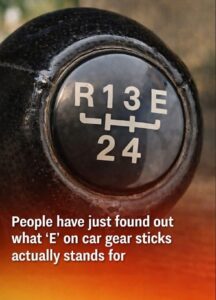
That is exactly why a mysterious letter “E” appearing on certain older gear sticks has sparked confusion, curiosity, and even online debate among modern drivers.
For younger generations especially, the extra letter looked oddly misplaced. Many assumed it must have been connected to emergency driving, electronic systems, or perhaps an early electric vehicle feature. Others joked that it stood for “extra speed” or some forgotten luxury setting. The confusion spread rapidly online as photos of vintage gear selectors circulated across forums and social media platforms, with drivers trying to solve the mystery behind the unfamiliar symbol.
Eventually, experienced motorists and automotive enthusiasts stepped in with the answer.
The “E” stood for “Economy.”
What seemed mysterious at first suddenly became a fascinating glimpse into an earlier era of automotive engineering — a time when fuel efficiency required more direct involvement from the driver and clever mechanical solutions long before modern onboard computers handled everything automatically.
What the “E” Gear Actually Did
In older vehicles equipped with this feature, the “E” mode functioned as an economy driving setting designed specifically to reduce fuel consumption.
At its core, the idea was surprisingly simple.
When drivers selected the “E” setting, the transmission prioritized lower engine revolutions and smoother acceleration patterns. Instead of allowing the engine to rev aggressively and burn more fuel, the system encouraged the vehicle to operate more calmly and efficiently.
In many cars, this meant the transmission would shift gears earlier, keeping engine speed lower during normal driving conditions. On highways or long-distance trips, the effect could noticeably reduce fuel consumption over time.
The feature was particularly useful during periods when fuel prices rose sharply and manufacturers began searching for practical ways to improve efficiency without sacrificing everyday usability.
Unlike today’s highly computerized driving systems, however, older vehicles relied far more heavily on driver awareness and participation. Economy mode gave motorists some control over how the car balanced performance and fuel savings.
Drivers who selected “E” were essentially telling the vehicle:
“Prioritize efficiency over power.”
A Reflection of a Different Driving Era
The forgotten “E” gear represents more than a simple mechanical feature — it reflects an entirely different relationship between drivers and their vehicles.
Older cars demanded greater engagement from the person behind the wheel. Drivers paid close attention to gear changes, engine sounds, fuel consumption, road conditions, and mechanical behavior. Understanding how your car operated was considered an essential skill rather than an optional interest.
Fuel efficiency depended not only on the vehicle itself but also on driving habits.
Smooth acceleration, careful shifting, and proper use of economy settings could make a meaningful difference in fuel consumption, especially during long drives or periods of high gasoline prices.
In that environment, the “E” setting felt practical and forward-thinking.
Rather than simply automating everything invisibly, manufacturers gave drivers tools to actively influence how the vehicle performed.
For many older drivers, features like Economy mode symbolized a more hands-on era of motoring — one where driving felt mechanical, tactile, and deeply connected to the machine itself.
Why the “E” Gear Eventually Disappeared
Over time, however, automotive technology advanced rapidly.
As electronic systems became more sophisticated, the need for a dedicated Economy gear gradually faded away.
Fuel injection systems replaced carburetors. Onboard computers began monitoring engine conditions in real time. Automatic transmissions evolved dramatically, becoming capable of adjusting shift timing, throttle response, and fuel delivery far more efficiently than human drivers ever could manually.
Modern vehicles continuously optimize performance behind the scenes without requiring any special input from the driver.
Today’s cars can automatically:
- Detect driving conditions
- Adjust transmission behavior
- Manage fuel-air mixtures
- Optimize engine timing
- Reduce unnecessary fuel usage
- Shift gears for maximum efficiency
As a result, the original purpose of the “E” mode became largely obsolete.
The concept itself never disappeared — it simply became integrated into the vehicle’s software and operating systems instead of existing as a visible gear selection.
In many ways, modern cars are permanently operating in some form of intelligent economy mode already.
The Evolution of Driver Convenience
The disappearance of the “E” gear also reflects a broader shift in automotive philosophy.
Earlier generations of vehicles required drivers to make more decisions manually. Cars asked for greater mechanical awareness, and many drivers took pride in understanding the technical details of how their vehicles worked.
Modern vehicles, by contrast, prioritize convenience, automation, and simplicity.
Technology increasingly handles complex decisions invisibly so drivers can focus less on mechanics and more on comfort and usability.
This transformation has changed not only how cars function but also how people experience driving itself.
Many younger drivers have never needed to think about engine revolutions, gear ratios, or fuel management strategies because computers now manage those details automatically.
To older enthusiasts, this shift sometimes feels bittersweet.
While modern vehicles are undeniably safer, more efficient, and easier to drive, some argue that automation has reduced the sense of connection between driver and machine that once defined the driving experience.
The forgotten “E” gear has therefore become a nostalgic symbol of that earlier era.
How the Meaning of “E” Changed Completely
Interestingly, the letter “E” has returned to the automotive world — but with an entirely different meaning.
Today, when most people encounter the letter “E” in relation to vehicles, they immediately think of “Electric.”
This shift perfectly captures how dramatically transportation technology has evolved.
Where “E” once represented fuel-saving techniques within gasoline-powered engines, it now increasingly symbolizes the complete transition away from combustion engines altogether.
Electric vehicles have fundamentally changed the concept of driving.
Unlike traditional gasoline cars, many electric vehicles operate without multi-speed transmissions entirely. Instead of shifting through gears, electric motors deliver immediate torque through simpler single-speed systems.
The result is a driving experience that feels smoother, quieter, and mechanically different from older vehicles.
In many modern electric cars, even the traditional gear stick has disappeared.
Buttons, touchscreens, rotary dials, and digital interfaces now replace the familiar mechanical shifters that once dominated vehicle interiors.
The transformation is remarkable when viewed historically.
A single letter that once symbolized fuel conservation inside combustion engines now represents the movement beyond combustion technology itself.
Why the Story Fascinates Drivers Today
Part of what makes the forgotten “E” gear so fascinating is how effectively it captures technological evolution in one small detail.
The feature feels almost like a time capsule from a transitional period in automotive history — a bridge between fully mechanical driving and today’s highly computerized transportation systems.
It also reminds modern drivers how quickly technology changes.
Features that once seemed innovative and practical can become obsolete within a generation, only to return later with entirely new meanings shaped by different technological realities.
For younger drivers unfamiliar with older gear systems, discovering the original “E” mode offers a glimpse into how previous generations interacted with cars in more direct and mechanical ways.
For older drivers, it often triggers nostalgia for a period when driving demanded greater awareness and participation.
Either way, the story highlights how even small details inside vehicles can reveal much larger changes in culture, engineering, and human behavior over time.
The Broader Lesson Behind the Forgotten “E”
Beyond simple automotive trivia, the story of the “E” gear reflects a broader truth about technological progress.
Innovation rarely disappears completely.
Instead, it evolves.
The original purpose behind Economy mode — improving efficiency — never stopped mattering. What changed was the method used to achieve it. Mechanical systems gave way to intelligent automation, and now entire vehicle platforms are shifting toward electric power.
The goals remained similar:
- Reduce energy consumption
- Improve efficiency
- Simplify operation
- Adapt to changing economic and environmental demands
The technology simply became more advanced over time.
In that sense, the forgotten “E” on old gear sticks quietly tells the story of the automotive industry itself — an industry constantly reinventing how humans move through the world.
The Bottom Line
The mysterious “E” once found on older gear sticks was not a mistake, a forgotten symbol, or an obscure driving mode. It stood for “Economy,” a practical fuel-saving feature designed to help drivers reduce fuel consumption during an earlier era of automotive engineering.
By encouraging lower engine speeds and smoother performance, the mode reflected a time when efficiency depended more heavily on driver participation and mechanical awareness.
As automotive technology advanced, computerized systems absorbed those functions automatically, making the dedicated “E” setting largely unnecessary. Yet the letter itself eventually returned with an entirely new identity tied to electric vehicles and the future of transportation.
What began as a simple fuel-saving tool has become a symbol of how dramatically driving technology has evolved across generations.
And perhaps that is what makes the story so compelling.
Sometimes the smallest forgotten details inside old machines reveal the biggest stories about how the world changes over time.