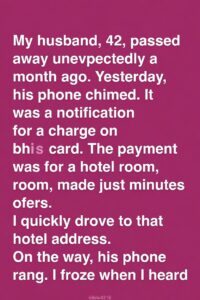
The sound of David’s phone ringing nearly stopped my heart. For a brief second, I forgot he was gone. Instinctively, I glanced toward the hallway expecting him to emerge from his office with that familiar half-smile he always wore whenever work interrupted our evenings. But the house remained painfully silent except for the vibration buzzing across the kitchen counter where his phone still sat charging exactly where I had left it after the funeral.
One month had passed since my husband’s sudden death.
Thirty-one days since the phone call from the hospital.
Thirty-one days since doctors told me that a massive heart attack had taken the healthy, energetic forty-two-year-old man I had loved for more than half my life.
I stared at the screen as the unknown number flashed repeatedly. Normally I ignored calls on his phone, unable to bring myself to disconnect the service yet because hearing notifications somehow made the house feel less empty. But something about this call unsettled me. Maybe it was the lateness of the hour. Maybe it was intuition. Or maybe grief sharpens instincts in strange ways.
My hand trembled as I answered.
“Hey love,” a woman whispered softly. “Are you almost here? The room is ready and I seriously can’t wait to be in your arms again after all this time apart.”
Every muscle in my body froze.
The voice was intimate. Familiar. Comfortable.
Not the kind of voice someone uses accidentally.
I couldn’t speak.
“I know last month scared you,” she continued with a quiet laugh. “But everything’s okay now. I miss you so much.”
The room spun around me.
Before she could say another word, I ended the call.
My breathing turned shallow as I stared at David’s phone like it had transformed into something dangerous. My husband was dead. Buried. Gone forever. Yet some woman somewhere still believed she was in an ongoing relationship with him.
Within seconds, another notification appeared.
A hotel charge.
Paid less than twenty minutes earlier using David’s credit card.
My stomach dropped.
I opened the banking app with numb fingers and saw the transaction clearly listed: a reservation at a mid-range hotel across town. Room 312.
At first, my mind searched desperately for logical explanations. Fraud. Identity theft. Some terrible misunderstanding.
But deep down, another possibility was already clawing its way into my consciousness.
I grabbed my keys before I could talk myself out of it.
The drive to the hotel felt surreal. Streetlights blurred through tears while memories flooded my mind in painful fragments. David teaching our children to ride bicycles. David dancing with me in the kitchen. David kissing my forehead the night before he died and promising we’d finally take that vacation to Italy once things “settled down at work.”
Work.
That word suddenly sounded poisonous.
How many late nights had there really been? How many “business trips” were actually lies? How many moments had I mistaken exhaustion for stress when they were really signs of deception?
By the time I reached the hotel parking lot, I felt physically sick.
The building looked ordinary. Almost offensively ordinary.
Families wheeled luggage through the entrance. A businessman smoked near the curb while checking emails. Soft yellow lights glowed behind the lobby windows.
Yet somewhere inside that building existed a secret life I knew nothing about.
I sat in my car gripping the steering wheel so tightly my fingers ached.
Then David’s phone buzzed again.
A text message.
“David? Everything okay? I’m waiting in 312. Miss you already.”
Another message appeared seconds later.
“And don’t panic. Your wife never suspected anything before. She definitely won’t now.”
That sentence shattered something inside me.
Not just because it confirmed the affair.
But because suddenly every memory from our marriage became contaminated by doubt.
Had everyone known except me?
Was I the fool?
I forced myself out of the car.
Each step toward the hotel entrance felt heavier than the last. My reflection in the glass doors startled me—pale skin, swollen eyes, grief written across every inch of my face.
The receptionist greeted me politely, but I walked straight past her toward the elevators.
I don’t remember breathing during the ride to the third floor.
When I reached room 312, I stood frozen outside the door listening to faint movement inside.
Then I knocked.
At first softly.
Then harder.
The door opened slowly.
A woman stood there staring at me.
She looked around thirty-eight, maybe forty. Dark hair. Simple summer dress. Beautiful in an understated way.
Her expression shifted instantly from anticipation to horror.
“Oh my God,” she whispered.
She knew exactly who I was.
“You’re his wife.”
Not “were.”
Are.
I pushed past her into the room before she could stop me.
The scent hit me first.
David’s cologne.
The exact one I bought him for his birthday last year.
Two wine glasses sat beside the bed. An open suitcase rested near the dresser. A men’s shirt hung neatly in the closet.
Not David’s.
Another man’s, maybe.
Or maybe she had expected him to arrive carrying one.
“I didn’t know he was dead,” she said suddenly behind me, voice trembling. “I swear to you, I didn’t know.”
I turned toward her slowly.
“How long?”
She looked down immediately.
“Three years.”
Three years.
The number echoed violently through my chest.
Three years of lies.
Three years of fake business trips.
Three years of sleeping beside me while loving someone else.
“He told me your marriage was basically over,” she said quietly. “He said you stayed together for the kids.”
I laughed then.
Not because anything was funny.
Because sometimes pain becomes so enormous it escapes as disbelief instead of tears.
“We were planning our twentieth anniversary trip,” I whispered.
Her face crumpled.
“He said he loved you,” she admitted softly. “But differently. He said you were family. Stability. History.”
Family.
Stability.
History.
Words people use for old furniture they no longer appreciate.
I sat heavily in the chair near the window because my legs suddenly couldn’t support me anymore.
She remained standing awkwardly near the bed.
For several minutes, neither of us spoke.
Then quietly, almost apologetically, she reached for her phone.
“There’s something you should probably see.”
I wanted to refuse.
I wanted to run.
But another part of me needed the truth no matter how badly it hurt.
She showed me photographs first.
David smiling beside a lake I’d never visited.
David holding her hand at restaurants during weekends he claimed to be attending conferences.
David laughing in hotel rooms, beaches, airports.
Entire pieces of his life I had never known existed.
Then came the messages.
Hundreds of them.
Thousands maybe.
“I miss you already.”
“I wish I were waking up beside you.”
“She suspects nothing.”
“I’ll leave eventually. Just give me time.”
Each sentence dismantled another piece of the man I thought I knew.
The cruelest part wasn’t even the affair itself.
It was realizing how ordinary I had become to him.
I thought about all the sacrifices marriage demanded over twenty years. Raising children. Managing finances. Supporting careers. Caring for aging parents. Surviving stress and exhaustion together.
Meanwhile another woman received the version of him untouched by responsibility.
The exciting version.
The passionate version.
The version that still felt free.
“Did he love you?” I asked quietly.
She hesitated too long.
“Yes.”
The honesty hurt more than denial would have.
“And you?”
Tears filled her eyes instantly.
“Yes.”
For a moment, the anger inside me shifted unexpectedly into something more complicated.
Because she was grieving too.
Not the same way I was.
But genuinely.
The man who betrayed me had apparently promised her an entirely different future.
We were both victims of the same deception.
Just in different ways.
Eventually she sat across from me and began talking softly about their relationship.
They met during a work conference.
It started as flirting.
Then emotional intimacy.
Then hotel rooms and secret vacations and plans for a life together once “the timing was right.”
“He kept saying he didn’t want to hurt you,” she whispered.
I stared at her in disbelief.
“He already did.”
Silence filled the room again.
I thought about the last evening David and I spent together. We had watched television on the couch while discussing retirement dreams. He rubbed my feet absently while answering emails on his laptop.
At one point he looked at me and smiled.
“You know I love you, right?”
At the time, I never questioned it.
Now I wondered whether guilt inspired those words.
Or whether he somehow truly loved us both.
That possibility disturbed me most of all.
Because life would feel simpler if he had simply been cruel.
Instead, evidence suggested something messier: a flawed man divided between two identities he could no longer reconcile.
When I finally left the hotel, the sun had already begun setting.
The world outside looked unchanged despite the fact my entire reality had collapsed within a single afternoon.
Cars moved through intersections.
People laughed outside restaurants.
Music played faintly from somewhere nearby.
How could life continue normally when mine had just been destroyed twice?
First by death.
Then by truth.
The following weeks became an emotional nightmare.
I searched through financial statements and discovered hidden expenses stretching back years. Hotel charges. Jewelry purchases I never received. Airline tickets connected to “work conferences.”
There was even a separate bank account.
Nothing extravagant.
Just enough to support another life quietly.
The betrayal infected every memory.
Family vacations became suspect.
Late meetings became lies.
Even tender moments now carried uncertainty.
Had he been texting her while holding my hand?
Thinking about her while kissing me goodbye each morning?
I stopped sleeping properly.
Some nights I sat on the floor of his office reading old notebooks and journals searching desperately for clarity.
One entry shattered me completely.
“I love my family more than anything,” he wrote. “But sometimes I feel like I disappeared somewhere inside routine and responsibility. With her I remember who I used to be.”
I read that sentence repeatedly through tears.
Because after the anger faded slightly, another painful truth emerged.
Marriage had changed both of us.
We had become parents, providers, planners, problem-solvers.
Somewhere along the way, maybe we both lost parts of ourselves.
But unlike me, David searched for those missing pieces in another person instead of confronting the emptiness honestly.
That choice destroyed everything.
Telling our children was the hardest conversation of my life.
Our daughter cried immediately.
Our son reacted with fury.
“That’s impossible,” he kept repeating. “Dad wouldn’t do that.”
But eventually evidence outweighed denial.
For months afterward, grief hung over our family in strange complicated layers. We mourned not only the man who died but also the illusion of who we believed he was.
Therapy helped slowly.
So did time.
So did honesty.
The woman from the hotel contacted me occasionally afterward. Not intrusively. Mostly apologies. Shared stories. Small pieces of closure.
Oddly enough, I no longer hated her.
The real damage belonged to the man who created separate realities for both of us.
Nearly two years later, I finally understand something important.
People are rarely entirely good or entirely bad.
David loved our family.
I truly believe that.
But he was also selfish, dishonest, and emotionally cowardly.
Those truths exist together.
The experience changed me permanently.
I became more independent.
More cautious.
But also strangely stronger.
I started traveling alone. Reconnected with old friends. Returned to painting after abandoning it during motherhood. Slowly, painfully, I rebuilt an identity beyond being someone’s wife.
The scar remains.
Some betrayals never disappear completely.
Even now, certain songs or hotel signs can trigger memories sharp enough to steal my breath.
But I survived.
And survival itself became a quiet form of victory.
Sometimes people ask whether I regret loving him.
The answer is complicated.
I regret the lies.
I regret the stolen choices.
I regret the years spent trusting someone who wasn’t fully honest.
But I don’t regret the life that gave me my children, my resilience, and the strength I eventually discovered within myself after everything shattered.
Because in the end, David’s secret double life did not destroy me.
It revealed that even after unimaginable heartbreak, betrayal, and grief, it is still possible to rebuild a meaningful life from ruins you never expected to face.