There are some memories that never truly leave you.
No matter how many years pass, no matter how much life changes, certain moments stay frozen in your mind with painful clarity. For me, one of those moments happened when I was thirteen years old, sitting silently at a dinner table in somebody else’s home, trying desperately not to look too hungry.
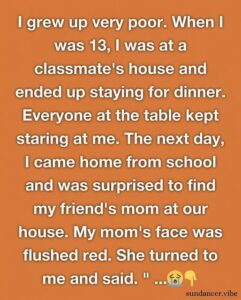
I grew up very poor.
Not the kind of poor where you simply skip vacations or wear hand-me-down clothes. I mean the kind of poor where every bill feels like an emergency, where the refrigerator is often close to empty, and where dinner sometimes means eating whatever scraps can be stretched far enough to feed everyone in the house.
My mother worked constantly. She took every odd job she could find—cleaning homes, folding laundry, helping neighbors with errands, babysitting children late into the evening. She worked herself to exhaustion just to keep a roof over our heads. Still, there were many nights when she quietly claimed she “wasn’t hungry” so I could eat the last serving.
As a kid, you don’t fully understand sacrifice at first.
You just know you’re different.
You notice your classmates buying snacks without checking prices. You notice how casually other families waste food. You notice how embarrassed your mother looks when counting coins at the grocery store checkout.
And eventually, you learn to stay quiet about your needs.
By the time I was thirteen, hunger had become normal to me. I didn’t complain about it anymore. I didn’t even think about it much. It was simply part of life, like cold winters or rainy days.
Then one evening, everything changed because of a dinner invitation.
A classmate of mine named Zara invited me over after school to work on a project together. I almost said no because I hated visiting other people’s homes. It always reminded me of what we lacked.
But she insisted, so I went.
I still remember stepping inside their house and immediately smelling food.
Real food.
Not instant noodles or canned soup stretched across several meals. I’m talking about warm bread fresh from the oven, roasted meat seasoned with herbs, vegetables simmering in butter, and something sweet baking somewhere in the kitchen.
The smell alone nearly overwhelmed me.
I tried not to stare, but when dinner time came and everyone sat around the table together, I couldn’t help myself. Dish after dish kept appearing in front of me. A basket of warm rolls. Thick slices of roast beef. Mashed potatoes with gravy. Bright green beans cooked with garlic.
To most people, it was probably just an ordinary family dinner.
To me, it looked like something from another world.
I remember feeling both amazed and deeply ashamed at the same time. I didn’t know the proper manners for a meal like that. I didn’t know whether I should take seconds. I was terrified of eating too quickly and looking greedy, but I was so hungry it physically hurt.
So I kept my eyes lowered and barely spoke.
The whole time, I could feel people glancing at me.
I thought maybe I’d done something wrong.
The next afternoon, when I came home from school, I froze in the doorway.
Zara’s mother, Ms. Allen, was standing inside our tiny living room speaking quietly with my mom.
My mother’s face was bright red.
The second she saw me, she said softly, “Sit down. We need to talk.”
My stomach dropped instantly.
I thought maybe I’d embarrassed myself at dinner. Maybe I’d eaten too much. Maybe I’d broken some unspoken rule without realizing it.
Ms. Allen turned toward me with a gentle expression.
“I hope this doesn’t embarrass you,” she said carefully. “But I noticed something last night.”
I stared at the floor.
“You looked hungry,” she continued quietly. “Not just hungry for dinner. Hungry in a way a child shouldn’t be.”
I felt heat rush into my face.
Nobody had ever said it out loud before.
There’s something painful about hearing your struggle spoken openly by someone else. Suddenly the thing you’ve spent years hiding becomes real.
My mother cleared her throat awkwardly and wiped at her eyes.
Then Ms. Allen said something I never expected.
“I was wondering if you’d like to come over once a week and cook with me.”
I looked up, confused.
“Cook?” I asked.
She smiled gently.
“Yes. Help me make dinner. Learn recipes. Eat with us. Nothing formal. I just thought… maybe you’d enjoy it.”
Part of me wanted to disappear from embarrassment.
Another part of me felt something I hadn’t experienced in a long time:
Hope.
I glanced at my mother. She looked exhausted but emotional, like she was trying not to cry.
“Only if you want to,” she whispered.
I swallowed hard and nodded.
That single decision changed my entire life.
Every Wednesday after school, I went to Ms. Allen’s house.
At first, I was nervous constantly. I worried they secretly pitied me. I worried I didn’t belong there.
But Ms. Allen never treated me like a charity case.
She treated me like I mattered.
The first day, she handed me an apron and said, “All right, chef. Let’s start with onions.”
And just like that, I became part of the kitchen.
I learned how to chop vegetables properly without slicing my fingers. I learned how to season soup by tasting instead of measuring blindly. I learned how to knead dough, roast chicken, boil pasta, and bake biscuits from scratch.
More importantly, I learned what warmth felt like.
Not just physical warmth from hot meals, but emotional warmth.
The kind that comes from people welcoming you without judgment.
Sometimes Zara would sit on the counter laughing while I concentrated intensely on stirring sauces like my life depended on it. Sometimes Ms. Allen would tell stories while we cooked, explaining why certain recipes reminded her of childhood or family traditions.
For the first time in my life, I felt calm somewhere outside my own home.
Weeks turned into months.
Then months turned into years.
And slowly, something inside me started changing.
I became more confident.
At school, teachers noticed I was speaking up more in class. I smiled more often. I even stood taller somehow.
Cooking gave me pride.
When you grow up poor, you often feel invisible. Like life is happening for other people while you’re just trying to survive.
But creating something beautiful with your own hands changes you.
One evening after we finished baking bread, Ms. Allen asked me a question nobody had ever seriously asked before.
“What do you want your future to look like?”
I shrugged awkwardly.
“I don’t know,” I muttered.
She tilted her head.
“You’re allowed to dream bigger than survival, you know.”
That sentence stayed with me for years.
Because until then, survival was all I’d ever thought about.
Dreams felt like luxuries for richer people.
But Ms. Allen refused to let me think that way.
She started encouraging me constantly. She bought me a small notebook and told me to write down every recipe we made together.
Soon that notebook became my treasure.
I filled it with soups, sauces, roasted vegetables, homemade desserts, seasoning combinations, cooking tips, and little notes about what worked and what didn’t.
I carried it everywhere.
And for the first time in my life, I discovered something incredible:
I was actually good at something.
Not just average.
Not just “trying my best.”
Good.
Ms. Allen noticed it too.
“You have instincts,” she told me one evening while tasting a sauce I adjusted myself. “That can’t really be taught.”
Those words meant more to me than she probably realized.
Because when you grow up poor, people often expect very little from you. Sometimes you even start expecting very little from yourself.
But Ms. Allen saw possibility in me before I could see it myself.
When I turned sixteen, she surprised me with a gift certificate for a culinary workshop run by a local chef.
I nearly cried opening it.
Nobody had ever invested in my future before.
That workshop changed everything again.
For the first time, I met other young people who loved cooking the way I did. I learned professional kitchen basics, experimented with flavors, and started imagining a future that once felt impossible.
Maybe I could become a chef.
Maybe I could own a restaurant someday.
Maybe my life didn’t have to be defined by poverty forever.
During my final year of high school, Ms. Allen helped me apply for a culinary scholarship.
I remember laughing nervously while filling out the forms because I truly didn’t believe someone like me would ever win.
But I applied anyway.
Then one afternoon, after weeks of waiting, I opened my email and froze.
I had received the scholarship.
I screamed so loudly my mother thought something terrible had happened.
Instead, we both ended up crying in the kitchen together.
Then we rushed straight to Ms. Allen’s house.
I’ll never forget the way she hugged me and whispered, “I knew you could do it.”
Years later, after culinary school and countless exhausting shifts working in restaurants, I finally opened my own small place in my hometown.
It isn’t fancy.
But it’s warm.
It smells like fresh bread and garlic and home.
And every time I see someone sitting quietly at a table, unsure whether they belong there, I remember exactly what that feels like.
That’s why I make sure nobody leaves my restaurant hungry.
I also hire teenagers from difficult backgrounds whenever I can. Some remind me painfully of myself at that age—quiet, uncertain, carrying invisible burdens they don’t know how to explain.
I try to offer them what Ms. Allen offered me:
Patience.
Guidance.
A chance.
Because one kind gesture can completely redirect someone’s future.
Looking back now, I realize that dinner invitation was never really about food.
It was about dignity.
It was about being seen.
It was about someone recognizing a struggling child and choosing compassion instead of judgment.
That single act of kindness shaped the entire course of my life.
And if there’s one thing I’ve learned from all of this, it’s that small moments matter far more than we realize.
A meal.
An encouraging word.
A little patience.
A simple opportunity.
Sometimes those things become the turning points people carry with them forever.
So if you ever have the chance to help someone—especially quietly, without making them feel ashamed—do it.
You may never fully understand how much it means.
And if you’re someone struggling right now, please remember this:
Your current circumstances do not define your future.
Sometimes hope arrives in the smallest and most unexpected ways.
For me, it arrived at a dinner table beside a basket of warm rolls and a woman kind enough to say, “Would you like to learn how to cook?”
That invitation changed everything.