The first sign that something inside my father had changed came not through tears, conversations, or dramatic expressions of grief, but through a sound that felt strangely unfamiliar inside our home—the soft, steady hum of a sewing machine late at night.
At first, I thought I was imagining it.
My father was not the kind of man anyone would associate with delicate fabric or careful stitching. He spent most of his life working with heavy tools, repairing engines, fixing broken appliances, and solving problems through practical effort rather than emotional discussion. His hands were rough from years of labor, permanently marked by cuts, grease stains, and tiny scars gathered through long days of physical work.
After my mother died, he changed in ways that were difficult to explain.
Not dramatically.
Quietly.
He became more routine-oriented, more focused on responsibilities, as though structure itself helped him survive the enormous emptiness her absence created. He never spoke much about grief, but grief lived everywhere around him anyway—in the way he paused too long near her photographs, in the exhaustion hidden behind his eyes, in the silence that filled rooms once occupied by her laughter.
Still, he never allowed that grief to interfere with raising me.
He packed lunches every morning.
He attended school events no matter how tired he was.
He learned how to braid hair badly but enthusiastically.
He remembered parent meetings, dentist appointments, birthday traditions, and every small thing my mother used to handle naturally.
He never claimed to replace her.
He simply refused to let me feel abandoned.
That was how my father loved—through action rather than words.
So hearing that sewing machine at night felt almost surreal.
The first time I noticed it clearly, I stood halfway down the hallway listening quietly. The sound stopped suddenly when he realized I was nearby. A few moments later, he stepped out of the spare room carrying an old cardboard box.
“Couldn’t sleep,” he said casually.
I nodded even though something about the explanation felt incomplete.
Over the following weeks, the sound continued.
Sometimes late at night.
Sometimes early in the morning before work.
Always brief.
Always private.
I never pushed him for answers because instinctively I understood that whatever he was doing mattered deeply to him. There was something fragile about the secrecy—not dishonest, but personal in a way that deserved respect.
At the time, I had no idea those quiet nights were connected to me.
Growing up without my mother created absences that were difficult to explain to people who still had theirs. The loss rarely appeared dramatically. Instead, it surfaced in ordinary moments that carried invisible emotional weight.
School dances.
Doctor appointments.
Shopping trips.
Advice about friendships, relationships, and insecurities.
I watched other girls lean naturally toward their mothers for reassurance during milestones that felt confusing or emotional. Meanwhile, I learned how to handle those moments independently, pretending not to notice what was missing because acknowledging it too openly made the loneliness harder to carry.
Eventually, self-protection became habit.
By the time senior prom approached, I had already decided not to expect much from the experience. Most girls in my class spent months discussing hairstyles, limousines, expensive dresses, and elaborate plans. Some of them treated prom like the most important night of their entire lives.
I mostly treated it like an event to survive gracefully.
Money was always tight after my mother passed away. My father worked constantly just to maintain stability, and I understood from a young age that unnecessary expenses created stress he tried hard not to show. Because of that, I became careful about what I asked for.
When prom came up, I planned to borrow a dress from an older cousin and keep things simple.
One evening during dinner, I mentioned the plan casually.
“I think Claire still has her old prom dress,” I said. “I’ll probably just wear that.”
My father looked up immediately.
“No,” he said calmly.
I blinked.
“No?”
“Leave the dress to me.”
I actually laughed at first because the statement felt so unexpected.
“Dad,” I said gently, “you don’t have to—”
“I already have it handled.”
The certainty in his voice stopped me from arguing further.
Still, I assumed he meant he would help me buy something affordable or maybe ask someone he knew for assistance. The possibility that he personally intended to create a dress himself never even crossed my mind.
Over the next several weeks, the sewing machine continued humming behind closed doors.
Fabric occasionally appeared draped across chairs before disappearing again.
Once, I noticed my mother’s old storage chest sitting open inside the spare room.
But I still didn’t fully understand.
Then came the night everything finally made sense.
Prom was only two days away when my father knocked softly on my bedroom door carrying a long garment bag. He looked unusually nervous, shifting his weight awkwardly as though uncertain how I might react.
“I finished it,” he said quietly.
Finished what?
For a moment, I genuinely didn’t understand.
Then he handed me the garment bag.
Something inside me tightened instantly.
My hands trembled slightly as I unzipped it.
The moment I pulled the dress free, the entire room seemed to stop moving.
I could not speak.
The fabric was unmistakable.
Ivory satin softened by age.
Delicate lace along the sleeves.
Tiny embroidered details I remembered seeing years earlier in photographs.
My mother’s wedding dress had been transformed completely.
Not copied.
Transformed.
My father had carefully redesigned it into a prom gown made specifically for me.
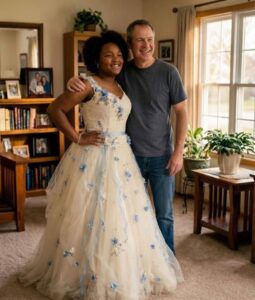
It was beautiful in a way that felt impossible to describe because its beauty came from meaning rather than perfection. The silhouette fit modern enough to feel elegant but still carried subtle traces of my mother’s original gown. Small blue flowers had been hand-stitched carefully along the waistline and shoulders, each one slightly imperfect in ways that made them feel deeply human.
I realized immediately he had taught himself how to do this entirely alone.
Every stitch represented hours of effort.
Mistakes corrected quietly.
Tutorials probably watched late at night after work.
Needles threaded by rough exhausted hands determined to create something meaningful.
My throat tightened painfully.
“Dad…” was all I managed.
He looked suddenly embarrassed.
“It’s probably not professional quality,” he admitted quickly. “I know some parts aren’t perfect. I had to redo the hem twice because I kept messing it up, and the zipper gave me trouble for days—”
I hugged him before he could continue.
Hard.
For several seconds neither of us spoke.
Then quietly against my shoulder he whispered something that nearly broke my heart completely.
“I just didn’t want you to feel like she wasn’t there.”
That was the moment I finally understood what those late-night sewing sessions truly meant.
This wasn’t just a dress.
It was grief reshaped into love.
It was my father finding a way to include my mother in a milestone she would never physically witness.
It was devotion expressed through effort instead of language.
And suddenly, the dress became the most meaningful thing I had ever owned.
The night of prom arrived faster than I expected.
As I stood in front of the mirror fully dressed, emotions hit me in waves. For the first time in years, I didn’t feel defined by what was missing from my life. Instead, I felt surrounded by the people who loved me—even one who was no longer physically there.
I carried both my parents with me.
One through memory.
One through sacrifice.
When my father saw me descending the stairs, he froze completely.
His eyes filled instantly.
“You look just like her,” he whispered.
I smiled through tears.
For a while, prom felt magical in the simple honest way meaningful moments sometimes do. Music echoed through the decorated ballroom while students laughed, danced, and took endless photographs beneath strings of lights. Friends complimented my dress constantly, asking where I found it.
At first, I simply thanked them without explaining.
Then something happened that changed the night.
My English teacher approached during the dance.
Mrs. Ellison had always been known for her sharp tongue disguised as sophistication. She carried herself with the kind of superiority that made students constantly second-guess themselves around her.
She smiled tightly while examining my dress.
“Well,” she said loudly enough for nearby students to hear, “that certainly looks… vintage.”
A few people shifted awkwardly.
I forced a polite smile.
Then she continued.
“It’s almost like something pulled out of another decade entirely. Brave choice for prom.”
The words landed harder than they should have.
Not because they directly insulted the dress itself, but because they reduced everything it represented into something laughable and outdated. Suddenly I felt exposed in the worst possible way, as though my father’s effort and my mother’s memory had become public objects open for judgment.
Heat rushed painfully into my face.
For several seconds, I could not think clearly.
All the confidence I carried into that room began cracking under humiliation and self-consciousness.
Then another voice interrupted sharply.
“That’s enough.”
The entire conversation stopped instantly.
Vice Principal Ramirez stood nearby, expression cold and unmistakably displeased.
“Excuse me?” Mrs. Ellison replied stiffly.
“I said that’s enough,” he repeated firmly.
The tension shifted immediately.
What followed unfolded quickly and publicly enough that everyone nearby understood something larger was happening. Vice Principal Ramirez addressed her behavior directly in a way that suggested this was not an isolated incident. Other faculty members gradually approached. Fragments of conversation revealed complaints, patterns of inappropriate comments, and concerns that had apparently existed long before that evening.
As adults quietly moved Mrs. Ellison away from the dance floor, realization settled over me slowly.
The problem had never been me.
And it certainly was not the dress.
Relief washed through me so suddenly it almost felt physical.
My best friend grabbed my hands immediately afterward.
“Do not let her ruin this night,” she said firmly.
Others nearby began asking about the dress more sincerely now, curiosity replacing judgment.
So I told them.
I explained how my father transformed my mother’s wedding gown by teaching himself to sew in secret after months of work.
The atmosphere changed instantly.
People looked at the dress differently after hearing its story.
Not with pity.
With admiration.
Some students actually teared up listening.
One girl whispered, “That’s the most beautiful thing I’ve ever heard.”
And somehow, from that moment onward, the dress no longer felt vulnerable to criticism.
It had outgrown that entirely.
Because meaning always matters more than appearance once people truly understand what they are seeing.
The rest of the evening passed differently after that.
Lighter.
Warmer.
Freer.
I danced without worrying whether the dress looked fashionable enough. I laughed openly. I allowed myself to exist fully inside the moment instead of shrinking beneath fear of judgment.
By the time I returned home late that night, my father was still awake waiting in the living room.
Of course he was.
He stood immediately when I walked through the door.
For a second, he simply studied my expression nervously.
Then he asked quietly:
“Did the dress hold up okay?”
I smiled instantly.
“It did more than that.”
He looked confused.
So I sat beside him and told him everything.
The comments.
The humiliation.
The intervention.
The conversations afterward.
The way people reacted once they learned the truth behind the dress.
He listened silently the entire time.
When I finished, he looked down at his hands for several moments before speaking.
“I was worried maybe it wouldn’t be good enough,” he admitted softly.
That sentence hurt more than anything else from the evening because it revealed how deeply he doubted himself despite everything he had done for me.
I reached for his hand immediately.
“Dad,” I said carefully, “it was never just a dress.”
And it truly wasn’t.
That gown carried love stitched carefully into every seam.
It carried grief transformed into courage.
It carried memory, effort, sacrifice, and devotion stronger than embarrassment or cruelty could ever diminish.
Years later, I still think about that night often.
Not because of the insult.
Not because of prom itself.
But because it taught me something I have never forgotten:
Love does not need to be flawless to be extraordinary.
Sometimes love looks like rough hands learning delicate work late at night after exhausting shifts.
Sometimes love looks imperfect because real effort always leaves marks behind.
Sometimes the most meaningful gifts are not purchased at all, but created slowly through patience, vulnerability, and courage.