In a world increasingly defined by complex technology, it is easy to overlook the quiet brilliance of simple tools. We are surrounded by devices that demand attention—smartphones, computers, and machines filled with intricate systems and advanced features. Yet, among these innovations, there exist humble objects that perform their function so effectively, so seamlessly, that they almost disappear from our awareness.
One such object is the nail clipper.
Small, affordable, and nearly universal, it is a tool most people use regularly without giving it a second thought. It sits in drawers, toiletry bags, or travel kits, always ready when needed, yet rarely examined. Its design feels obvious, almost inevitable, as though it could not possibly be any other way.
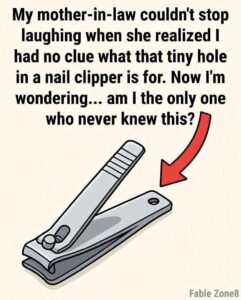
But hidden within its compact form is a small detail that many people never question: the tiny hole at the end of its lever.
At first glance, this feature appears insignificant—perhaps decorative, perhaps incidental. It is easy to assume it serves no real purpose at all. However, this small circular opening is anything but accidental. It represents a convergence of thoughtful design choices shaped by practicality, human behavior, historical context, and manufacturing efficiency.
When examined closely, it reveals something remarkable: even the simplest tools are often the result of layered, intentional design.
A Small Feature With Immediate Utility
The most obvious function of the hole is portability.
Nail clippers are intentionally small, which makes them convenient to carry—but also easy to misplace. The addition of a hole allows the clipper to be attached to a keychain, a hook, or a loop inside a bag. This simple feature transforms it from a loose, easily lost object into something anchored and accessible.
Consider how often small items disappear into clutter. A nail clipper, without a designated place, can easily be forgotten in a drawer or buried in a bag. The hole offers a straightforward solution. By allowing the clipper to be attached to something larger, it reduces the likelihood of loss and increases convenience.
This is a subtle but meaningful shift. It changes the clipper from something that is stored to something that can be carried intentionally. In modern life, where mobility and readiness are highly valued, this small addition enhances usability in a tangible way.
Ergonomics: Designed for Real Hands
Beyond portability, the hole also contributes to how the clipper is used.
For many people, especially those with limited grip strength or dexterity, the hole can serve as an additional point of control. A finger can be inserted through it to stabilize the clipper or improve leverage. This can make trimming nails easier, more precise, and safer.
This benefit is not always immediately obvious, which is precisely what makes it a strong example of thoughtful design. It does not impose itself on every user. Instead, it offers an optional advantage—available when needed, invisible when not.
Good design often works this way. It accommodates a wide range of users without requiring instructions or adjustments. The hole on a nail clipper reflects this principle. It quietly expands the tool’s usability without complicating its form.
A Link to the Past
The presence of the hole is not just practical—it is historical.
Before modern storage habits, people carried essential tools directly on their person. Items such as keys, pocket watches, and grooming tools were often attached to chains or belts. This ensured they were always within reach and less likely to be lost.
Nail clippers were part of this portable toolkit.
The hole made it possible to attach the clipper to a chain, integrating it into a system of everyday carry. In an era when people relied more heavily on physical tools and had fewer places to store them, this feature was not optional—it was essential.
As lifestyles evolved, the need to carry tools in this way diminished. However, the feature remained. Why? Because it continued to provide value.
Even today, many people attach nail clippers to keychains or travel kits. The context has changed, but the function endures.
This continuity highlights an important truth about design: features that solve fundamental problems tend to survive across generations.
Manufacturing Efficiency and Hidden Practicality
While most users think about how a product works in their hands, manufacturers must also consider how it is made.
The hole in a nail clipper can serve practical purposes during production. It provides a convenient point for handling, positioning, or aligning components. It can simplify certain steps in assembly or finishing processes.
These benefits are largely invisible to the end user, but they matter. Efficient manufacturing reduces cost, improves consistency, and ensures reliability. When a single feature can contribute to both usability and production efficiency, it becomes especially valuable.
This dual-purpose design—serving both the maker and the user—is a hallmark of well-engineered products.
The Power of Incremental Improvement
The nail clipper is an example of a design that has reached a state of quiet refinement.
Unlike rapidly evolving technologies, it has not undergone dramatic transformation. Its basic structure has remained largely unchanged for decades. This is not due to a lack of innovation, but rather the success of its existing form.
Each element has been shaped by repeated use, feedback, and small improvements over time. The hole is one of those refinements—a detail that enhances the tool without altering its identity.
This approach reflects a broader philosophy in design: not all progress requires reinvention. Sometimes, the most effective solutions come from small, thoughtful adjustments.
Designed Around Human Behavior
One of the most striking aspects of this tiny feature is how well it aligns with real human behavior.
People misplace small objects.
People value convenience.
People benefit from tools that are easy to handle.
The hole addresses all of these realities directly. It does not rely on idealized assumptions about how people should behave. Instead, it acknowledges how they actually behave and offers a simple, effective solution.
This is what makes the design feel intuitive. It does not require explanation. It simply works.
The Beauty of Invisible Design
There is a paradox at the heart of good design: the better it is, the less we notice it.
The nail clipper exemplifies this idea. Its effectiveness makes it almost invisible. We use it without thinking, rarely stopping to consider how its form supports its function.
The hole is part of this invisibility. It does not demand attention, yet it contributes to the overall experience in meaningful ways.
This kind of design does not seek recognition. It seeks reliability.
A Broader Perspective
The lesson extends beyond nail clippers.
Once you begin to notice small details like this, you start to see them everywhere. Everyday objects are filled with subtle features shaped by years of refinement. Handles are angled for comfort. Surfaces are textured for grip. Components are positioned for efficiency.
These details are easy to overlook, but they are essential.
They represent the accumulated knowledge of designers, engineers, and users—each contributing to the evolution of the object.
Simplicity in a Complex World
In a culture that often celebrates complexity and novelty, there is something refreshing about tools that succeed through simplicity.
The nail clipper does not rely on advanced materials or digital technology. Its effectiveness comes from understanding basic needs and addressing them with precision.
The small hole is a perfect example of this philosophy. It is not flashy. It does not attract attention. Yet it enhances the tool in multiple ways.
This is the essence of thoughtful design.
A New Way of Seeing the Ordinary
The next time you pick up a nail clipper, take a moment to notice that small opening at the end.
It is easy to dismiss it as insignificant.
But it is not.
It is a connection point—between past and present, between user and object, between problem and solution. It reflects a history of use, a response to real needs, and a commitment to efficiency.
In that tiny detail, you can see something larger: the idea that even the simplest tools are shaped by intention.
Final Reflection
The nail clipper’s small hole reminds us that design is not always about what stands out.
Often, it is about what quietly supports us.
It is about solving problems so effectively that the solution becomes invisible. It is about creating tools that feel natural, intuitive, and reliable.