Home security is often imagined as something complex, expensive, and highly technological. People tend to associate safety with alarm systems, surveillance cameras, smart locks, motion sensors, and professionally installed infrastructure designed to detect and deter intrusions. Yet beneath this modern layer of technology lies a long tradition of simple, low-cost household strategies that aim to increase awareness and reduce vulnerability using nothing more than everyday materials.
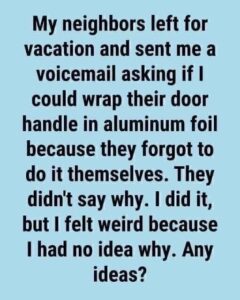
One such idea that has circulated widely in online discussions, home safety communities, and social media spaces is the use of aluminum foil wrapped around door handles. At first glance, the concept seems almost too simple to be meaningful. Aluminum foil is typically associated with cooking, food storage, or basic kitchen tasks. However, this humble material has been repurposed in creative ways, with proponents claiming it can serve as a low-tech alert system for detecting tampering, discouraging opportunistic intrusions, and even improving general awareness of household activity.
The appeal of this method lies not in its sophistication, but in its accessibility. Nearly every home already has aluminum foil available. It requires no installation, no wiring, no configuration, and no financial investment beyond what most households already spend on basic supplies. In a world where home security systems can cost hundreds or even thousands of dollars, the idea that a simple roll of foil could contribute in some small way to peace of mind is understandably attractive.
The basic technique is straightforward. A sheet of aluminum foil is wrapped snugly around an exterior door handle, typically in a smooth layer that conforms to the shape of the handle itself. The foil is not meant to be decorative or loose; instead, it is applied tightly enough that any contact, twisting, or pressure will leave a visible imprint. The homeowner then leaves the foil in place when going to bed, leaving the house, or during extended periods of absence.
When they return, the foil is inspected. If it remains intact and smooth, it suggests that the handle has not been touched. If it is wrinkled, torn, or disturbed, it may indicate that someone has attempted to open or manipulate the door.
On a surface level, the logic is simple: aluminum foil is highly sensitive to deformation. Even minor contact leaves noticeable marks. Unlike some materials that can be reshaped or smoothed without evidence, foil tends to retain the history of its interaction. This property makes it an interesting candidate for visual monitoring in low-risk environments.
Beyond the visual element, there is also an auditory component. Aluminum foil produces a distinct crinkling sound when touched or moved. In theory, this sound could serve as a subtle alert if someone were to attempt to handle the door at night while occupants are nearby. Even if the sound is not loud enough to act as a full alarm system, it may still be noticeable in quiet environments, potentially drawing attention to movement at entry points.
Supporters of this method often emphasize its psychological dimension. Home security is not only about physical barriers but also about perception and deterrence. Many intrusions are opportunistic rather than planned, meaning that visible signs of attention or monitoring can influence decision-making. A door handle wrapped in an unusual material like foil may signal that a homeowner is observant or cautious, potentially discouraging someone looking for an easy, unmonitored entry point.
This concept aligns with a broader principle in security design: deterrence often relies on perceived risk rather than actual resistance. Even simple indicators of awareness can shift behavior. A reflective, crinkled surface on a door handle may suggest that the home is being actively checked, increasing the perceived likelihood of detection.
However, it is important to understand the limitations of this approach. While aluminum foil can provide a basic indicator of disturbance, it is not a replacement for genuine security systems. It does not prevent entry, nor does it alert homeowners in real time if something occurs while they are away or asleep. Its effectiveness depends entirely on the homeowner checking it afterward and interpreting its condition correctly.
In other words, it is a retrospective indicator, not a real-time protective system.
Despite this limitation, the method continues to gain attention because it represents a broader philosophy of resourceful problem-solving. Not every household has access to advanced security infrastructure, and not every situation requires it. In low-risk environments, simple awareness tools can still play a meaningful role in encouraging vigilance and reinforcing good habits.
There is also a hygiene-related interpretation of the foil trick, though this is less commonly emphasized. Door handles are among the most frequently touched surfaces in any home, making them potential points of germ transmission. While aluminum foil itself does not disinfect or sterilize surfaces, some people use it as a reminder mechanism to prompt regular cleaning or awareness of contact points. In this context, the foil serves less as a protective barrier and more as a behavioral cue, encouraging attention to cleanliness and surface hygiene.
Another reason this hack resonates with many people is its psychological reassurance. Homeowners often seek small actions that make them feel more in control of their environment. Even if the practical security benefit is limited, the act of applying a visible marker to a vulnerable point can create a sense of agency. It transforms an abstract concern—“Is my home secure?”—into a tangible, observable condition that can be checked and verified.
This sense of control can be particularly important in times of uncertainty. When people feel vulnerable, they often gravitate toward simple rituals or systems that provide structure and feedback. The foil-wrapped handle becomes a symbolic checkpoint: a way of confirming that nothing has changed during absence.
At the same time, it is important to critically evaluate how much weight should be placed on such methods. Security experts generally emphasize layered protection strategies rather than single-point solutions. A strong door lock, reinforced frame, proper lighting, and community awareness are significantly more effective than any passive indicator. In this context, aluminum foil should be viewed as a supplementary tool at best, not a primary defense mechanism.
One potential risk of relying too heavily on such hacks is false confidence. If homeowners believe they are protected because of a simple visual indicator, they may neglect more important upgrades or fail to recognize actual vulnerabilities. This is why experts often stress balance: low-cost tricks can be useful for awareness, but they should not replace foundational security measures.
Still, the underlying creativity behind the idea is worth acknowledging. Human beings have always used improvised tools to solve practical problems. Before modern security systems existed, people relied on noise, visibility, and simple mechanical signals to detect intrusion. In that sense, aluminum foil is just a modern expression of an old principle: make disturbances visible and noticeable.
There is also a behavioral dimension worth considering. When individuals engage in small protective actions, they often become more mindful overall. Wrapping a door handle in foil may encourage someone to think more carefully about locking doors, checking windows, or noticing unusual patterns around the home. Even if the foil itself is not highly effective, the awareness it promotes may have indirect benefits.
Additionally, the simplicity of the method makes it accessible across different socioeconomic contexts. Not everyone can afford advanced systems, but nearly everyone can participate in basic preventive habits. This democratization of security awareness is part of why such ideas spread quickly online. They offer a sense of empowerment without financial barriers.
However, accessibility should not be confused with sufficiency. A low-cost method is not automatically a complete solution. It must always be understood within context. Homes in high-risk environments require more robust measures, and even in low-risk areas, multiple layers of protection are necessary for meaningful safety.
Another interesting aspect of the aluminum foil method is how it reflects human psychology around uncertainty. People often prefer imperfect information over no information at all. A wrinkled piece of foil is not definitive proof of anything; it could have been disturbed accidentally, by wind, pets, or normal household activity. Yet even ambiguous signals can influence perception and behavior.
This ambiguity can be both useful and problematic. It can prompt awareness and caution, but it can also create unnecessary worry or misinterpretation. Like many low-tech systems, its value depends heavily on how it is used and understood.
Ultimately, the aluminum foil door handle hack is less about the material itself and more about what it represents. It symbolizes a desire for control in uncertain environments, a preference for visible indicators over invisible risks, and a willingness to use simple tools creatively to address complex concerns.
It also highlights an important truth about home security: safety is not always about the sophistication of tools, but about consistency of habits. Locking doors, paying attention to entry points, maintaining visibility around the home, and staying aware of changes in the environment often matter more than any single gadget or trick.
In conclusion, aluminum foil on door handles is best understood as a supplementary awareness tool rather than a true security system. It can provide minor visual and auditory cues, potentially contribute to psychological deterrence, and encourage mindfulness about home safety. However, its real value lies in its simplicity and the broader mindset it reflects—one that emphasizes resourcefulness, attentiveness, and proactive thinking.
When used appropriately and in combination with stronger protective measures, it may serve as a small but interesting reminder that security is often built from layers of awareness rather than reliance on any single solution. In that sense, even something as ordinary as aluminum foil can spark a larger conversation about how we protect our spaces, our routines, and our sense of peace in everyday life.