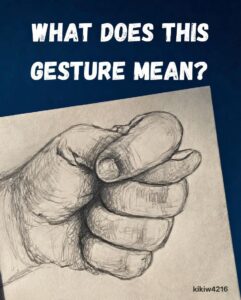
In an age of emojis, reaction buttons, and instant messages, it is easy to assume that modern technology has revolutionized nonverbal communication. Yet long before digital icons allowed people to express emotions with a tap of a screen, entire cultures relied on gestures to convey messages that words could not—or should not—express.
Among the most fascinating of these forgotten signals is an ancient hand gesture known as the “fig” or manus fica.
At first glance, the gesture appears simple enough. The hand forms a fist, but with one distinctive detail: the thumb is tucked between the index and middle fingers. To modern observers unfamiliar with its history, the gesture may seem insignificant or even accidental.
For centuries, however, this small movement carried remarkable power.
Depending on the time, place, and circumstance, the fig gesture could communicate refusal, mockery, protection, fertility, courage, humor, resistance, or spiritual defense.
It was a gesture rich in meaning—one that quietly traveled across empires, religions, villages, marketplaces, and generations before gradually disappearing from everyday use.
Its story offers a fascinating glimpse into how people communicated in a world where words were not always the safest option.
A Gesture Older Than Many Languages
The origins of the fig gesture stretch deep into antiquity.
While historians continue to debate its earliest appearance, evidence suggests that versions of the gesture existed throughout the ancient Mediterranean world.
The gesture became especially prominent in the culture of the Roman Empire, where it was known as manus fica, literally meaning “fig hand.”
To modern ears, the name may seem unusual.
Yet the fig fruit carried symbolic associations throughout the ancient world. It represented fertility, abundance, life, and prosperity. As a result, gestures connected to the fig acquired layers of cultural and spiritual significance.
Ancient societies often believed that symbols could influence unseen forces.
A simple hand movement was not merely symbolic.
It was thought to possess real power.
The fig gesture became one of many protective signs used to guard against misfortune, illness, envy, and supernatural threats.
Protection Against the Evil Eye
Perhaps the most widespread use of the fig gesture involved protection from what many cultures called the “evil eye.”
Across parts of Europe, North Africa, and the Middle East, people believed that excessive envy or malicious attention could cause bad luck, sickness, or hardship.
The belief persisted for thousands of years and remains present in some communities today.
To defend themselves, people employed protective objects and gestures known as apotropaic symbols.
The fig gesture was among the most common.
Many believed the gesture could redirect harmful intentions or repel negative spiritual influences.
People performed it discreetly when encountering someone believed to carry dangerous envy or bad fortune.
Children learned it from parents.
Parents learned it from grandparents.
Generations passed the practice along as a form of everyday protection.
Whether one believes in such supernatural dangers today is beside the point.
The gesture’s historical importance lies in what it reveals about how people understood uncertainty, fear, and personal security.
The Roman Connection
The fig gesture occupied a particularly important place in Roman culture.
During certain religious ceremonies, participants used symbolic hand motions to ward off hostile spirits and maintain spiritual protection.
One notable example involved the festival of Lemuria, an annual observance dedicated to appeasing restless ancestral spirits.
During these rituals, household leaders performed actions intended to protect the family from unwanted supernatural influences.
Historical accounts suggest that protective gestures similar to the fig were incorporated into these practices.
For Romans, the gesture was not merely superstition.
It formed part of a broader worldview in which symbols, rituals, and everyday actions were deeply intertwined.
Religion was not separate from daily life.
It existed within homes, marketplaces, streets, and family traditions.
The fig gesture became one small but meaningful part of that cultural fabric.
More Than Protection
Although many people associate the fig gesture primarily with spiritual defense, its meanings expanded considerably over time.
As the centuries passed, the gesture acquired social and political significance.
It became a way to communicate refusal without speaking.
In societies where direct confrontation could be dangerous, subtle gestures often carried enormous value.
A visible disagreement with a powerful authority figure could result in punishment.
A spoken insult could trigger conflict.
A quiet hand gesture, however, allowed individuals to express themselves with plausible deniability.
The fig became a discreet form of resistance.
It communicated:
- “No.”
- “I refuse.”
- “I disagree.”
- “Not today.”
- “You don’t control me.”
All without requiring a single spoken word.
A Language of Quiet Defiance
Throughout the Middle Ages and into the Renaissance, Europe remained a deeply hierarchical world.
Kings, nobles, clergy, landowners, and local authorities held significant power over ordinary citizens.
In many situations, openly challenging authority carried serious risks.
As a result, nonverbal communication flourished.
Gestures became tools of social navigation.
The fig gesture developed a reputation as a subtle expression of defiance.
A merchant dissatisfied with a deal might make the gesture discreetly.
A peasant frustrated with unfair treatment might use it where only trusted friends could see.
A citizen could communicate skepticism or refusal while avoiding direct confrontation.
Its effectiveness lay in its ambiguity.
Those familiar with its meaning understood the message immediately.
Others might miss it entirely.
This made the fig an ideal tool for expressing resistance in environments where words were dangerous.
Humor, Wit, and Everyday Life
Despite its associations with protection and defiance, the fig gesture was not always serious.
In many communities it carried a playful quality.
Children learned it as a teasing response.
Friends exchanged it jokingly.
Family members used it during harmless disagreements.
Its versatility made it particularly useful.
The same gesture could be:
- Protective
- Humorous
- Defiant
- Symbolic
- Affectionately teasing
Context determined the meaning.
This flexibility helped the gesture survive across centuries and cultures.
Unlike highly specific signs, the fig adapted to different social situations.
People could use it seriously one moment and playfully the next.
Fertility and Symbolic Power
Another intriguing aspect of the fig gesture involves its connection to fertility symbolism.
Ancient cultures frequently linked physical gestures with concepts of life, creation, and prosperity.
The shape of the gesture itself carried symbolic interpretations.
Many historians note that it was sometimes associated with reproductive imagery and life-giving forces.
Because fertility represented survival, prosperity, and continuity, symbols connected to it often acquired protective reputations.
The logic was simple:
Life defeated death.
Growth overcame decay.
Creation resisted destruction.
The fig gesture therefore became associated not only with protection but also with vitality itself.
This combination of meanings helped explain its enduring popularity.
From Gesture to Amulet
The power of the fig extended beyond the human hand.
Across the ancient and medieval world, artisans crafted small amulets shaped like the gesture.
These objects were worn as jewelry or carried for protection.
Materials included:
- Coral
- Silver
- Gold
- Bone
- Ivory
- Wood
Parents sometimes placed fig-shaped charms on children.
Travelers carried them on journeys.
Families kept them in homes.
These amulets demonstrate how deeply the gesture became embedded in everyday life.
It was no longer simply an action.
It had become an object, a symbol, and a cultural tradition.
Regional Variations
As the gesture spread across Europe, its meanings evolved.
In some regions it retained primarily protective associations.
Elsewhere it became mildly insulting.
Certain communities emphasized its humorous qualities.
Others focused on its connection to luck and fertility.
Parts of:
- Italy
- Greece
- Portugal
- Spain
- The Balkans
preserved variations of the gesture far longer than other regions.
Even today, echoes of its historical meanings can occasionally be found in local customs and folklore.
The adaptability of the gesture contributed significantly to its longevity.
Why It Began to Disappear
Like many traditional customs, the fig gesture gradually faded as societies modernized.
Several major changes contributed to its decline.
Urbanization
As populations moved into cities, regional traditions became diluted.
Local customs that once passed naturally from one generation to the next began disappearing.
Education and Literacy
Expanded literacy reduced reliance on symbolic communication.
People increasingly expressed ideas through writing and formal language.
Scientific Thinking
Beliefs surrounding supernatural protection lost influence as scientific explanations became more widely accepted.
New Communication Technologies
The arrival of newspapers, telephones, radio, television, and eventually the internet transformed how people shared ideas.
The need for subtle symbolic gestures diminished.
By the twentieth century, many younger generations no longer recognized the fig gesture’s historical meanings.
The Modern World and Lost Gestures
Today, communication occurs at extraordinary speed.
People can instantly share thoughts across continents.
A single emoji can express amusement, frustration, affection, or sarcasm.
Ironically, modern digital culture resembles ancient gesture systems in one important respect.
Both rely on symbols.
The difference is that ancient symbols were physical.
Modern symbols are digital.
The fig gesture reminds us that humans have always searched for efficient ways to communicate emotions and intentions.
Technology changes.
The underlying need remains remarkably consistent.
Why Historians Still Find It Fascinating
For historians, folklorists, anthropologists, and cultural researchers, the fig gesture represents far more than a curious hand position.
It provides evidence of how ordinary people navigated daily life.
It reveals:
- Popular beliefs
- Social hierarchies
- Folk traditions
- Religious practices
- Psychological coping mechanisms
- Community identity
Small gestures often survive because they meet practical human needs.
The fig endured for centuries because it helped people express feelings that were difficult to communicate openly.
In that sense, it functioned much like modern slang, memes, or reaction images.
The medium changed.
The purpose remained surprisingly similar.
Final Thoughts
The ancient fig gesture may seem like a minor historical curiosity, yet its story reveals something profound about human communication.
With a single movement of the hand, people once expressed refusal, humor, protection, resistance, courage, and hope. It served as a shield against misfortune, a subtle act of rebellion, a playful joke, and a cultural tradition passed from generation to generation.
Although it has largely vanished from everyday life, its legacy survives in folklore, archaeology, literature, and historical memory.
Most importantly, it reminds us that communication has never depended solely on words.
Long before smartphones, social media, and digital reactions, people developed sophisticated ways to share complex emotions through symbols and gestures.
The fig was one of those symbols.
Quiet.
Simple.
Powerful.
And for centuries, understood almost everywhere without a single word being spoken.