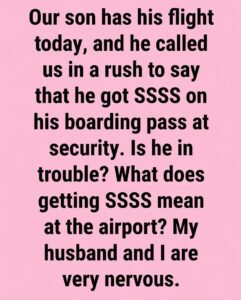
Seeing “SSSS” printed on a boarding pass can feel unsettling at first glance. Four identical letters standing alone on a travel document naturally draw attention, especially in an environment where passengers are already navigating time pressure, security procedures, and tight boarding schedules. The immediate assumption is often that something is wrong or that a problem has been flagged. In reality, however, SSSS simply stands for Secondary Security Screening Selection, a procedural designation used in aviation security systems to indicate that a passenger has been selected for additional screening before boarding.
It is important to understand what this designation is—and what it is not. It is not an accusation, a warning, or a sign of wrongdoing. It does not mean you are under investigation or suspected of anything specific. Instead, it reflects a structured layer of airport security designed to introduce variability and unpredictability into passenger screening processes. Many travelers encounter SSSS at least once in their lives, and for most, it never repeats consistently. It is a temporary checkpoint, not a permanent label.
Understanding how and why it appears can transform the experience from stressful to routine.
What SSSS Actually Means in Practical Terms
At its core, SSSS indicates that a passenger has been selected for additional security screening beyond the standard checkpoint process. This includes extra steps such as manual inspection of luggage, enhanced questioning, and closer review of travel documentation.
The selection is typically generated through automated systems used by aviation security agencies, including the Transportation Security Administration (TSA) in the United States and equivalent bodies in other countries. These systems are designed to evaluate risk patterns while maintaining unpredictability, which is a critical component of modern aviation safety.
Importantly, selection does not imply suspicion. Instead, it reflects a broader security strategy in which some passengers are chosen at random or through algorithmic criteria that are intentionally non-transparent.
This lack of transparency is not accidental—it is part of the system’s design.
Why SSSS Happens: The Logic Behind the Selection
There is no single universal trigger for SSSS. Instead, multiple overlapping factors may influence selection. However, even these factors are not deterministic.
Common contributing elements can include:
- Last-minute ticket purchases
- One-way international itineraries
- Complex or multi-leg travel routes
- Payment methods that differ from typical patterns
- Name similarities with individuals in watchlist databases
- Travel to or from higher-security regions
- System-generated random selection
However, none of these guarantees selection, and none alone define risk.
In fact, many travelers selected for SSSS have completely ordinary travel histories. The randomness is intentional. Security systems rely on unpredictability so that potential threats cannot anticipate or bypass screening logic.
This creates a paradox: the more routine the system is, the less effective it becomes. Randomized selection helps prevent patterns from being exploited.
So when SSSS appears, it is best understood as a procedural outcome of a probabilistic system, not a personal flag.
What Happens During Secondary Screening
Once selected, passengers are typically directed to a secondary screening area before boarding. The process is usually efficient, standardized, and completed within minutes.
It may include:
1. Enhanced Bag Inspection
Carry-on items are manually inspected more thoroughly than in standard screening lanes. Security officers may open bags and examine contents individually.
2. Explosive Trace Detection
Hands, luggage, and electronic devices may be swabbed to detect trace residues associated with explosive materials.
3. Additional Identity Verification
Travel documents may be reviewed more carefully, and basic travel-related questions may be asked.
4. Physical Screening
A more detailed pat-down may be conducted, following standard security protocols.
These steps are procedural rather than investigative. Officers are not gathering personal intelligence; they are following predefined screening requirements.
The entire process usually lasts between a few minutes and roughly fifteen minutes, depending on airport traffic and staffing.
Once completed, passengers proceed to boarding normally, with no additional restrictions.
Why the Experience Feels Stressful (Even When It Isn’t)
The emotional response to SSSS is often stronger than the actual process warrants. This is primarily due to psychological perception rather than procedural complexity.
Three main factors contribute to this reaction:
1. Lack of Explanation
Passengers are rarely told why they were selected, which naturally leads to uncertainty.
2. Visible Singling-Out
Being directed to a separate screening area can create a feeling of being isolated or flagged.
3. Time Pressure
Airports are time-sensitive environments, and any additional step feels amplified under departure deadlines.
Together, these factors can create disproportionate anxiety relative to the actual security procedure.
How Security Systems Are Designed to Work
Modern aviation security operates on a layered defense model. Instead of relying on a single checkpoint, multiple overlapping systems evaluate passengers and baggage through:
- Behavioral pattern analysis
- Travel data review
- Randomized selection
- Intelligence-based screening lists
- Physical checkpoint inspections
SSSS is just one layer in this broader structure.
Crucially, unpredictability is a core principle. If passengers could reliably predict when enhanced screening occurs, the system would lose effectiveness. This is why selection criteria are intentionally opaque.
From a security design perspective, SSSS is less about identifying individuals and more about maintaining system-wide unpredictability.
How to Stay Calm and Prepared if You Are Selected
While SSSS cannot be controlled or predicted, your response to it can be managed effectively.
Arrive Earlier Than Usual
Allow extra time at the airport so that additional screening does not create urgency or stress.
Keep Travel Documents Accessible
Boarding pass, passport, and identification should be easy to retrieve.
Organize Your Carry-On
A well-organized bag makes manual inspection faster and smoother.
Stay Calm and Cooperative
Security procedures are faster and easier when interactions are straightforward and calm.
Avoid Overthinking the Situation
Selection is not an evaluation of behavior or intent. Treat it as a procedural checkpoint.
What SSSS Does Not Mean
It is equally important to understand what this designation does not represent:
- It is not a criminal flag
- It is not a personal investigation
- It is not permanent
- It does not affect future travel rights
- It is not based on suspicion of wrongdoing
- It does not appear because you “did something wrong”
Most importantly, it does not reflect how “risky” or “safe” a passenger is in any meaningful personal sense.
The Emotional Shift: From Alarm to Routine
For many travelers, the first encounter with SSSS feels alarming. But for frequent flyers, it quickly becomes just another procedural variation.
The key shift in perspective is this:
Instead of seeing it as an exception, recognize it as a built-in variation in a standardized system.
Once understood, the experience loses its emotional weight. The same process that initially feels intrusive becomes simply another step before boarding.
After the Screening: Nothing Changes
Once secondary screening is complete, there are no lingering effects:
- No additional checks during boarding
- No impact on your flight
- No follow-up restrictions
- No record affecting your next trip
For most travelers, SSSS is a one-time event or an occasional occurrence that never defines their travel experience again.
By the time you reach your seat on the plane, the entire process is usually forgotten.
Final Perspective: A Small Pause in a Larger Journey
Air travel involves multiple layers of security designed to balance safety with efficiency. Within that system, SSSS represents a brief, structured pause rather than a disruption.
What feels personal in the moment is actually procedural. What feels unusual is often routine at scale.
And what feels stressful at first usually becomes, with understanding, just another quiet step between check-in and takeoff.
In the broader context of your journey, SSSS is not a barrier.
It is simply a momentary checkpoint—one that passes as quickly as it appears, leaving your travel plans unchanged and your destination still ahead.