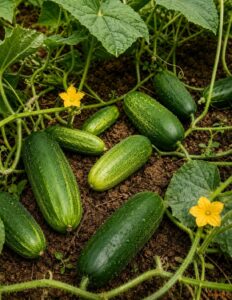
Maya didn’t think much about cucumbers.
They were just there—quiet, green, predictable. The kind of food you never question. In her kitchen, they lived in the lower shelf of the refrigerator beside lemons and herbs, always ready to be sliced into salads or added to sandwiches. Nothing about them suggested mystery.
That was what made everything that followed feel so strange.
It began on a warm summer morning when she prepared a large bowl of cucumber salad for breakfast. She had done it many times before: sliced cucumbers, olive oil, salt, a touch of vinegar, and herbs from her balcony planter. Simple. Refreshing. Safe.
But that morning, something changed.
Within an hour of eating, Maya noticed a discomfort in her stomach—not pain exactly, but a strange heaviness, like her body was processing something unfamiliar. She paused at her desk, waiting for it to pass. It didn’t.
By midday, she felt slightly bloated and unusually tired. She assumed it was coincidence. Maybe she had eaten too quickly. Maybe it was the heat. Still, something about it lingered in her mind.
She decided to ignore it.
The human mind is good at ignoring things that don’t repeat.
So she went on with her life.
The Pattern Begins
Two days later, she made cucumber salad again.
And the same feeling returned.
This time, it was stronger. Not painful, but unmistakable. A sense of internal discomfort paired with a mild fogginess in her thinking. She found herself rereading emails, losing focus in conversations, and feeling oddly sluggish.
That night, she sat on her bed and tried to trace what she had eaten.
Everything else was familiar. Nothing new. No unusual spices. No expired food.
Only one constant remained.
Cucumber.
She laughed at herself for even considering it.
“It’s just a vegetable,” she said aloud.
But the body has a way of continuing conversations the mind wants to end.
Observation
Maya decided to test something simple.
She stopped eating cucumbers.
For three days, her digestion felt normal again. Her energy stabilized. The fog lifted.
She almost dismissed the entire idea as imagination.
Then curiosity pulled her back in.
She reintroduced cucumbers—but in a different form. This time, peeled, washed thoroughly, from a different store. Organic label. Fresh delivery.
Within hours, the symptoms returned.
That was the moment she stopped laughing about it.
She opened her laptop and began searching.
What she found surprised her.
Cucumbers were considered one of the least allergenic foods. They were often recommended for hydration, detox diets, and sensitive stomachs. But buried in medical forums and research summaries, she found scattered reports of rare reactions: digestive sensitivity, mild inflammation responses, and reactions linked not to the cucumber itself, but to compounds on its skin or introduced during farming.
That phrase stood out to her.
Introduced during farming.
Something external.
Something added.
The Journal
Maya started a notebook.
At first, it felt excessive, even dramatic. But she wrote anyway.
Day 1: cucumber salad. mild discomfort.
Day 2: no cucumber. normal.
Day 3: cucumber again. fatigue and bloating.
Day 4: no cucumber. normal.
Patterns emerged quickly.
It wasn’t just digestion. It was energy levels, sleep quality, even mood stability. The days she consumed cucumbers felt slightly “off,” as if her system was working harder than it needed to.
She expanded her tracking.
She tested cucumbers from different sources. Grocery store brands. Farmers’ market produce. Pre-washed packaged slices.
The reaction varied in intensity but never disappeared entirely.
That was when she stopped treating it as a food issue.
And started considering an environmental one.
The Doctor Visit
Maya eventually booked an appointment with a general practitioner.
She explained her findings carefully, expecting reassurance or dismissal.
Instead, the doctor surprised her by listening without interruption.
When she finished, he leaned back slightly.
“You’re not the first person to report unusual reactions to specific vegetables,” he said. “But it’s rarely the vegetable itself. It’s usually what’s on it—or what’s in it at a microscopic level.”
“What do you mean?” Maya asked.
“Pesticide residue,” he said. “Wax coatings. Storage contamination. Sometimes even soil-related compounds that vary from farm to farm.”
He paused.
“And sometimes,” he added, “it’s gut sensitivity that amplifies minor exposures into noticeable symptoms.”
He recommended a controlled elimination diet and basic allergy testing.
But something in Maya’s mind stayed fixed on one phrase.
Farm to farm variation.
That meant inconsistency.
That meant hidden differences.
That meant there was more beneath the surface than appearance suggested.
The Deep Dive
Maya began researching agriculture practices.
At first, it was overwhelming. Terms like “post-harvest treatment,” “fungicide coatings,” and “controlled atmosphere storage” appeared everywhere. The more she read, the more she realized how little she had ever known about the food she considered simple.
Cucumbers, she learned, were often treated with protective coatings to extend shelf life. Some were grown in greenhouse environments with controlled humidity and nutrient systems. Others were sprayed regularly to prevent mold during transport.
None of this was unusual in modern agriculture.
But it introduced variability.
And variability meant unpredictability.
She started comparing suppliers.
One local distributor caught her attention. Their cucumbers were labeled “organic,” but reviews mentioned inconsistent quality and occasional odd textures or bitterness.
Bitterness.
That detail mattered.
Bitterness in cucumbers is sometimes linked to compounds called cucurbitacins, naturally occurring but influenced by stress conditions in the plant. High levels could trigger digestive discomfort in sensitive individuals.
Maya had her first hypothesis.
Maybe it wasn’t an allergy.
Maybe it was stress chemistry in the plant itself.
The Experiment Expands
She decided to run a more structured experiment.
Over two weeks, she sourced cucumbers from four different origins:
- Local supermarket chain
- Organic market supplier
- Imported greenhouse cucumbers
- Small farm stand outside the city
She labeled each batch and consumed them on separate days under controlled conditions.
She recorded everything: timing, symptoms, intensity.
The results were inconsistent but revealing.
The supermarket cucumbers produced the strongest reactions.
The organic ones were milder but still noticeable.
The imported greenhouse batch caused delayed fatigue rather than immediate discomfort.
The farm stand cucumbers produced almost no reaction at all.
That last result changed everything.
Because it suggested the issue wasn’t cucumbers in general.
It was specific sources.
Specific practices.
Specific environments.
The Farm Visit
Maya drove to the farm stand she had purchased from.
It was a small operation on the outskirts of town. Rows of green stretched across modest fields. Nothing about it looked industrial or heavily controlled. A man in his fifties greeted her at the stall.
When she explained her interest, he seemed amused at first.
“You’re telling me cucumbers made you curious?” he asked.
She nodded.
He shrugged.
“Cucumbers are honest plants,” he said. “They only become complicated when people interfere too much.”
That sentence stayed with her.
She asked him about pesticides.
He shook his head.
“No heavy treatments. Just rotation, soil care. We keep things simple.”
She asked about bitterness.
He smiled slightly.
“That depends on stress. Plants don’t like being rushed or overfed. When they’re left to grow properly, they behave better.”
It wasn’t scientific language.
But it was consistent with what she had been reading.
She bought another batch.
The Turning Point
Back home, Maya tested the farm cucumbers again.
No symptoms.
None.
For the first time in weeks, she felt completely normal after eating them.
That should have ended the mystery.
But instead, it deepened it.
Because now the question wasn’t “why do cucumbers affect me?”
It was “why do some cucumbers affect me and others don’t?”
She returned to research with renewed intensity.
What she eventually discovered reframed everything.
It wasn’t just pesticides or stress compounds.
It was the entire chain: soil composition, irrigation practices, storage time, transport temperature fluctuations, and even handling methods after harvest.
Each step introduced microscopic changes.
Not enough to affect most people.
But enough to affect someone sensitive enough to notice.
And Maya, it seemed, was sensitive.
The Body’s Signal
One evening, she sat at her kitchen table looking at her notes.
She realized something important.
Her body had not been reacting randomly.
It had been responding consistently to small variations she had never been taught to notice.
In a way, her discomfort had been information.
Not danger.
Information.
She thought about how easily she had dismissed it at first. How quickly she had assumed it was “nothing.” How many people might do the same without ever investigating further.
Her attention shifted from cucumbers to something broader.
What else was she ignoring?
What else was her body trying to tell her quietly?
Resolution
Maya didn’t stop eating cucumbers entirely.
Instead, she became selective.
She learned which sources worked for her and which didn’t. She adjusted her diet with awareness instead of assumption. She stopped treating food as uniform and started seeing it as variable.
Her journal evolved into something more structured—almost a personal food sensitivity map.
The mystery of cucumbers didn’t end with a dramatic revelation.
It ended with understanding.
There was no single hidden poison.
No conspiracy.
No sudden allergy.
Just complexity hidden inside something everyone assumed was simple.
And a body sensitive enough to notice what most people never would.
Final Reflection
Months later, Maya still thought about that first breakfast bowl.
It hadn’t been dangerous.
It had been informative.
The difference mattered more than she expected.
Because once you notice that ordinary things are not as uniform as they seem, you start paying attention differently—not with fear, but with precision.