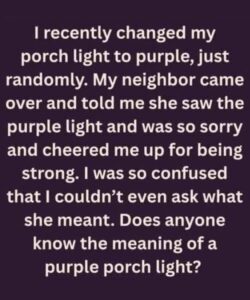
If you have ever walked through a neighborhood after sunset and noticed a house glowing softly in purple, you may have wondered whether there was a special occasion taking place. Unlike traditional porch lights, which are usually warm white or yellow, purple lighting immediately stands out. It captures attention without being overwhelming, creating an atmosphere that feels both peaceful and intentional. For many people, that unusual color sparks curiosity. Why purple? Is it decorative? Seasonal? Personal?
The answer is often much deeper than most people expect.
Across communities around the world, purple porch lights have become meaningful symbols connected to awareness campaigns, advocacy efforts, and messages of support for individuals facing difficult challenges. While the exact meaning can vary depending on the homeowner and the community, purple lighting is most commonly associated with awareness for domestic violence, as well as broader themes of compassion, healing, resilience, and solidarity.
What makes these lights particularly powerful is their simplicity. No speeches are required. No signs need to be posted. No conversations are forced. Yet a single purple bulb can communicate a message that many people immediately understand.
It represents the idea that someone cares.
It signals that difficult issues deserve attention.
And for some individuals, it serves as a reminder that they are not alone.
The growing popularity of purple porch lights demonstrates how small actions can carry significant meaning. In a world filled with constant noise, sometimes the quietest messages are the ones that resonate most deeply.
One of the primary reasons purple porch lights have become so recognizable is their connection to Domestic Violence Awareness Month, observed each October. Domestic violence affects millions of individuals and families across every demographic group, regardless of age, income, education level, or geographic location. Yet despite its prevalence, it often remains hidden from public view.
Unlike many social challenges that occur in public spaces, domestic violence frequently takes place behind closed doors. Victims may feel isolated, frightened, or uncertain about where to seek help. Many endure abuse in silence for years.
Because of this hidden nature, awareness plays a critical role.
Purple has long been associated with domestic violence awareness campaigns. During October, advocacy organizations encourage supporters to wear purple clothing, display purple ribbons, illuminate buildings with purple lighting, and participate in educational events designed to increase understanding of the issue.
The purple porch light emerged as one of the simplest ways for ordinary people to participate.
Changing a light bulb requires very little effort, yet it transforms a home’s exterior into a visible statement of support. It tells survivors that their experiences matter. It reminds neighbors that domestic violence exists in every community. It encourages conversations that might otherwise never occur.
For survivors who see these lights, the impact can be surprisingly meaningful. While a purple porch light cannot solve the challenges they face, it can provide something valuable: recognition.
Recognition matters.
Many survivors struggle with feelings of invisibility. Abuse often thrives in secrecy, making victims feel disconnected from the people around them. Seeing visible signs of awareness within a community can create a sense of belonging and validation.
It communicates a simple but important message:
“We see this issue.”
“We care about it.”
“You are not alone.”
Beyond domestic violence awareness, purple lighting has gradually become associated with a broader range of causes related to health, advocacy, and community support.
In some communities, purple lights are used during awareness campaigns related to epilepsy. Organizations promoting epilepsy awareness often encourage supporters to wear purple and display purple lighting to increase understanding of the condition and reduce stigma surrounding seizures.
Purple is also associated with certain dementia and Alzheimer’s awareness initiatives. Families affected by memory-related illnesses sometimes choose purple lighting as a way to honor loved ones while supporting efforts focused on research, education, and care.
Mental health advocacy has also embraced purple symbolism in many contexts.
Mental health challenges affect people from every walk of life, yet stigma continues to discourage many individuals from seeking support. Purple’s association with understanding, reflection, and compassion makes it a natural symbol for campaigns focused on emotional well-being.
For some homeowners, a purple porch light may represent support for mental health awareness, suicide prevention efforts, or the importance of creating communities where people feel safe discussing their struggles.
The specific meaning may vary, but the underlying themes remain remarkably consistent.
Compassion.
Understanding.
Awareness.
Hope.
These values help explain why the color continues to resonate with so many different causes.
The symbolism of purple itself also contributes to its popularity.
Throughout history, purple has carried unique cultural significance. In ancient civilizations, purple dyes were rare and expensive, making purple garments symbols of prestige, importance, and status. Royal families and political leaders often wore purple because few others could afford it.
Over time, the symbolism evolved.
Purple became associated not only with authority but also with wisdom, reflection, spirituality, and transformation. Modern color psychology often describes purple as a color that combines the stability of blue with the energy of red, creating a balance between strength and calmness.
This balance makes purple especially effective as a symbol for awareness campaigns.
Many of the issues represented by purple lights involve difficult experiences, including trauma, illness, grief, or personal struggle. Purple acknowledges those challenges without focusing exclusively on pain.
Instead, it also symbolizes resilience.
Recovery.
Growth.
The possibility of healing.
A bright red light might feel urgent or alarming. A blue light might seem distant or cold. Purple occupies a unique middle ground. It feels thoughtful, comforting, and dignified.
That emotional quality helps explain why it continues to serve as a powerful visual symbol.
The rise of purple porch lights also highlights an important aspect of community life: people often want to help but aren’t always sure how.
Large-scale social problems can feel overwhelming. Individuals may care deeply about issues such as domestic violence, mental health, or chronic illness yet struggle to identify meaningful ways to contribute.
A purple porch light offers a practical starting point.
It allows participation.
It creates visibility.
It starts conversations.
And perhaps most importantly, it encourages awareness.
Awareness alone is not a complete solution to any major social issue. However, awareness is frequently the first step toward meaningful action.
People are more likely to support resources when they understand a problem.
They are more likely to volunteer when they recognize a need.
They are more likely to intervene when they know warning signs.
They are more likely to show empathy when they understand another person’s experience.
The simple act of displaying a purple light can contribute to that process.
Sometimes a neighbor asks about it.
Sometimes a child becomes curious.
Sometimes a conversation begins that would not have happened otherwise.
Those moments may seem small, but social change often starts with small moments.
Entire communities have embraced purple lighting initiatives as a way of demonstrating collective support.
In some neighborhoods, dozens of homes participate simultaneously during awareness campaigns. Streets glow with a shared purple hue, creating a visual reminder that residents stand together in recognizing important issues.
Schools, community centers, libraries, and local organizations sometimes join these efforts as well. When public buildings participate alongside private homes, the message becomes even more visible.
The result is not merely decorative.
It becomes symbolic.
A neighborhood illuminated in purple sends a message about the values that community wishes to uphold.
Safety.
Respect.
Compassion.
Support.
These initiatives can foster a stronger sense of connection among residents while drawing attention to causes that deserve public discussion.
For many families, however, the decision to install a purple porch light is deeply personal rather than public.
Some have experienced domestic violence firsthand.
Some have supported loved ones through mental health crises.
Some have lost family members to illness.
Some are honoring survivors.
Some are remembering people who are no longer here.
In these cases, the light becomes more than an awareness symbol.
It becomes a personal tribute.
A reminder.
A reflection of a family’s journey.
Visitors passing by may never know the story behind the purple glow, but for those inside the home, its meaning can be profound.
It may represent strength after hardship.
Healing after trauma.
Hope after loss.
Or gratitude for having survived difficult circumstances.
This personal dimension adds another layer to the growing popularity of purple lighting. Not every purple porch light carries the same story, yet many share similar themes of resilience and compassion.
One reason these lights continue to gain attention is that they communicate without requiring confrontation.
Many important social issues are difficult to discuss.
Conversations about abuse, mental illness, trauma, and grief can feel uncomfortable. People often worry about saying the wrong thing or making others uncomfortable.
A purple porch light creates space for awareness without forcing interaction.
It is visible but not intrusive.
Meaningful but not overwhelming.
Those who understand its significance recognize the message immediately. Those who do not may become curious and learn something new.
In that way, purple lighting functions as both a symbol and an invitation.
An invitation to ask questions.
An invitation to learn.
An invitation to care.
As more people become aware of the symbolism, the presence of purple lights continues to expand beyond specific awareness months. What once appeared primarily in October can now be seen throughout the year in many communities.
This reflects a growing recognition that issues such as domestic violence and mental health challenges do not follow a calendar.
Awareness should not disappear when a campaign ends.
Support should not be limited to a single month.
Compassion should not be seasonal.
For many households, keeping a purple light illuminated year-round represents a commitment to these values.
It serves as a constant reminder that kindness matters.
That support matters.
That people facing difficult circumstances deserve understanding rather than judgment.
The next time you notice a purple porch light glowing in the evening, take a moment to appreciate what it may represent.
Perhaps it honors a survivor.
Perhaps it supports a cause.
Perhaps it remembers a loved one.
Perhaps it reflects a family’s values.
Or perhaps it simply serves as a quiet reminder that empathy still exists.
Whatever the specific reason, the growing presence of purple porch lights demonstrates something encouraging about human nature.
People care.
People want to help.
People want others to know they are not alone.
And sometimes, a single light shining in the darkness can communicate that message more powerfully than words ever could.