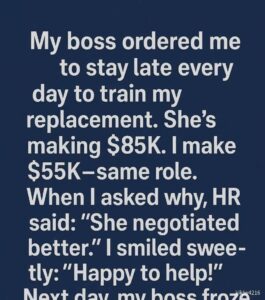
By the end of the first week, I had settled into a routine.
Every morning, I arrived before anyone else, coffee in hand, unlocking systems and reviewing reports that would later become everyone else’s priorities. Sarah would usually arrive a few minutes after me, eager to learn and carrying a notebook already filled with pages of handwritten notes.
I couldn’t blame her.
She hadn’t created the situation.
She had simply accepted an opportunity that any qualified professional might have accepted.
My frustration wasn’t directed at Sarah—it was directed at the leadership team that had decided loyalty was worth less than negotiation.
As the training continued, Sarah became increasingly aware that my responsibilities extended far beyond my official job description.
“Wait,” she said one afternoon while reviewing the monthly reconciliation process. “This isn’t listed anywhere.”
“It isn’t,” I replied.
“Then who normally does it?”
“I do.”
She looked genuinely confused.
“And this client escalation procedure?”
“I created it.”
“The reporting template?”
“Also mine.”
“The automation script?”
“I taught myself enough programming to build it.”
Sarah slowly closed her notebook.
“How many of these processes belong to you?”
I smiled.
“More than anyone realizes.”
For years I had quietly solved problems instead of announcing every accomplishment in meetings.
Whenever software failed, I fixed it.
Whenever a client threatened to leave, I handled the conversation.
Whenever two departments argued over responsibilities, I became the unofficial mediator.
Management praised teamwork.
They rarely acknowledged the individual keeping everything together.
Sarah finally asked the question that had been bothering her.
“Why weren’t you promoted?”
I laughed softly.
“I’ve wondered that myself.”
That evening another anonymous report went to the company’s ethics hotline.
This time it wasn’t only about salary disparities.
I documented the expectation that employees regularly worked unpaid overtime, the inconsistent promotion process, and the lack of transparency surrounding compensation.
Everything was factual.
No exaggeration.
No emotion.
Just dates, emails, performance reviews, and documented responsibilities.
If someone investigated, the evidence would speak for itself.
Meanwhile, my job search was progressing far better than expected.
Within days I had completed three interviews.
One company immediately understood the value of someone who had spent years improving internal systems.
Another recruiter laughed when I described my responsibilities.
“You’re doing the work of two senior analysts,” she said.
For the first time in years, I felt appreciated before even receiving an offer.
Back at the office, small cracks were beginning to appear.
Sarah asked increasingly difficult questions during meetings.
“Why wasn’t this documented?”
“Who approved this workflow?”
“Why wasn’t the salary range shared internally?”
Managers seemed uncomfortable.
My boss, Karen, began checking on our training sessions more frequently.
Everything going smoothly?” she’d ask.
“Perfectly,” I answered every time.
Technically, I wasn’t lying.
Sarah was learning quickly.
Very quickly.
One Thursday afternoon she quietly closed her laptop after another long training session.
“Can I ask you something personal?”
“Sure.”
“If another company offered you a better position tomorrow…”
I smiled.
“I’d probably take it.”
She nodded.
“I think I would too.”
There was a long silence.
Finally she admitted something I hadn’t expected.
“When the recruiter called me, they said the company had struggled to keep people in this role.”
I looked up.
“They never mentioned someone already doing the job.”
That sentence told me everything.
Management hadn’t viewed me as an employee worth retaining.
They had viewed me as someone easy to replace.
Unfortunately for them, replacing a title wasn’t the same as replacing years of knowledge.
The following Monday my phone rang during lunch.
It was the recruiter from my favorite interview.
“We’d like to make you an offer.”
The salary was $102,000.
Better benefits.
Flexible hours.
A signing bonus.
Most importantly…
The hiring manager specifically mentioned my experience building systems rather than simply maintaining them.
Someone had finally noticed what my current employer never had.
I accepted immediately.
But I didn’t resign.
Not yet.
There were still several days remaining in my notice period.
Enough time for one final surprise.
The ethics investigation had officially begun.
HR started requesting documentation from multiple departments.
Managers suddenly became nervous.
People whispered outside conference rooms.
Karen spent more time behind closed doors than at her desk.
Then, on Wednesday morning, Sarah approached my cubicle carrying an envelope.
“I thought you should know.”
Inside was a revised employment contract.
She had negotiated additional protections before officially accepting the position.
Guaranteed annual reviews.
Written promotion criteria.
Compensation transparency.
Limits on mandatory overtime.
“They agreed to all of it,” she said.
I smiled.
“Good.”
She hesitated.
“I wouldn’t have known to ask without you.”
At that moment I realized something important.
Winning wasn’t about revenge.
It wasn’t about embarrassing management.
It was about making sure the next person wasn’t treated the same way I had been.
As Friday approached, Karen called me into her office once again.
This time, however, the confident smile she usually wore was gone.
She looked tired.
Concerned.
Almost uncertain.
She folded her hands across the desk before speaking.
“I hear you’ve accepted another position.”
I nodded.
“Yes.”
“When were you planning to tell us?”
I slid my resignation letter across the desk.
“I figured now was the right time.”
She stared at the paper for several long seconds.
Then came the question I’d been expecting all week.
“Would you consider staying if we matched the salary?”
For the first time in six years…
I didn’t need the answer immediately.
I already knew it.