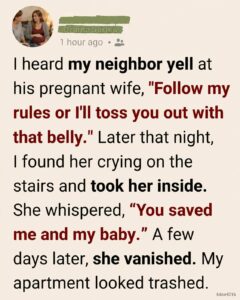
She said, “I—I’m fine,” but her voice cracked at the end, betraying her.
Nobody says that kind of fine when they’re actually fine. Especially not someone sitting on a stairwell at midnight with bruised eyes and a trembling body.
I crouched a few steps below her so I wasn’t towering over her. “You don’t have to be. Not here.”
Her fingers tightened around her stomach like she was holding herself together through sheer force.
“He gets like that sometimes,” she whispered after a long pause.
Sometimes.
The word made something cold settle in my chest.
“How long have you been living with him?” I asked gently.
She hesitated. “Two years.”
“And he talks to you like that often?”
Silence again. Then a small nod.
I didn’t think. I just said it. “You can come stay with me tonight. Just tonight. If you want.”
Her head snapped up. Fear flickered across her face first—fear of him, fear of me, fear of the unknown.
“I don’t want trouble,” she said quickly.
“You won’t get trouble,” I replied. “You’ll get a door that locks.”
That made her cry harder.
It took another ten minutes before she finally agreed. She moved slowly, like every step hurt. I carried a small bag for her—barely anything, just what she could grab in a rush. She kept looking back toward her apartment door like it might open any second.
It didn’t.
When we stepped into my apartment, I noticed how small everything suddenly felt. My safe space, my normal life—it all shrank around her silence.
I gave her the couch. I gave her a blanket. I gave her water.
What I didn’t give her was sleep.
She didn’t sleep at all that night. Neither did I.
At around 3 a.m., I heard her crying softly into the pillow. Not loud. Not dramatic. Just the kind of crying people do when they’ve run out of energy to even make noise.
I wanted to say something comforting, but I didn’t know what words could fix that kind of fear.
So I just stayed awake.
The next morning, she looked worse. Pale, exhausted, but calmer in a distant way.
“I should go back before he notices,” she said immediately.
“That’s not safe,” I told her.
“It’s worse if I’m gone.”
That line stayed with me.
Worse if I’m gone.
She didn’t explain what she meant, and I didn’t push. But I started to understand that fear like hers didn’t behave logically. It followed rules I didn’t know.
Over the next few days, she stayed.
Just “a few days,” she said.
I told myself I was helping. I told myself it was temporary.
But the building around us began to feel different.
At first, it was small things.
Footsteps in the hallway when no one was there.
A door downstairs closing too slowly.
The neighbor’s apartment upstairs going silent whenever I entered the hallway, like someone was listening.
She noticed it too.
“He’s watching,” she whispered one afternoon without looking up from her hands.
“From where?” I asked.
“Everywhere.”
I wanted to tell her it was paranoia, trauma talking. But something about the way she said it didn’t sound like fear.
It sounded like certainty.
On the fourth night, I woke up to the sound of knocking.
Not on my door.
On the wall.
Three slow taps.
Pause.
Three more.
I sat up in bed.
The knocking came again.
She was sitting in the dark on the couch, wide awake.
“He knows I’m here,” she said quietly.
I got out of bed and pressed my palm against the wall separating our apartments. The wall was thin, cheap, old.
Nothing.
No movement.
No sound.
Just silence.
But the silence felt intentional.
The next morning, I went to check the hallway camera the landlord had installed years ago. It barely worked, but it recorded motion.
The footage from the previous night was gone.
Completely erased.
When I asked the landlord about it, he shrugged. “System glitches. Happens.”
That was the moment something inside me shifted from concern to unease.
Because systems don’t usually “glitch” on nights like that.
She started asking questions after that.
“Do you ever hear things in your walls?” she asked.
“Sometimes. Old building.”
She shook her head. “Not like this.”
Not like this.
A few nights later, she disappeared.
Just like that.
I woke up and the couch was empty. The blanket was folded neatly. Her shoes were gone.
At first, I thought she had gone back to him.
Then I noticed my front door was still locked from the inside.
And the window in the kitchen was open.
Not wide. Just enough.
I checked the hallway. Empty.
Upstairs. Nothing.
His apartment door was shut.
Too shut.
Like it hadn’t moved in days.
I knocked.
No answer.
I knocked again.
Still nothing.
Something was wrong.
I called out her name outside his door. My voice sounded too loud in the hallway.
Then I heard it.
A faint sound from inside.
A dragging noise.
Then silence.
I went back into my apartment and waited.
Hours passed.
No one came out.
No one went in.
But at 2:17 a.m., I woke up to find my apartment door open.
Not forced.
Not broken.
Just… open.
The air inside felt different.
Heavier.
The lights in my living room were on.
I hadn’t turned them on.
My stomach dropped.
I stepped inside slowly.
Everything looked normal at first.
Too normal.
Then I noticed the couch.
It wasn’t in the same position.
The rug was turned slightly.
The kitchen chairs were rearranged.
Someone had been inside.
Not just inside.
Living.
My heart pounded as I checked room by room.
Nothing.
No one.
But when I reached the bedroom, I stopped.
There was a message on the mirror.
Written in something dark.
Not paint.
Not marker.
Something thicker.
It said:
“YOU SHOULDN’T HAVE TAKEN HER.”
My breath caught.
The apartment felt like it was shrinking around me.
I turned around fast—
No one there.
But I wasn’t alone.
I started locking every door, every window, hands shaking so badly I dropped my keys twice. I called the police, but the line went dead halfway through the call.
Signal issue.
Or something worse.
I don’t know.
By morning, I convinced myself I had imagined it. Stress. Lack of sleep. Fear filling in gaps.
Then I saw the second message.
On my kitchen wall.
Behind the fridge.
Something I couldn’t have missed before unless it wasn’t there before.
“SHE LEFT BECAUSE YOU LET HER.”
That was the moment I realized something terrifying:
Someone had been moving through my apartment while I was inside it.
And I hadn’t noticed.
I left the building that day.
Stayed at a friend’s place.
I told myself I’d come back when I felt safer.
But safety didn’t follow me.
Because two days later, I got a call from the landlord.
His voice was shaky.
“You need to come see your apartment,” he said.
I didn’t want to.
But I went.
The hallway looked normal.
The building looked normal.
That’s what made it worse.
Normal things shouldn’t feel wrong.
He opened my door for me.
I stepped inside.
And stopped breathing.
My apartment was not my apartment anymore.
The furniture was gone.
Not moved—gone.
The walls were covered in notes, paper, photographs, fragments of something I didn’t recognize at first.
Then I saw her face.
Dozens of pictures of her.
Sleeping.
Crying.
Sitting in my living room.
Pictures I never took.
Pictures that shouldn’t exist.
And in the center of the living room floor was something carefully placed.
A small hospital bracelet.
Her name on it.
And beneath it, a note:
“SHE NEVER LEFT THE BUILDING.”
My knees nearly gave out.
The landlord backed away slowly. “I didn’t do this,” he said.
I believed him.
Because whoever did this knew my apartment better than I did.
And that meant they had been inside long before I ever let her in.
That night, I stayed in a hotel.
I didn’t sleep.
Because every time I closed my eyes, I heard knocking.
Three taps.
Pause.
Three taps.
The same rhythm as before.
From the wall.
From everywhere.
And now I understand something I didn’t want to understand before.
She wasn’t the only one being watched.
Neither was I.
And whatever had been living in those walls…
wasn’t done yet.