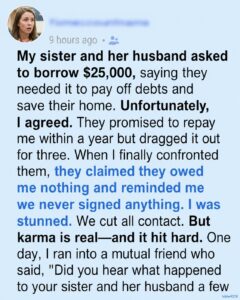
It didn’t feel like a decision at the time.
That’s the part I keep returning to when I think about it later—the way it started with something that looked like urgency rather than risk, like helping rather than lending, like family rather than a transaction.
My sister called me on a Thursday evening when I was halfway through making dinner. I remember the sound of the stove clicking in the background while I balanced the phone between my shoulder and ear, chopping vegetables without really paying attention to the size or shape of anything I was cutting.
Her voice was different immediately. Tight. Controlled. The kind of tone people use when they’ve already rehearsed what they’re going to say and are just hoping you don’t interrupt before they finish.
“We’re in trouble,” she said.
That was the opening line. No greeting, no small talk. Just the weight of it dropped straight into the conversation.
I stopped chopping.
“What kind of trouble?” I asked.
She explained it in pieces. Debt. Missed payments. Interest stacking faster than they could manage. Her husband’s hours reduced. A temporary fix that had turned into a permanent gap. The mortgage falling behind. Penalties accumulating.
And then, finally, the number.
Twenty-five thousand dollars.
She said it like it was already partially agreed upon, like the conversation was just a formality before I confirmed what she had already assumed I would do.
“We just need a bridge,” she added quickly. “A year, maybe less. We’ll pay you back. We promise.”
Promises are strange things when they come wrapped in desperation. They sound more like emotional guarantees than financial ones.
I remember looking at the vegetables on the cutting board, suddenly unsure why I had been preparing food at all, as if the normal rhythm of my evening had been interrupted by something that didn’t belong in it.
Twenty-five thousand is not a casual number. Not for me. Not for them either, which is why it carried the emotional weight it did.
We talked for almost an hour. I asked questions. They answered quickly, sometimes too quickly. I asked about repayment plans, timelines, income adjustments. They kept returning to the same idea: temporary setback, guaranteed recovery, just help us get through this moment.
At some point in the conversation, the financial details stopped feeling like the center of it. What remained was something older and harder to refuse—family obligation, shared history, the unspoken expectation that if I could help and didn’t, it would say something about who I was.
By the end of the call, I agreed.
I told myself it was a loan.
But the truth is, I didn’t structure it like one. There was no contract. No formal repayment schedule. No interest. Just a bank transfer and a set of verbal promises that felt solid in the moment because I wanted them to be.
When I hit “send,” I remember staring at the confirmation screen longer than necessary, as if waiting for it to undo itself.
It didn’t.
The first few months after that were normal in the way borrowed money always makes things feel temporarily normal. There were updates—occasional messages, reassurances, mentions of progress. Small payments never came. Instead, there were explanations. Unexpected expenses. Delays. One step forward, two steps stabilizing.
I told myself I was being patient.
But patience slowly started to feel like absence of structure.
Six months passed. Then eight. Then ten.
The updates became less frequent. The tone changed. Less urgency, more avoidance. Less explanation, more vagueness.
By the end of the first year, I stopped hearing anything unless I initiated it.
When I finally asked directly about repayment, the response was immediate and defensive.
“We never signed anything,” my sister said.
I remember reading that message twice before it fully registered.
Not “we can’t pay yet.” Not “we need more time.” Not even “we’re struggling.”
Just a procedural denial of obligation.
As if the absence of paperwork erased the existence of memory.
I called her after that. The conversation didn’t last long. Her husband joined halfway through, his tone sharper, more final.
They repeated the same idea in different forms: no contract, no legal obligation, no enforceable debt. Help had been given voluntarily, therefore it could not be demanded back.
I remember sitting on my couch after the call ended, holding the phone loosely in my hand while the screen dimmed and locked itself, as if even the device was done participating.
What hurt wasn’t just the money.
It was the shift in narrative. The way something that had been framed as trust suddenly got redefined as generosity I had no right to revisit.
That was the moment I stopped speaking to them.
Not dramatically. Not with a final message or declaration. Just gradually, by removing myself from every channel of contact until silence became the default.
Family gatherings continued without me. Photos circulated through mutual relatives. Updates arrived indirectly, like weather reports from a place I no longer lived in.
At first, I expected guilt to soften over time. That’s what people usually say happens—that distance makes things easier.
Instead, clarity sharpened.
Three years passed.
Three years of no contact. No repayment. No acknowledgment beyond occasional indirect references through others.
And then, on an ordinary afternoon in a grocery store parking lot, I ran into someone I hadn’t seen in a while—a mutual friend from years back.
The conversation started normally. Small updates, life summaries, polite catching up.
And then, without any dramatic setup, she said, “Did you hear what happened to your sister and her husband?”
The way she said it wasn’t malicious. More like reluctant disclosure, the kind people deliver when they’re unsure whether you already know.
I hadn’t heard anything.
She hesitated before continuing, choosing words carefully.
There had been financial trouble again. Worse this time. A business arrangement that collapsed. A refinancing attempt that failed. Accounts frozen temporarily due to unresolved obligations. Pressure from lenders. Legal consultation fees stacking faster than they could manage.
Nothing cinematic. No single dramatic collapse. Just a slow tightening of constraints until options disappeared one by one.
“They had to sell the house,” she said finally.
That landed quietly. Not like shock. More like confirmation of something that had been unresolved in the background for a long time.
I didn’t respond immediately. I wasn’t sure what response would even fit.
There was no satisfaction in it. No clean emotional resolution. Just a strange sense of continuity, as if the story had simply moved forward without asking permission.
The friend added, more softly, that they were staying with relatives now, trying to rebuild, keeping a low profile.
I nodded, thanked her for telling me, and the conversation shifted quickly after that into safer topics.
But the rest of the day didn’t shift with it.
Later that evening, I found myself thinking about the original phone call. The urgency in her voice. The certainty that repayment would be simple. The ease with which I had agreed.
And I thought about the phrase she had used when she refused repayment.
“We never signed anything.”
At the time, it felt like an erasure of obligation.
Now it felt more like an erasure attempt of history.
Because nothing about those twenty-five thousand dollars had ever been abstract to me. It had been real the moment it left my account. Real in the adjustments I made afterward. Real in the choices I delayed. Real in the quiet recalibration of my own financial safety net.
The absence of paperwork didn’t change that reality.
But it had changed something else: trust.
Months later, I received a message from another relative. Short. Neutral.
My sister wanted to reconnect.
No apology attached. No reference to the past. Just a request to “move forward.”
I didn’t respond immediately.
Instead, I sat with it for a long time, considering not just the message but everything that had led to it—the loan, the silence, the denial, the years in between.
Eventually, I wrote back.
Not angrily. Not coldly.
Just clearly.
I told her I hoped things were improving. I acknowledged what had happened without reopening it. And I said I wasn’t in a place to return to what we had before.
Then I stopped.
Not out of punishment. Not out of revenge.
But because I had already learned what I needed to learn the first time.
Some debts are not enforced by contracts.
They’re enforced by memory.