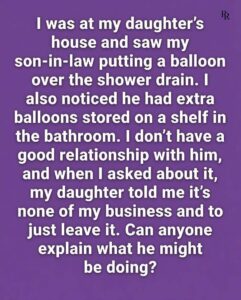
At first glance, it feels like one of those ideas that should work.
Simple. Cheap. Immediate. The kind of fix that spreads quickly online because it looks like it solves a problem without requiring tools, knowledge, or effort. A balloon stretched over a shower drain is one of those suggestions that sounds almost clever enough to be true.
But household problems rarely respect simplicity.
Especially not pests.
Bathrooms are not neutral spaces in a home. They are active environments—warm, damp, and constantly connected to hidden infrastructure that most people rarely think about. Pipes, vents, cavities inside walls, and drainage systems form a network that runs behind surfaces and underneath floors. To insects, this isn’t “plumbing.” It’s access.
And that is the first misunderstanding behind the balloon trick: it assumes pests are entering through a single obvious point, when in reality entry is distributed across multiple weak spots in the structure of the home.
A drain might be one of them. But it is rarely the only one.
Why bathrooms attract pests in the first place
To understand why a balloon doesn’t solve the problem, you have to start with why pests appear in bathrooms at all.
Most insects and small pests that show up in these areas are not random visitors. They are responding to conditions that already exist:
Moisture is the biggest factor. Constant humidity from showers, condensation, and slow-drying surfaces creates an environment many insects depend on for survival or reproduction. Drain flies, for example, thrive in organic buildup inside pipes where moisture is constant and food sources accumulate invisibly.
Warmth matters too. Bathrooms retain heat longer than other rooms, especially after hot water use. That warmth creates a stable environment that pests can rely on, particularly in colder months when other parts of a building become less hospitable.
Then there is access to organic material. Hair, soap residue, skin particles, and mildew all accumulate in drainage systems. To a human, it’s residue. To insects, it’s food.
So when pests appear in a bathroom, it’s rarely because they “found a way in” from outside. It’s often because they were already inside the plumbing ecosystem or nearby structural voids and simply expanded into visible space.
The illusion of a single-entry problem
The balloon method assumes a linear problem: pests come through drain → block drain → pests stop.
But buildings are not linear systems. They are interconnected networks with redundancy built in for water flow, air pressure, and drainage. That redundancy is exactly what makes them vulnerable to pests.
Even if a drain were perfectly sealed, which a balloon cannot realistically achieve, it would only address one possible exit or entry point in a much larger system.
Pests don’t need the main opening. They use:
Small cracks around pipe penetrations in walls
Gaps in tile grout or silicone seals
Air gaps in ventilation systems
Improperly sealed floor edges
Drain overflow channels
Shared plumbing vents between units
And in multi-unit buildings, the problem expands further because plumbing systems are often connected vertically or laterally. What appears in one bathroom can originate in another apartment entirely.
This is why pest control professionals rarely focus on a single fixture. They look at the entire structural environment.
Why viral hacks like balloons feel convincing
There is a psychological reason these ideas spread.
They offer control.
Pest problems are frustrating because they feel invasive and unpredictable. A simple visual fix—a barrier, a cover, a plug—creates the illusion that the problem can be physically contained with minimal effort.
A balloon is especially appealing because it looks airtight. It stretches. It seals. It conforms to shape. On the surface, it resembles a professional plug.
But materials matter more than appearance.
Latex or rubber balloons are not designed for constant moisture, chemical exposure from cleaning products, or temperature variation. Over time, they degrade, slip, or lose tension. Even when initially tight, they rarely maintain a consistent seal against irregular plumbing surfaces.
More importantly, they do nothing to address biological buildup inside the pipe itself.
If the source of the pest activity is within the drain system—such as organic sludge or standing water—a surface barrier does nothing to stop reproduction. It only blocks visibility.
What’s actually happening inside drains
To understand the failure of the balloon method, it helps to look at what is happening inside the plumbing itself.
Drain systems are not dry conduits. They retain moisture in bends and traps. Over time, microscopic layers of organic matter accumulate along the inner surfaces. This creates a biofilm—a thin, sticky layer that can support microbial and insect life.
Certain pests, particularly small flies often found in bathrooms, lay eggs in this environment. The larvae develop inside the film, feeding on the organic material.
This means the source of the infestation is not the visible opening of the drain, but the interior ecosystem of the pipe.
Covering the top of the drain does not eliminate that ecosystem. It only blocks external airflow or movement at the surface level.
In some cases, sealing a drain too tightly without addressing internal buildup can even trap odors or moisture, creating conditions that continue to support pest activity behind the seal.
Why moisture control matters more than barriers
If there is a single factor that consistently determines whether pests persist in a bathroom, it is moisture management.
Without excess moisture, most of the environments pests rely on collapse naturally.
This is why professional approaches often prioritize drying, ventilation, and cleaning over physical blocking methods.
Improving airflow in bathrooms reduces humidity levels. Ensuring that exhaust fans function properly prevents moisture accumulation after showers. Fixing slow leaks or dripping fixtures removes hidden water sources that pests can depend on.
Even simple habits like leaving the shower door open after use or wiping down excess water can reduce the microenvironments that pests need.
None of these are dramatic solutions. They don’t go viral. But they address the actual conditions pests rely on.
Entry points beyond the drain
One of the most overlooked aspects of household pest control is how many entry points exist outside of plumbing.
Pests are remarkably efficient at exploiting small structural weaknesses.
A gap of just a few millimeters can be enough for certain insects to pass through. Over time, buildings develop these gaps naturally due to temperature changes, settling, or wear.
Common entry points include:
Unsealed gaps where pipes enter walls
Cracks in tile or grout lines
Loose floor trim or baseboards
Window and door seals
Ventilation openings without proper screening
In many cases, pests entering a bathroom are not originating from the drain at all. They are moving through wall voids or floor spaces and simply emerging in the bathroom because the conditions are favorable.
This is why sealing a single drain does not interrupt the overall movement pattern.
The role of maintenance versus improvisation
The appeal of hacks like a balloon drain cover is that they bypass maintenance. They suggest that a problem can be solved without inspection, cleaning, or repair.
But structural issues rarely respond to improvisation.
Bathrooms, like all water-connected spaces, require ongoing maintenance because they are inherently dynamic systems. Pipes age. Seals degrade. Moisture fluctuates. Materials shift.
Pest prevention in such environments is less about one-time fixes and more about consistency:
Regular cleaning of drains to remove buildup
Inspection of seals and grout lines
Ensuring proper ventilation
Addressing leaks quickly
Using appropriate drain traps or strainers designed for plumbing systems
These measures don’t just prevent pests. They maintain the integrity of the system itself.
Why real solutions feel less satisfying
One reason viral hacks persist is that real solutions often feel underwhelming.
Cleaning a drain does not feel as decisive as sealing it with a visible barrier. Checking ventilation does not feel as immediate as physically blocking an opening. Maintenance lacks the emotional finality that hacks provide.
But effectiveness rarely aligns with satisfaction.
A balloon gives the impression of control. Maintenance provides actual control—but it is distributed across time and effort rather than concentrated in a single action.
The deeper misunderstanding: symptoms vs systems
Ultimately, the balloon trick fails because it treats a system-level issue as a surface symptom.
Pests in bathrooms are not a drain problem. They are a conditions problem.
The drain is simply where the conditions become visible.
Moisture, access, organic buildup, structural gaps—these are the real variables. Addressing one visible point without adjusting the surrounding system is like plugging a leak without turning off the water pressure.
It might slow the symptom temporarily. But it does not resolve the cause.
What actually works instead
Effective pest prevention in bathrooms tends to follow a layered approach:
Reducing moisture through ventilation and drying
Cleaning drains to remove organic buildup
Sealing structural gaps around plumbing and fixtures
Maintaining grout, caulking, and trim integrity
Ensuring proper airflow and drainage function
In persistent cases, professional inspection may be necessary to identify hidden pathways or structural issues that are not visible at surface level.
None of these solutions are as instantly appealing as a balloon. But they work because they address the environment rather than the symptom.
Final thought
The balloon over the drain is a symbol of something broader: the desire for simple fixes to complex systems.
But homes are systems. So are pest problems. And systems don’t respond to shortcuts in isolated places.
They respond to structure, maintenance, and consistency.
And once that is understood, the balloon stops looking like a solution—and starts looking like what it always was.
A temporary cover over a much larger issue.