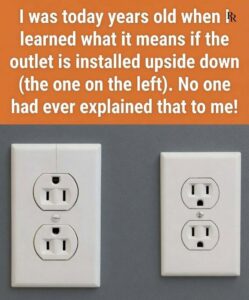
If you’ve ever noticed a wall outlet with the ground hole positioned at the top instead of the bottom, it can look like a mistake at first glance. Many homeowners assume it was installed incorrectly or flipped by accident. In reality, this orientation is often intentional and can reflect a range of practical, historical, or regional reasons.
The standard orientation in many countries places the two vertical slots above the round grounding hole. However, electricians sometimes install outlets in the opposite direction depending on the situation or preference.
One of the most common explanations is safety awareness. In certain settings—such as workshops, garages, or commercial environments—installing an outlet with the ground pin facing upward can slightly reduce the chance of a metal object falling across the live contacts and causing a short circuit. While this doesn’t eliminate risk entirely, some electricians consider it a small added precaution in specific environments.
Another reason is identification of special wiring or switched outlets. In some older homes or custom electrical setups, an outlet may be connected to a wall switch that controls power to one or both receptacles. Electricians occasionally use a reversed orientation as a visual cue to distinguish these outlets from standard ones nearby. For example, a lamp might be plugged into a switched outlet so it can be turned on and off using a wall switch.
However, this practice is not a universal standard, and it should not be relied on as proof of how an outlet is wired. The orientation alone does not guarantee that an outlet is switched, grounded differently, or wired for a specific purpose. The only reliable way to know is by testing the outlet or inspecting the wiring.
In many cases, the reason is much simpler: installer preference or local convention. Electrical codes in many regions allow either orientation as long as the outlet is installed safely and correctly. Some electricians are trained to install them one way, while others prefer the opposite based on experience, habit, or customer request.
There is also a practical installation reason. When multiple outlets are installed in a row, flipping one may help align wiring paths behind the wall or reduce strain on internal connections depending on how the cables are routed. While this is not always necessary, it can sometimes make installation cleaner or more efficient.
Importantly, modern electrical standards in many countries do not require a specific “right-side-up” orientation for standard duplex outlets. As long as grounding, polarity, and safety requirements are met, either position is generally acceptable.
That said, homeowners should not assume that an upside-down outlet automatically indicates a special function. If you are unsure whether an outlet is switched or wired differently, it’s best to test it using a plug-in device or consult a licensed electrician rather than relying on appearance alone.
In the end, what looks like a mistake is often just a variation in practice. The “upside-down” outlet is less about hidden meaning and more about flexibility in installation, personal habit, and occasional functional design choices. While it may catch your eye, it rarely signals anything dangerous on its own.