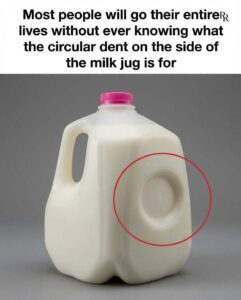
Most people open a gallon of milk without giving the container a second thought. The handle makes it easy to carry, the cap seals the contents, and the plastic body simply does its job. Hidden within this familiar design, however, is a small feature that demonstrates how thoughtful engineering can solve multiple challenges at once. The circular indentation often found on the side of plastic milk jugs may appear insignificant, but it represents decades of refinement in packaging design.
At first glance, the indentation looks like a manufacturing mark or a cosmetic detail. Some people even mistake it for damage caused during shipping. In reality, it is an intentional structural element that contributes to the container’s strength, flexibility, efficiency, and safety. Rather than making the jug from thicker plastic, engineers use geometry to achieve better performance while reducing material usage.
Packaging engineers constantly balance competing priorities. Containers must be lightweight yet durable, inexpensive yet reliable, attractive yet practical. Every curve, corner, and surface is carefully evaluated to determine how it affects manufacturing, transportation, storage, and consumer use. The small indentation is one example of how a seemingly minor adjustment can provide major benefits.
One of its most important functions involves managing internal pressure. Milk expands slightly as temperatures rise and contracts when cooled. During transportation and storage, containers experience repeated temperature changes. Without some ability to accommodate these volume changes, pressure could build inside the jug, increasing the risk of deformation or leaks.
The flexible indentation acts as a pressure-relief zone. As internal pressure changes, this section can move slightly inward or outward. This controlled flexibility helps the container maintain its overall shape while reducing stress on the plastic walls. Instead of the entire jug swelling unpredictably, the indentation absorbs much of the movement.
This principle resembles expansion joints used in bridges and buildings. Large structures need designated areas that allow controlled movement caused by changing temperatures. The milk jug applies the same engineering concept on a much smaller scale.
Structural strength is another major advantage. Flat plastic surfaces tend to bend more easily under load. Introducing curves or recessed shapes changes how forces travel through the material. The indentation distributes stress more evenly across the container, allowing it to resist deformation more effectively.
During shipping, milk jugs are stacked in crates, cartons, and pallets. Hundreds or even thousands of containers may support one another while being transported over long distances. Every bump, vibration, and sudden stop generates additional forces. The reinforced geometry helps prevent excessive flexing that could weaken the container over time.
Using shape instead of extra material offers significant economic advantages. Plastic resin represents a major cost in container manufacturing. Even reducing the weight of each jug by a few grams can save manufacturers substantial amounts of material over millions of units produced annually.
Less plastic also benefits the environment. Every reduction in raw material lowers energy consumption during production and decreases transportation weight. Small improvements multiplied across billions of containers can result in meaningful reductions in resource use and greenhouse gas emissions.
The indentation also improves manufacturing consistency. Most milk jugs are produced through blow molding, a process in which heated plastic is inflated inside a mold until it takes the desired shape. Certain geometries help plastic distribute more evenly during molding, reducing weak spots and improving product consistency.
Uniform wall thickness is critical because excessively thin sections may tear while overly thick sections waste material. Carefully designed contours guide how molten plastic stretches during production, resulting in stronger, more predictable containers.
Another overlooked advantage involves handling accidental impacts. Milk containers are frequently dropped during transportation, stocking, shopping, or home use. The flexible recessed area can absorb part of the impact energy, reducing the likelihood of catastrophic cracking.
Consumers also benefit from the improved grip provided by the container’s overall shape. Although the handle performs most of the lifting function, the contours of the jug contribute to comfortable handling during pouring and carrying.
Food safety remains one of the highest priorities in packaging engineering. Durable containers help maintain a reliable seal throughout the product’s shelf life. Preventing cracks and leaks protects milk from contamination while reducing food waste.
Recycling facilities also benefit from efficient container designs. High-density polyethylene (HDPE), the plastic commonly used for milk jugs, is one of the most widely recycled plastics. Designing containers that use less material while maintaining strength helps improve the overall sustainability of the packaging lifecycle.
The indentation is only one example of how engineers rely on geometry to improve products. Beverage bottles include ribs that increase stiffness. Aluminum cans feature domed bottoms that resist internal pressure. Egg cartons use carefully shaped compartments to absorb impacts. These designs demonstrate that engineering often relies on intelligent shapes rather than simply adding more material.
Engineers use sophisticated computer simulations to evaluate stress distribution across packaging designs. Virtual testing allows them to observe how containers respond to pressure, compression, drops, and transportation vibrations before physical prototypes are manufactured. This process helps identify designs that maximize performance while minimizing material usage.
Real-world testing follows computer modeling. Containers undergo compression tests, drop tests, temperature cycling, leak detection, and transportation simulations. Each stage verifies that the packaging will perform reliably under everyday conditions.
Consumer expectations also influence packaging design. Shoppers want containers that pour smoothly, fit comfortably in refrigerators, stack efficiently, and remain easy to recycle. Engineers must satisfy all these requirements without significantly increasing manufacturing costs.
Innovation in packaging continues to evolve. Researchers explore bio-based plastics, recycled materials, lightweight composites, and improved manufacturing techniques. Future milk containers may incorporate new materials while retaining familiar structural features because the underlying engineering principles remain effective.
Artificial intelligence and advanced manufacturing technologies are also beginning to influence packaging development. Machine learning systems can analyze thousands of design variations, identifying subtle improvements that might not be obvious through traditional engineering methods alone.
Despite these advances, the fundamental lesson remains unchanged: thoughtful design often outperforms brute force. A carefully positioned curve or indentation can accomplish what much thicker materials cannot, delivering strength, flexibility, and efficiency simultaneously.
The milk jug serves as an excellent example of invisible engineering. Consumers rarely notice the countless decisions behind everyday objects, yet each feature has likely been refined through years of research, testing, and practical experience.
This hidden complexity exists throughout modern life. Smartphone cases, automobile panels, aircraft wings, shipping boxes, water bottles, and food containers all rely on subtle geometric features that enhance performance while reducing cost. These solutions often go unnoticed precisely because they work so well.
Next time you pick up a milk jug, take a closer look at the small circular indentation. What appears to be a simple dent is actually the result of engineering principles involving material science, structural mechanics, manufacturing efficiency, sustainability, transportation logistics, and consumer safety. It quietly manages pressure changes, strengthens the container, conserves plastic, supports recycling goals, and helps ensure that milk arrives safely from the dairy to your refrigerator.
In many ways, this tiny design element captures the essence of good engineering. The best solutions are not always the largest or most obvious. Sometimes, they are hidden in plain sight—small details that solve multiple problems elegantly, efficiently, and reliably. Every trip to the grocery store offers countless examples of this philosophy, reminding us that innovation often lives inside the ordinary objects we use every day.