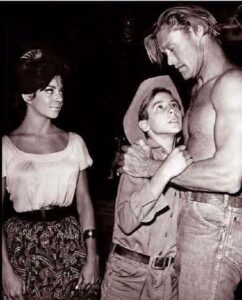
The program became memorable because it combined the familiar ingredients of a frontier drama—ranch life, gunfights, outlaws, lawmen, horseback rides, and dusty streets—with something more personal: the relationship between a father and his son.
At the center of the story was Lucas McCain, played by Chuck Connors, and his young son, Mark. Their relationship gave the series an emotional foundation that helped separate it from many other Western programs of its era.
Lucas was not simply a gunslinger or rancher. He was a father trying to raise his son in a difficult environment.
That distinction mattered.
Throughout the series, Lucas’s conversations with Mark often dealt with subjects such as responsibility, honesty, courage, consequences, and trust. The action might attract viewers, but the relationship between father and son gave the stories their lasting emotional appeal.
That is one reason fans continue to revisit episodes of The Rifleman decades after the series originally aired.
And when viewers watch closely, they may also notice something else.
Not everything on screen fits perfectly with the historical period the show is supposed to represent.
That is hardly unusual for television.
Western programs have always taken certain liberties with history. Producers have to tell entertaining stories, keep filming practical, and create characters and situations that modern audiences can understand. As a result, details involving clothing, language, technology, architecture, weapons, and everyday behavior can sometimes feel more like television than an exact recreation of nineteenth-century life.
For longtime fans, those details can become part of the fun.
A Western That Wasn’t Really a History Lesson
The Rifleman was set in the American West during the 1870s, but viewers should not necessarily treat every object or behavior in the series as documentary evidence.
The show’s primary purpose was entertainment.
That distinction is important because modern viewers often approach older television differently from the audiences who originally watched it. A contemporary viewer may pause a scene, examine the background, and immediately notice something that seems historically questionable.
A character might use a phrase that sounds too modern.
A piece of clothing might seem out of place.
A building might look more like a twentieth-century television set than an actual frontier structure.
A piece of technology might appear decades earlier than expected.
These details can be fascinating precisely because they reveal how television production worked.
The people making the show had to create a believable world quickly and efficiently. Sets were reused. Costumes could appear in multiple productions. Props had to be available. Actors needed dialogue that audiences could easily understand.
Absolute historical accuracy was rarely the only priority.
The Clothing Can Tell a Story
One of the easiest things to overlook in an older Western is clothing.
At first glance, costumes may appear completely convincing. Hats, boots, shirts, coats, vests, trousers, and dresses all create the visual impression of the Old West.
Look closer, however, and some pieces may appear surprisingly familiar.
Western television productions sometimes used clothing that was influenced by contemporary fashion. Even when costumes were designed to look historical, they were ultimately being created for television audiences living in another century.
That can produce subtle differences in cut, fabric, fit, and styling.
The result is a fascinating mixture of historical inspiration and modern interpretation.
It does not necessarily mean the show was poorly made.
In fact, those details can help viewers understand how television represented the past.
The West seen on television was often a cultural creation as much as a historical setting.
Language Is Another Clue
Dialogue provides another opportunity for viewers to spot anachronisms.
Words and expressions change over time. Some phrases that sound completely ordinary today would not necessarily have been common in the nineteenth century.
Writers working on The Rifleman had an additional challenge: they needed dialogue that contemporary viewers could understand and enjoy.
That meant characters could sometimes speak in a way that sounded natural to 1950s audiences rather than perfectly authentic to people living in the 1870s.
Again, this is not necessarily a flaw.
If every line of dialogue were written using obscure historical vocabulary, the show might feel less accessible.
Television depends on communication.
The audience has to understand the characters quickly, especially during a dramatic scene.
So writers often favored clear, direct language over strict historical reconstruction.
Technology Can Give Away the Era
Technology is perhaps where historical inconsistencies become easiest to spot.
The nineteenth-century American West had access to remarkable innovations, including railroads, telegraph systems, firearms, photography, and increasingly sophisticated machinery.
But those technologies developed gradually, and their availability varied considerably by location.
A television show can sometimes compress that timeline.
A piece of equipment may appear in a setting where it would have been unusual. A particular design might belong to a later period. A modern-looking object may accidentally appear in the background.
Sometimes the problem is even simpler.
An item may not actually be part of the story at all.
It could be something from the filming environment that accidentally made its way into the shot.
Modern audiences are particularly good at noticing these mistakes because we are accustomed to stopping video and examining individual frames.
When The Rifleman originally aired, viewers did not have that luxury.
If something appeared on screen for two seconds, most people simply saw it and continued watching the episode.
Today, a fan can pause, rewind, enlarge, and analyze the same moment repeatedly.
That changes the viewing experience.
The Famous McCain Relationship
Yet historical inconsistencies are not really what made The Rifleman memorable.
The heart of the show was Lucas and Mark.
Lucas McCain was a character built around responsibility. He was a single father trying to provide his son with guidance while also protecting him from the dangers of frontier life.
Mark, meanwhile, was learning what it meant to grow up.
Their relationship allowed the show to explore serious subjects without becoming entirely dark or preachy.
Lucas could explain why honesty mattered.
He could teach Mark about courage.
He could demonstrate that strength was not simply about winning a fight.
And he could show his son that making the right decision sometimes required patience and restraint.
These lessons gave the series an emotional dimension that went beyond the traditional Western formula.
The gunfights and action sequences created excitement, but the conversations afterward often provided the meaning.
Why Fans Still Analyze the Details
There is a special kind of enjoyment that comes from discovering small mistakes or inconsistencies in beloved television shows.
For fans, these details can become part of the mythology surrounding a series.
Someone notices something unusual in an episode.
Another viewer spots it too.
Eventually, fans begin discussing whether it was an intentional choice, a production shortcut, or simply an accident.
Older shows are particularly interesting because television production was different from what it is today.
Episodes were produced under demanding schedules. Sets and props had to be prepared quickly. Filming could involve repeated takes, changing camera positions, and practical limitations that modern productions can sometimes avoid through digital technology.
There was also less expectation that viewers would scrutinize every frame.
A small mistake that lasted less than a second might have gone unnoticed by almost everyone watching at home.
Decades later, however, it can become a favorite piece of trivia.
Historical Accuracy Versus Entertainment
It is tempting to judge an older Western entirely by modern standards of historical accuracy.
But doing so can miss the point.
The Rifleman was not presented as a scholarly reconstruction of nineteenth-century American life. It was a television drama designed to tell stories about people, relationships, morality, danger, and family.
Its fictional town and characters created a version of the West that audiences could recognize and emotionally connect with.
That version of the West was influenced by history, but it was also shaped by the conventions of television.
The distinction is similar to the difference between a historical novel and a history textbook.
One can be inspired by real events and settings without reproducing every detail exactly.
The Small Details Become Part of the Experience
Ironically, the inconsistencies that might initially seem like weaknesses can make the show more interesting for modern viewers.
A fan might watch an episode and notice an unusual costume.
Another might catch a modern object in the background.
Someone else might question a line of dialogue.
These discoveries encourage viewers to pay closer attention.
Instead of simply watching the story, they begin examining how the story was made.
And that can create a second layer of appreciation.
You begin noticing the sets.
Then the costumes.
Then the props.
Then the way scenes were filmed.
Then the performances.
Suddenly, an episode that you thought you knew contains details you had never noticed before.
That is one of the pleasures of revisiting classic television.
Why the Series Still Works
Despite its occasional historical liberties, The Rifleman remains memorable because its central themes have not become outdated.
Parents still worry about teaching their children right from wrong.
Children still test boundaries.
People still struggle with trust.
Courage still matters.
Honesty still has consequences.
And families still try to protect one another while preparing younger generations to face the world independently.
Those ideas do not belong to one particular decade.
That is why the relationship between Lucas and Mark remains important even when some of the surrounding details look dated.
The fashions may change.
The technology may change.
The dialogue may sound old-fashioned.
Television production techniques certainly change.
But the emotional core of the story can remain surprisingly recognizable.
A Different Way to Watch Classic Television
Perhaps the best way to appreciate The Rifleman today is to enjoy it on two levels.
First, watch it as the Western drama it was intended to be.
Enjoy the characters, stories, action, humor, and relationship between Lucas and Mark.
Then, if you want, watch it again with a more analytical eye.
Look at the background.
Notice the clothing.
Listen carefully to the dialogue.
Pay attention to the technology and props.
Think about whether each detail really belongs to the period.
You may begin seeing things you missed the first time.
But those discoveries should not necessarily diminish the series.
They can make it more fascinating.
Classic television is a record of the era in which it was produced as much as it is a depiction of the era in which its stories are set.
The Rifleman tells us something about the fictional American West, but it also tells us something about how mid-twentieth-century America imagined that West.
That is why those little inconsistencies matter.
They reveal the distance between history and storytelling.
And they remind us that every historical drama is, in some way, a conversation between the past and the time in which the show was made.
For longtime fans, spotting a questionable detail can therefore become part of the enjoyment.
The next time you watch a classic Rifleman scene, look beyond the obvious action.
Watch Lucas.
Watch Mark.
Listen to the dialogue.
Then look at the background.
You might notice a detail that has been hiding there all along.
It may be a tiny costume choice, an unusual piece of technology, a phrase that feels surprisingly modern, or some other production detail that doesn’t quite belong.
Whatever you find, remember that these imperfections are part of what makes old television so interesting.