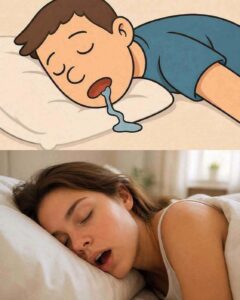
Waking up with a damp pillow can be embarrassing, especially when you notice it first thing in the morning.
You might wonder whether something is wrong.
You might even feel embarrassed if someone points it out.
But nighttime drooling is actually very common.
For most people, it is nothing to worry about.
Drooling during sleep is usually the result of several completely ordinary things happening at the same time: your body is relaxed, your swallowing becomes less frequent, your mouth may open slightly, and gravity does the rest.
In other words, that wet spot on your pillow is often simply evidence that your body was doing what bodies naturally do while sleeping.
Your Body Still Produces Saliva While You Sleep
Saliva is important.
Your body produces it throughout the day because it helps moisten your mouth, makes swallowing easier, protects your teeth, and begins the digestive process.
You may not notice how often you swallow during the day because it happens automatically.
Even when you’re not eating or drinking, your body regularly clears saliva from your mouth.
Sleep changes that process.
When you fall asleep, many of the muscles involved in swallowing and maintaining the position of your jaw and lips become more relaxed.
You don’t stop producing saliva completely.
Instead, your swallowing becomes less frequent.
As saliva accumulates, it normally remains inside your mouth.
But if your lips aren’t fully closed, some of it can eventually escape.
And that’s when your pillow gets involved.
Why Does Your Mouth Open While You Sleep?
One of the biggest contributors to nighttime drooling is sleeping with your mouth open.
There are many reasons this can happen.
Sometimes it’s simply your natural sleeping habit.
Other times, you’re breathing through your mouth because your nose isn’t allowing enough air to pass comfortably.
A blocked nose can make mouth breathing much more likely.
This can happen when you’re dealing with:
- A common cold
- Seasonal allergies
- Nasal congestion
- Sinus problems
- A stuffy nose
- Certain structural nasal issues
- Enlarged tonsils or other airway-related factors
When your mouth stays open for extended periods, saliva has an easier path out.
That’s why some people notice that they drool much more when they’re congested.
Your Sleeping Position Matters
Gravity doesn’t stop working just because you’re asleep.
In fact, it can have a surprisingly noticeable effect on drooling.
People who sleep on their sides or stomachs may be more likely to notice saliva escaping from their mouths.
When your head is turned sideways, saliva can naturally move toward the side of your mouth.
If your lips are slightly open, gravity can allow it to leave.
Sleeping on your stomach can create a similar situation because your face is often turned to one side.
Sleeping on your back may reduce drooling for some people.
In that position, saliva is more likely to remain inside the mouth rather than immediately flowing toward the edge.
However, sleeping position isn’t the only factor.
Some people naturally sleep with their mouths open regardless of how they position their bodies.
Deep Sleep Can Play a Role
Sleep isn’t one single state.
Your brain and body move through different stages throughout the night.
During deeper stages of sleep, your muscles become particularly relaxed.
That includes muscles around your jaw and mouth.
The more relaxed your facial muscles become, the easier it can be for your lips to part.
At the same time, you’re not consciously thinking about swallowing.
During the day, if saliva builds up in your mouth, you simply swallow it.
During sleep, that automatic process becomes slower.
Eventually, saliva may collect.
If your mouth is open, it can escape.
So drooling can actually be a small consequence of your body entering a deeply relaxed state.
Mouth Breathing Can Make It Worse
Mouth breathing is another important piece of the puzzle.
Ideally, most people breathe through their nose while sleeping.
The nose helps filter, warm, and humidify incoming air.
But if your nasal passages become blocked, your body may switch to mouth breathing.
That can keep your lips open for much of the night.
And when your mouth remains open, saliva has an easier route out.
This can create a cycle.
You become congested.
You breathe through your mouth.
Your mouth stays open.
Saliva escapes.
You wake up with a wet pillow.
Then, if the congestion disappears, the drooling may decrease as well.
Is Drooling a Sign That You’re Sleeping Well?
Not necessarily.
Some people jokingly assume that drooling means they must have been sleeping extremely deeply.
While relaxation during sleep can contribute to drooling, it isn’t a reliable measurement of sleep quality.
You can drool and sleep well.
You can also drool while having disrupted sleep.
The presence or absence of drooling doesn’t tell you by itself whether your sleep is restorative.
It’s simply one possible consequence of how your mouth, muscles, breathing, and sleeping position interact during the night.
Why Do Some People Drool More Than Others?
There isn’t one universal explanation.
People naturally differ in how much saliva they produce, how they sleep, how their mouths close, and how easily they breathe through their noses.
Some people also naturally have more open-mouth sleeping habits.
Age can influence sleeping patterns as well.
Children may drool more frequently, particularly during certain stages of development.
Adults can also experience nighttime drooling for a variety of ordinary reasons.
The important point is that occasional drooling isn’t automatically a sign of a medical problem.
What About Dreams?
Dreaming is sometimes blamed for drooling.
But dreams themselves generally aren’t the direct reason saliva ends up on your pillow.
You may dream about eating, drinking, or even talking, but your dream isn’t necessarily causing your mouth to produce enough saliva to make you drool.
The physical factors are more straightforward.
Your mouth may be open.
Your swallowing may be less frequent.
Your body is relaxed.
Saliva accumulates.
Gravity takes over.
That’s usually enough.
Can Stress or Tiredness Cause It?
Indirectly, they may affect sleeping habits.
When you’re extremely tired, you may fall asleep more quickly and sleep differently than usual.
Changes in sleep position, breathing, or muscle relaxation can influence whether you drool.
Stress can also affect sleep patterns.
But it’s usually more useful to look at the immediate physical factors rather than assuming stress itself directly causes saliva to escape.
If you suddenly begin drooling much more than usual, it may be worth considering whether something else has changed, such as nasal congestion, medications, sleep habits, or general health.
When Should You Pay Attention?
Occasional nighttime drooling is generally harmless.
However, persistent or unusually heavy drooling can sometimes be associated with other conditions.
For example, if you regularly wake up choking, gasping, or struggling to breathe, that’s different from simply finding a little saliva on your pillow.
Similarly, if you experience loud snoring, witnessed pauses in breathing, significant daytime sleepiness, or frequent morning headaches, those symptoms may deserve medical attention because they can occur with sleep-related breathing disorders.
Sudden changes in swallowing ability are also worth discussing with a healthcare professional.
The same applies if excessive drooling occurs while you’re awake or is accompanied by other neurological or muscular symptoms.
The important distinction is between ordinary nighttime drooling and drooling that appears alongside other concerning changes.
Can You Reduce Nighttime Drooling?
If drooling bothers you, there are several simple things you can try.
First, pay attention to your sleeping position.
If you usually sleep on your stomach or side, experimenting with sleeping on your back may reduce saliva escaping.
Of course, comfort matters.
You shouldn’t force yourself into an uncomfortable sleeping position simply to avoid a damp pillow.
Next, consider whether nasal congestion is contributing.
If you regularly have a blocked nose because of allergies or another issue, addressing the underlying problem may make nasal breathing easier.
Keeping your sleeping environment comfortable and managing known allergies may also help.
If congestion is persistent, a healthcare professional can help determine why.
What About Hydration?
Staying adequately hydrated is important for overall health.
But drinking enormous amounts of water immediately before bed isn’t a reliable solution for nighttime drooling.
In fact, it may simply mean more nighttime trips to the bathroom.
The goal isn’t to eliminate saliva.
Your body needs saliva.
The goal is simply to understand why it may be escaping while you’re asleep.
Don’t Be Embarrassed
One of the biggest problems with nighttime drooling is psychological rather than physical.
People sometimes feel embarrassed when someone notices.
But there is nothing unusual or shameful about it.
Sleep is a state in which you temporarily lose conscious control over many ordinary bodily functions.
You may move.
You may change positions.
You may snore.
You may talk.
You may breathe through your mouth.
And yes, you may drool.
None of these automatically means something is wrong.
Your body doesn’t care whether your pillow stays perfectly dry.
It’s focused on keeping you asleep and breathing comfortably.