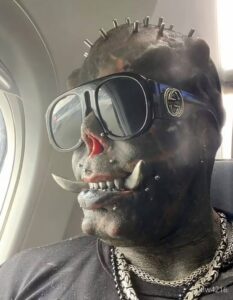
In the world of extreme body modification, few names provoke as much fascination, discomfort, and debate as Michel Praddo, widely recognized as “Diabão” or the “Human Satan.” His transformation from a tattoo artist in Santos, São Paulo, Brazil into one of the most radically modified individuals on the planet has become a global subject of discussion—spanning art, psychology, ethics, and personal autonomy.
Born in 1975, Diabão did not begin his journey intending to become a living symbol of extremity. His early career centered around tattoo artistry, where he developed a reputation for bold blackwork designs and experimental body aesthetics. Over time, however, what began as artistic expression gradually evolved into something far more immersive: a lifelong transformation of his entire physical identity.
Today, his appearance is the result of decades of cumulative modifications. His body is extensively covered in black ink, with an estimated majority of his skin fully saturated in dense tattoo work. Subdermal implants have been inserted into his scalp to create horn-like protrusions, while his ears have been surgically removed, his nose reshaped, and his tongue split to create a forked effect. His teeth have been modified with fang-like structures, and his eyes tattooed to appear fully black—a procedure known for its risks to vision.
Each stage of his transformation has been deliberate, incremental, and deeply tied to his evolving personal philosophy. Diabão has described his body not as something fixed, but as a canvas in constant evolution. In interviews and public statements, he has often emphasized that his modifications are not impulsive acts, but long-considered steps in a larger artistic vision of self-reinvention.
One of the most controversial aspects of his transformation occurred in recent years, when he underwent finger amputations to create claw-like hands. These procedures, which he has documented publicly, intensified global debate about the limits of bodily autonomy. While supporters interpret these changes as the ultimate form of self-expression, critics question the psychological and medical implications of such irreversible alterations.
Despite the controversy, Diabão continues to share his journey openly through social media, where he has built a significant following. His posts often include detailed recovery updates, images of healing procedures, and reflections on identity and transformation. This transparency has contributed to both fascination and concern, as audiences witness the physical consequences of extreme modification in real time.
His wife, Carol Praddo, known as “Mulher Demônia” (Demon Woman), plays an equally important role in his narrative. She has also undergone extensive modifications, including full-body blackwork tattoos and facial alterations that align with Diabão’s aesthetic vision. Together, they present a unified artistic identity, often appearing in public as a coordinated expression of their shared philosophy.
Their partnership is frequently described as both romantic and collaborative. Rather than separating personal life from artistic expression, they have merged the two entirely. This fusion has made them a unique phenomenon in global body modification culture, where few couples pursue synchronized transformation to such an extreme degree.
The psychological dimension of Diabão’s journey has been widely debated. Some mental health professionals question whether his choices reflect body dysmorphia or other underlying conditions, while others caution against pathologizing what may be a deeply intentional form of identity expression. Diabão himself rejects the notion that his transformation is symptomatic of illness, insisting instead that it represents clarity, control, and authenticity.
He has often spoken about his past struggles, including periods of homelessness and substance addiction, as formative experiences that influenced his desire to completely redefine himself. In his view, transformation was not destruction, but reconstruction—an attempt to reclaim agency over a life that once felt unstable.
Culturally, his appearance has made him both an icon and a target. In Brazil, a predominantly Catholic country, his demonic aesthetic has sparked strong reactions ranging from admiration to condemnation. Some view him as a provocative performance artist challenging traditional norms of beauty and morality. Others see his transformation as deeply unsettling or even offensive.
Internationally, his story has circulated widely through media outlets, documentaries, and online discussions. Coverage from global platforms has amplified his visibility, turning him into a viral figure whose image is instantly recognizable even outside body modification communities. This exposure has intensified the duality of his reputation: celebrated in niche artistic circles, yet often misunderstood or sensationalized in mainstream discourse.
Beyond aesthetics, Diabão’s transformation raises complex ethical questions. Medical professionals express concern about the risks associated with repeated surgical interventions, including infection, nerve damage, and long-term complications. Ethicists debate where the boundary lies between personal freedom and potential self-harm, particularly when modifications are irreversible and medically invasive.
Yet within body modification communities, Diabão is often regarded as a pioneer. His willingness to endure pain and commit fully to his vision is seen as an extreme but sincere expression of bodily autonomy. For supporters, he represents the idea that identity is not fixed, but something that can be sculpted, rebuilt, and continuously redefined.
His legal name change to Diabão Faro do Prado further cemented this transformation. It was not merely symbolic, but administrative—a formal separation from his previous identity and a declaration of his chosen self. This act reflects the depth of his commitment, extending beyond physical appearance into legal and social identity.
Despite his notoriety, Diabão and his wife maintain a relatively structured life in coastal Brazil. They generate income through social media platforms, merchandise, appearances, and commissioned artwork. Their online presence serves both as documentation of their transformation and as a means of financial sustainability.
Public reaction to their lifestyle remains deeply divided. Admirers see them as living art installations—embodiments of radical self-expression. Critics argue that their transformation promotes dangerous ideals or normalizes irreversible body alteration. This tension has kept their story at the center of ongoing cultural debate.
What makes Diabão’s case particularly compelling is not only the extent of his physical transformation, but the consistency of his vision over time. Many individuals experiment with body modification, but few pursue it with such sustained intensity across decades. His evolution is continuous rather than complete, suggesting that for him, identity is an ongoing process rather than a finished state.
As of 2026, Diabão shows no indication of stopping. He continues to document healing from previous procedures while hinting at future modifications. Each new development adds another layer to an already complex narrative, reinforcing his status as one of the most extreme examples of human body modification in modern history.
Ultimately, Diabão Praddo’s story exists at the intersection of art, identity, and controversy. Whether interpreted as self-expression, performance art, or self-destruction, it forces uncomfortable but important questions about the limits of bodily autonomy and the meaning of transformation.
In a world where appearance is increasingly malleable—through tattoos, cosmetic surgery, digital alteration, and beyond—his radical journey stands as an extreme endpoint on a spectrum many people already participate in. It challenges observers not only to judge what they see, but to reflect on how far identity can be shaped before it becomes something entirely new.
Diabão’s legacy, still unfolding, is not simply about becoming something unrecognizable. It is about the human desire to define oneself completely, even when that definition pushes against every conventional boundary of comfort, normality, and acceptance.