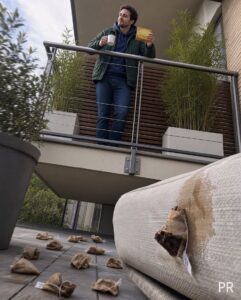
For eleven years, I lived peacefully in the same apartment.
I knew most of my neighbors by name. We exchanged polite greetings in the hallway, held the elevator for one another, and occasionally accepted packages when someone wasn’t home.
It wasn’t perfect, but it was peaceful.
I had always believed that good neighbors didn’t need to become best friends.
They simply needed to respect each other’s space.
Then the tea bags started falling.
The first one landed on my balcony early one Tuesday morning.
I was standing by the window watering my plants when I heard a soft plop.
I looked down.
A used tea bag was lying beside one of my flowerpots.
I assumed someone had dropped it accidentally.
I picked it up, threw it away, and forgot about it.
The next evening, another one appeared.
Then another the following morning.
At first, I laughed about it.
“Someone upstairs has terrible aim,” I told myself.
I lived on the second floor, directly beneath several apartments, so I had no idea who was responsible.
I continued cleaning them up.
I didn’t complain.
I didn’t knock on doors.
I simply assumed it would stop.
Then one morning, a tea bag landed on a white towel I had hung over the balcony railing to dry.
When I picked it up, I saw a brown circular stain spreading across the fabric.
I washed the towel twice.
The mark remained.
That was the moment my amusement disappeared.
I looked upward.
There was a balcony directly above mine.
I had seen the man who lived there many times.
His name was Greg.
We had spoken occasionally in the elevator, though we weren’t close.
I decided to talk to him.
I climbed the stairs and knocked on his door.
When he opened it, I explained what had been happening.
His face immediately changed.
“Oh, those?”
“Yes.”
“I’m sorry.”
He looked genuinely embarrassed.
“I drink tea every morning. I must be dropping the bags without realizing it.”
I smiled.
“I understand accidents happen. I just need you to make sure they don’t land on my balcony.”
“Absolutely.”
He promised.
I went downstairs feeling relieved.
Problem solved.
Or so I thought.
The next morning, another tea bag landed on my balcony.
I stared at it.
For a moment, I wondered whether it was an old one that I had somehow missed.
Then another appeared that evening.
I went upstairs again.
Greg opened the door.
“Another one fell.”
He sighed.
“Sorry.”
“You said you’d be careful.”
“I know.”
He closed the door.
I walked away.
For the next several weeks, the tea bags continued.
Sometimes one would appear in the morning.
Sometimes there would be two.
Once, I found three scattered around my plants.
The stains became worse.
One landed in a pot of flowers and damaged several leaves.
Another landed on a chair cushion.
I began keeping a small plastic bag beside the balcony door so I could collect them without touching them.
What bothered me most wasn’t the tea.
It was the fact that Greg knew.
I had told him.
He had apologized.
And yet nothing changed.
Eventually, I confronted him again.
This time, he didn’t look embarrassed.
He looked annoyed.
“Honestly,” he said, “it’s just tea.”
I stared at him.
“That’s not the point.”
“It’s biodegradable.”
“That doesn’t mean you can throw it onto my balcony.”
He shrugged.
“Be glad it’s tea.”
I walked away without answering.
But I was furious.
For eleven years, I had believed that patience and politeness could solve almost anything.
Now I realized that patience without boundaries can sometimes encourage people to ignore you.
I decided I needed to stop arguing with Greg.
Instead, I started documenting everything.
I took photographs of every tea bag.
I photographed the stains.
I recorded the dates and approximate times.
I kept the damaged towel.
I photographed the flowerpot.
I wasn’t trying to start a war.
I simply wanted proof.
A few days later, another tea bag landed.
I took a picture.
Then I contacted the property manager.
I explained the situation calmly.
I showed her the photographs.
She asked whether I had spoken to Greg.
I told her I had.
She sighed.
“Unfortunately, you’re not the first person to mention problems with him.”
That surprised me.
“What do you mean?”
She explained that other residents had complained about litter being dropped from his balcony.
No one had wanted to pursue the matter because the incidents seemed minor.
But when she saw my photographs, she said she could understand why the situation had become frustrating.
She contacted Greg.
For several days, nothing happened.
Then I received a message from the property manager.
She told me Greg had agreed to meet with her.
I expected him to deny everything.
Instead, something unexpected happened.
Greg admitted it.
He said he had developed a habit of drinking tea while standing outside in the morning.
He would finish the tea and drop the bag without thinking.
He had assumed the wind would carry it away.
He hadn’t realized how often it was landing below.
But then the property manager asked him a simple question.
“If you knew it was happening, why didn’t you stop?”
According to her, Greg didn’t have an answer.
A few days later, he knocked on my door.
I almost didn’t open it.
When I did, he was holding something.
A small package of replacement tea towels.
“I owe you these,” he said.
I stared at him.
He looked uncomfortable.
“I was being a jerk.”
I didn’t expect that.
He continued.
“I kept telling myself it wasn’t a big deal because it was only tea. But it wasn’t my balcony being covered in it.”
I nodded.
“That’s what I was trying to explain.”
He handed me the package.
“I also talked to the manager. I’m going to stop throwing anything off the balcony.”
“Thank you.”
He stood there awkwardly.
Then he said something else.
“I didn’t realize how much it was bothering you.”
I smiled slightly.
“I told you.”
“I know.”
He looked down.
“That’s the part I’m embarrassed about.”
For the first time in weeks, I felt the tension leave my shoulders.
The tea bags stopped.
Completely.
Days passed.
Then weeks.
Nothing fell onto my balcony.
My plants recovered.
I bought a new towel.
And slowly, the whole ridiculous situation became something I could laugh about.
A month later, I ran into Greg in the elevator.
He smiled.
“I’ve been using the trash can.”
I laughed.
“Good to hear.”
We didn’t become close friends.
We didn’t suddenly start having coffee together.
But something had changed.
There was respect now.
And that was all I had wanted from the beginning.
The strange thing is that the problem had never really been about tea.
It was about what happens when someone’s small inconvenience becomes someone else’s repeated burden.
It was about how easy it can be to dismiss another person’s frustration when you aren’t the one cleaning up the mess.
And it taught me something I wish I had understood sooner.
Being patient doesn’t mean accepting disrespect.
Being polite doesn’t mean staying silent forever.
Sometimes the most peaceful solution isn’t avoiding confrontation.
It’s addressing the problem clearly, documenting what happens, and asking the right person to help when a direct conversation isn’t enough.
Greg’s tea bags were never going to destroy my life.
But the lesson they left behind was surprisingly important.
A shared building only works when everyone remembers that other people live there too.
Your balcony might be your space.
But the space below belongs to someone else.
And sometimes, respecting your neighbors starts with something as simple as putting your tea bag in the trash.