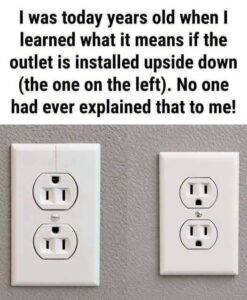
Have you ever walked into a room, looked at the wall, and noticed that one electrical outlet appears to be installed upside down?
Instead of the familiar ground opening facing downward, the rounded ground hole is positioned above the two vertical slots.
At first glance, it can look like someone simply installed the outlet incorrectly.
But that’s not necessarily the case.
In many homes, an upside-down outlet can be completely intentional. It may indicate a particular wiring arrangement, a switched receptacle, or simply reflect the electrician’s preferred installation style.
The interesting part is that the orientation itself doesn’t tell you exactly what’s happening behind the wall.
Why Would Anyone Install It That Way?
There isn’t one universal reason.
One common explanation involves electrical outlets that are partially controlled by a wall switch.
This arrangement was especially useful in older homes where rooms often didn’t have permanent ceiling lights.
Instead of walking into a dark room and searching for a lamp switch, homeowners could plug a lamp into a wall outlet and control it from a switch near the doorway.
Imagine walking into a living room at night.
The lamp is plugged into the wall.
You flip the switch.
The lamp turns on.
This arrangement made the room much more convenient to use without requiring a ceiling fixture.
In some installations, only one half of the receptacle is controlled by the wall switch, while the other half remains continuously powered.
That allows a homeowner to plug a lamp into the switched portion while using the other socket for something that needs constant power.
For example, a clock, charger, or another household device could remain plugged in without being affected by the light switch.
The Outlet Can Look Different for a Reason
Some electricians use outlet orientation as a visual clue.
If a particular receptacle is installed upside down, it may have been done to help distinguish it from standard outlets.
For example, an electrician might use the unusual orientation to indicate that the receptacle has a special wiring configuration.
That can make future maintenance easier because someone inspecting the room may immediately notice that the outlet isn’t installed in the same orientation as the others.
However, there’s an important catch.
This isn’t a universal rule.
An upside-down outlet doesn’t automatically mean it is connected to a wall switch.
The orientation is not a guaranteed electrical code.
In many cases, it may simply be how the electrician chose to install the receptacle.
Electrical Codes Don’t Require One Direction
Many people assume that electrical outlets must face a specific direction.
In residential installations in the United States, however, there isn’t a single national rule requiring every standard receptacle to have the ground opening facing up or down.
Installation practices can vary.
Some electricians prefer the ground opening at the top.
Others prefer it at the bottom.
Some may install the outlet horizontally in certain applications.
The orientation can therefore depend on the electrician, builder, local practices, or the specific requirements of the installation.
This is why you can walk into different houses and find outlets facing different directions.
It doesn’t necessarily mean that one installation is wrong.
Why Do Some People Prefer the Ground Up?
There are also practical arguments surrounding outlet orientation.
One reason sometimes given for installing the ground opening upward involves the possibility of a plug being partially pulled from the receptacle.
If a metal object were to fall onto the exposed prongs of a partially disconnected plug, the orientation of the receptacle could potentially affect what happens.
Some people argue that having the grounding connection above the other slots provides an additional safety advantage in certain situations.
Others point out that properly installed electrical equipment should not be treated as safe merely because of its orientation.
The important point is that outlet direction alone isn’t a substitute for proper electrical installation.
A receptacle should be securely mounted, correctly wired, and appropriate for the circuit.
What About Older Homes?
The upside-down outlet mystery becomes particularly interesting in older houses.
Many older homes were built at a time when central ceiling lighting wasn’t as common in certain rooms.
Wall outlets were therefore an important part of the lighting system.
A room might have several receptacles, but only one portion of one outlet could be connected to a wall switch.
This allowed homeowners to control a floor or table lamp from the entrance to the room.
Over time, building practices changed.
Ceiling fixtures became more common.
Modern homes often include dedicated lighting circuits and switches.
But the older outlet arrangements didn’t necessarily disappear.
That’s why you may find a switched receptacle in a house even if you don’t immediately understand why it was designed that way.
How Can You Tell If an Outlet Is Switched?
If you’re curious about an outlet in your own home, there may be a simple way to investigate.
One common method is to plug in a lamp and operate the wall switches nearby.
If the lamp turns on and off with a particular switch, that portion of the outlet may be controlled by the switch.
Some receptacles have one half switched while the other remains powered.
If you test this, use a normal lamp or another appropriate device and avoid opening the outlet or touching any wiring.
Never remove the cover plate simply to investigate unless you are qualified to work with electrical wiring.
Electricity can cause serious injury or death, so curiosity isn’t a good reason to take unnecessary risks.
If you’re unsure how an outlet is wired, a qualified electrician can inspect it safely.
Why Are Some Outlets Installed Sideways?
You may also encounter receptacles installed horizontally or in unusual positions.
Again, the orientation doesn’t automatically reveal the wiring configuration.
Different installations may have different requirements.
Commercial spaces, workshops, kitchens, garages, and specialized equipment installations can all use receptacles in ways that differ from the typical residential arrangement.
The important lesson is that physical appearance provides clues, but it doesn’t tell the entire story.
The wiring behind the wall is what determines what the outlet actually does.
So Is an Upside-Down Outlet Wrong?
Not necessarily.
An upside-down outlet may be completely intentional.
It could be associated with a switched receptacle.
It could have been installed as a visual indicator.
Or it could simply reflect the preference of the electrician who installed it.
The orientation by itself isn’t enough to determine which explanation applies.
That’s why the next time you see one, you shouldn’t automatically assume someone made a mistake.
There may be a perfectly practical reason behind it.
A Small Detail With a Bigger Story
Electrical outlets are among the most ordinary objects in a home.
We plug in phones, lamps, televisions, computers, and appliances without giving the receptacle much thought.
But the next time you notice one facing a different direction from the others, take a closer look.
It might tell you something about the history of the house.
Perhaps the room once relied on switched lamps.
Maybe the electrician used the orientation to identify a special circuit.
Or perhaps the outlet was simply installed that way because the person doing the work preferred it.
The important thing to remember is that there is no universal rule saying every household outlet must face one particular direction.
So that seemingly upside-down outlet may not be a mistake at all.
It could be a small reminder that even the simplest parts of a home can contain clues about how the house was designed, wired, and used over the years.