Sometimes the internet becomes a giant detective agency.
Someone discovers an unfamiliar object in an old kitchen, garage, attic, or storage room, takes a photograph, and asks a simple question:
“What is this?”
Within hours, strangers begin examining every detail.
Some people guess.
Others search through old catalogs.
Someone eventually recognizes the design.
And suddenly, an object that looked completely mysterious becomes something ordinary.
That is exactly what happened when an unusual steel kitchen device caught the attention of people online.
At first glance, the object didn’t look particularly familiar.
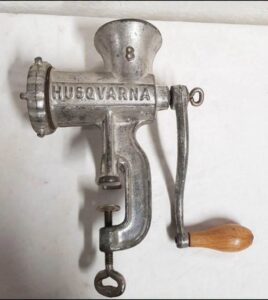
It had a heavy metal body, a strange opening at the top, and a handle extending from the side.
To someone accustomed to modern electric kitchen appliances, its purpose wasn’t immediately obvious.
Was it some kind of industrial tool?
A piece of farm equipment?
An old food-processing machine?
Or perhaps something designed for a purpose that had completely disappeared from modern kitchens?
People began offering theories.
Then someone recognized it.
It was a traditional meat mincer.
More commonly known in some places as a meat grinder.
And suddenly, the strange collection of metal parts made perfect sense.
How the Old Machine Worked
The basic principle behind the device was remarkably simple.
A piece of meat was placed into an opening at the top.
A rotating screw inside the machine moved the meat forward.
At the end of that mechanism was a sharp rotating blade positioned against a perforated metal plate.
As the handle was turned, the meat was forced through the small holes.
The result was minced or ground meat that could then be used in cooking.
There was no electricity.
No digital display.
No complicated controls.
Just mechanical force created by turning a handle.
The design was simple enough to operate manually but effective enough to process food efficiently.
That simplicity was one of the reasons these machines became so useful.
Before Electric Kitchen Appliances
Today, grinding meat can be as easy as placing ingredients into an electric appliance and pressing a button.
Older households didn’t have that convenience.
Preparing food often required considerably more physical effort.
A hand-operated meat grinder allowed families to process meat at home without needing expensive commercial equipment.
The machine could be clamped or attached securely to a sturdy table or countertop.
The user then placed meat into the top opening and turned the handle repeatedly.
It required effort, but the mechanism did most of the difficult work.
Once people understood how it worked, the mysterious object became remarkably logical.
It Wasn’t Only for Meat
One of the more interesting details about traditional grinders is that they could be surprisingly versatile.
Depending on the particular model and its attachments, similar machines could be used for processing other foods.
Some were capable of handling fish or vegetables.
Special attachments could expand their usefulness even further.
Certain grinders could be adapted for making sausages.
Others included accessories for preparing particular traditional dishes.
This meant that a single mechanical device could perform several kitchen tasks.
For families without modern appliances, that versatility was valuable.
The History Goes Back Centuries
The basic idea of mechanically processing food is much older than electric kitchen appliances.
But the modern meat grinder developed during the nineteenth century.
German inventor Karl Drais is commonly credited with developing an early meat-grinding machine.
His design demonstrated how a relatively simple mechanical system could replace much of the manual labor involved in chopping meat.
As manufacturers improved the concept, the machines became more practical for household use.
Different manufacturers produced their own designs.
Some were small and compact.
Others were heavy, elaborate machines built to withstand years of use.
The fundamental principle remained remarkably consistent.
A rotating screw moved the food forward while a blade and perforated plate controlled the final texture.
Why the Design Looks So Strange Today
For someone born in the age of modern appliances, the traditional grinder can look almost industrial.
The heavy metal construction is one reason.
Many older models were made primarily from cast iron or steel.
They were designed to be durable.
Unlike many modern appliances that contain lightweight plastic components, older kitchen equipment was often built with the expectation that it would be used for years—or even decades.
The hand crank is another clue that can confuse modern viewers.
Most people today associate kitchen appliances with electricity.
A machine that requires someone to stand there turning a handle can look inefficient.
But before electricity became a standard part of household kitchens, mechanical solutions were perfectly practical.
Why People Were Confused
The mystery surrounding the object demonstrates how quickly everyday technology can become unfamiliar.
Imagine showing a modern teenager an old typewriter.
They might recognize it as something related to writing, but they may not understand how people actually used it.
The same thing can happen with old kitchen equipment.
An object that was once found in countless homes can become almost unrecognizable within a few generations.
Technology changes so quickly that ordinary household tools can disappear from everyday life.
Eventually, their purpose becomes something that people have to rediscover.
The Internet Becomes a History Book
This is where online communities can be surprisingly useful.
When someone posts an unfamiliar object, thousands of people may see it.
Among those viewers might be collectors, historians, mechanics, cooks, antiques enthusiasts, or simply people who remember using similar objects when they were younger.
One person may recognize the shape.
Another may identify the manufacturer.
Someone else may locate an old catalog showing exactly how the device was used.
Together, these pieces of information can solve the mystery.
It’s a fascinating example of collective knowledge.
No single person necessarily knows everything.
But someone usually knows something.
From Hand Crank to Electric Motor
Eventually, electricity changed the way people used meat grinders.
Electric motors eliminated the need to manually turn the handle.
Instead of repeatedly rotating a crank, the user could switch on the machine and allow the motor to drive the internal mechanism.
This made processing larger quantities much easier.
Modern electric grinders can also come with multiple plates and attachments.
Different plates produce different textures.
Some attachments are designed for sausages.
Others are intended for specialized food preparation.
The basic concept, however, hasn’t changed dramatically.
Food still enters through the top.
A mechanism moves it forward.
A cutting system processes it.
And the finished product emerges through a perforated plate.
An Ordinary Tool With an Extraordinary History
The most interesting thing about the mystery wasn’t really the machine itself.
It was the realization that ordinary technology can become mysterious surprisingly quickly.
A tool that was once common can become unfamiliar simply because newer generations have stopped using it.
The same thing happens with countless objects.
Old cameras.
Mechanical typewriters.
Rotary telephones.
Manual egg beaters.
Washboards.
Sewing-machine attachments.
And traditional meat grinders.
They may look strange today, but each one represents a practical solution to a problem people once faced every day.
The Lesson Behind the Mystery
The next time you encounter a strange object online, don’t be surprised if someone eventually knows exactly what it is.
There is an enormous amount of knowledge stored in people’s memories.
Sometimes the answer comes from a professional.
Sometimes it comes from an antique collector.
And sometimes it comes from someone who simply says:
“My grandmother had one of those.”
That single sentence can transform an unidentified object into a piece of history.
The mysterious steel kitchen device wasn’t a secret machine or complicated invention.
It was a meat grinder.
Simple.
Practical.
Durable.
And once you understand how it worked, its unusual shape suddenly makes perfect sense.
Perhaps that’s what makes these internet mysteries so enjoyable.
They remind us that the past isn’t always hidden in museums.
Sometimes it’s sitting in an old kitchen drawer, covered in dust, waiting for someone to ask the simplest question of all:
“What was this used for?”