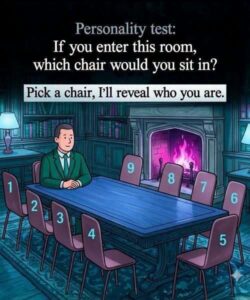
“Where will you sit?”
It sounds like a simple question.
Someone is arranging chairs around a dinner table, guests are arriving, and there are only a few places left.
You choose one.
Maybe you sit at the head of the table.
Perhaps you prefer a chair in the middle where everyone can easily reach you.
Maybe you automatically choose a corner where you can observe the entire room.
Or perhaps you don’t think about it at all.
But consider this for a moment:
What if the seat you choose changes more than where you sit?
What if it influences who you speak with, what conversations you hear, and how involved you become in the gathering?
A chair is simply a piece of furniture.
Yet around a shared table, it can become part of the experience.
Why Tables Matter
For thousands of years, people have gathered around food.
Before restaurants, formal dining rooms, and modern kitchens, communities gathered around fires and simple tables.
Food wasn’t merely something to consume.
It created an opportunity to stop working, sit together, exchange information, and strengthen relationships.
That tradition continues today.
Think about the meals you remember most clearly.
They may not have involved expensive food.
Perhaps you remember a family birthday.
A holiday dinner.
A meal with old friends.
A late-night conversation at a kitchen table.
What made those moments memorable wasn’t necessarily the furniture.
It was the people sitting around it.
The table created a shared space where everyone became part of the same experience.
The Head of the Table
The seat at the head of a table has traditionally carried a certain symbolism.
In many families, it belongs to the host.
In others, it may be reserved for the oldest family member.
Historically, the position could represent authority, responsibility, or status.
But being at the head isn’t always about power.
The person sitting there may also have the responsibility of making sure everyone feels included.
A good host notices when someone’s glass is empty.
They make introductions.
They help keep conversation moving.
They may notice when someone is sitting quietly and bring them into the discussion.
So the head of the table can represent responsibility just as much as importance.
Sometimes the person with the most prominent seat is also the person doing the most work.
The Middle Seats
The middle of the table can have its own unique character.
People sitting there are often close enough to interact with guests on either side.
They can participate in multiple conversations without having to turn completely around.
At a large family gathering, this can make the middle particularly lively.
Someone sitting there might hear a story from one side and then join a completely different conversation on the other.
They can become a bridge between groups.
Imagine a family dinner with grandparents at one end, parents in the middle, and younger relatives at the other.
The people in the middle may naturally connect the generations.
They can explain a story that younger guests don’t understand.
They can introduce an older relative to a new topic.
They can make sure someone doesn’t feel left out.
The middle seat isn’t necessarily the most important position.
But it can become the social center of the table.
The Corner Seat
Then there is the corner.
Some people love it.
Others avoid it.
A corner seat offers a different perspective.
Instead of being surrounded by conversation from every direction, you may have a clearer view of the entire table.
You can observe.
You notice who laughs first.
Who interrupts.
Who quietly refills someone else’s glass.
Who listens carefully.
Who seems uncomfortable.
Who suddenly becomes animated when a particular topic comes up.
People who naturally prefer observing may find this position comfortable.
But observation doesn’t mean disengagement.
Sometimes the quietest person at the table is paying the closest attention.
They may remember details that everyone else forgot.
The Seat Near the Kitchen
There is another seat that deserves attention.
The one closest to the kitchen.
It might not be the most comfortable place.
You may have people walking behind you.
You may constantly hear dishes being moved.
But it can also become an important position.
Someone sitting near the kitchen often becomes involved in practical tasks.
They may help carry plates.
Pass dishes around.
Refill drinks.
Check whether everyone has what they need.
It can become the unofficial assistant’s seat.
And sometimes, that person contributes more to the gathering than anyone realizes.
The Quiet Seat
Every table has one.
The chair where someone sits quietly.
Maybe they’re shy.
Maybe they’re tired.
Maybe they’re simply listening.
At first, other people might assume they’re not interested.
But quietness doesn’t necessarily mean discomfort.
Some people enjoy being present without dominating conversation.
They may speak less but listen more.
They may remember the details of everyone’s stories.
They may notice when someone needs support.
A gathering doesn’t need everyone to speak equally.
Sometimes simply being there is enough.
Choosing Your Seat
Have you ever noticed that you tend to choose the same kind of seat whenever you enter a room?
Maybe you always choose the chair against the wall.
Perhaps you prefer sitting near someone you know.
Maybe you instinctively sit at the center.
Or perhaps you wait until everyone else chooses before selecting your place.
These habits can be interesting to notice.
They don’t necessarily reveal a fixed personality type.
But they can encourage you to think about how you participate in groups.
Do you enjoy being surrounded by people?
Do you prefer observing first?
Do you naturally take responsibility?
Do you make an effort to connect people who don’t know each other?
Do you prefer being somewhere quiet?
There are no correct answers.
The Meaning of a Shared Table
Different cultures have their own traditions surrounding meals and seating.
But the broader idea is remarkably universal.
People come together.
Food is shared.
Stories are exchanged.
Relationships are strengthened.
A table creates physical proximity, but what happens around it creates emotional connection.
A disagreement may begin there.
A celebration may happen there.
A family secret may finally be revealed there.
A child may announce important news.
A grandparent may tell a story that gets repeated for decades.
Sometimes an ordinary dinner becomes one of the memories people carry for the rest of their lives.
Your Seat Isn’t Your Identity
It’s tempting to assign deep meaning to everything.
The head of the table must be the leader.
The person in the corner must be shy.
The person in the middle must be social.
But people are more complicated than that.
Someone may choose the corner because it’s the only empty chair.
Someone may sit at the head because they are hosting.
Someone who seems quiet at dinner may be incredibly outgoing in another setting.
A seat can influence an experience, but it doesn’t define a person.
That’s an important distinction.
So, Where Will You Sit?
The next time someone asks, “Where will you sit?” take a moment before answering.
You could choose the seat where you can talk to someone you haven’t seen in years.
You could sit beside the person who seems uncomfortable.
You could choose the corner and simply enjoy observing the evening.
Or you could take the head of the table and make sure everyone feels welcome.
The physical position matters less than what you do once you sit down.