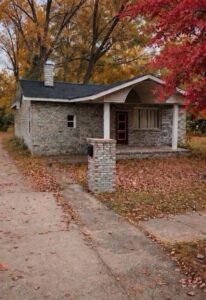
A three-bedroom, two-bathroom stone ranch listed for $29,900 sounds like the kind of property that makes people stop scrolling.
At first glance, the house appears to have plenty going for it.
It has a substantial stone exterior.
A broad lot.
Classic ranch-style architecture.
A welcoming arched entrance.
And what appears to be a relatively fresh roof.
From the street, it doesn’t immediately look like a property that should cost so little.
Then you read the listing conditions.
Cash only.
Sold as-is.
No tours.
No interior photographs.
Suddenly, the $29,900 price tag looks very different.
The house may still represent an opportunity.
But without seeing inside, a buyer isn’t simply purchasing a house.
They’re purchasing uncertainty.
The Attraction of a Very Low Price
Low-priced properties naturally attract attention.
For someone interested in renovation, a house at this price could potentially provide an opportunity to acquire a substantial property without paying the price associated with a fully renovated home.
The stone exterior is particularly interesting.
Stone ranch homes can have a distinctive appearance and, when properly maintained, can offer character that newer construction sometimes lacks.
The wide lot could also provide additional possibilities depending on local zoning and property restrictions.
But none of those features tells a buyer what condition the interior is in.
And that’s the most important problem.
The Locked Door
In a conventional home purchase, buyers generally expect to inspect the property before committing.
They can walk through the rooms.
Look beneath sinks.
Check ceilings.
Examine floors.
Open cabinets.
Observe windows and doors.
Ask questions about heating, cooling, plumbing, electrical systems, and previous repairs.
A professional inspection can identify many issues that aren’t obvious during a casual visit.
This property offers none of that before purchase, according to the listing conditions.
The buyer is being asked to make a major financial commitment without seeing what lies behind the walls.
That doesn’t automatically mean something is wrong.
There could be many reasons a property isn’t available for interior viewing.
But from a buyer’s perspective, the lack of access creates a significant information gap.
What Could Be Hidden?
A house can look excellent from the outside while having serious problems inside.
Water intrusion might be hidden behind walls.
Old plumbing could be approaching the end of its useful life.
Electrical wiring could require extensive updating.
The heating system might be outdated or nonfunctional.
There could be damaged flooring beneath carpets.
Mold could exist in areas that aren’t visible from outside.
Or the property could simply need years of cosmetic renovation.
The exterior cannot answer those questions.
Even the roof, despite appearing newer, doesn’t tell you everything.
A roof can be relatively new while the underlying structure has other problems.
Likewise, attractive stonework doesn’t eliminate concerns about drainage, foundation movement, moisture, or structural changes.
Why “As-Is” Matters
The phrase “as-is” deserves careful attention.
Generally, an as-is sale means the buyer should not assume the seller will make repairs simply because problems are discovered.
That can dramatically change the financial calculation.
Suppose the purchase price is $29,900.
A buyer might initially think they are getting a three-bedroom house for an unusually small amount.
But then imagine the property requires a new electrical system, plumbing work, HVAC replacement, extensive cleanup, and interior renovation.
The acquisition cost could quickly become much larger than the listing price suggests.
This is why experienced investors don’t evaluate inexpensive houses based solely on the purchase price.
They calculate the potential total cost.
Cash-Only Changes the Equation
The cash-only requirement adds another consideration.
A buyer cannot necessarily rely on a traditional mortgage to spread the purchase cost over time.
The buyer needs sufficient funds available to complete the transaction.
And that’s only the beginning.
There may also be closing costs, taxes, insurance, inspections, legal expenses, utility reconnection fees, debris removal, permits, contractor deposits, and renovation costs.
If the property has been vacant for a long period, additional expenses may appear once work begins.
A buyer who spends nearly all available cash on the purchase could find themselves without enough money to address urgent problems.
That’s one reason experienced buyers often maintain a substantial reserve when purchasing distressed or unusual properties.
What Should a Buyer Investigate?
Before making an offer, careful research becomes especially important.
Ownership records should be reviewed to confirm who has legal authority to sell the property.
A title search can help identify liens, claims, or other issues that could affect ownership.
Tax records should also be examined.
Are property taxes current?
Are there outstanding balances?
Are there municipal charges?
Are there code violations?
Zoning information can reveal what uses are permitted.
Permit records may show whether major renovations or additions were completed legally.
And local requirements can affect whether the property can be occupied immediately after purchase.
These questions may sound tedious.
But when you aren’t allowed to inspect the interior, documentation becomes even more important.
Look at Everything You Can
Even without entering the house, there are clues worth examining.
Look carefully at the exterior.
Are there cracks in the foundation?
Does the ground slope toward or away from the building?
Are gutters directing water away from the foundation?
Do windows appear damaged?
Are there signs of water staining?
Is vegetation growing directly against the structure?
Does the roof appear properly maintained?
Are there obvious signs of neglect?
None of these observations can replace an interior inspection.
But they can help identify questions that deserve answers.
A professional inspector may also be able to evaluate accessible exterior components and provide useful information without entering the property.
The Neighborhood Matters Too
The house shouldn’t be evaluated in isolation.
Nearby properties can provide valuable context.
What are comparable homes selling for?
What condition are they in?
How much do renovated properties in the area typically cost?
Are buyers actually purchasing renovated homes at prices that justify the required investment?
What are local property taxes?
What is happening with development in the surrounding area?
A cheap property isn’t necessarily a good investment if the surrounding market doesn’t support the finished value.
Conversely, a neglected house in an area undergoing meaningful development could potentially have long-term appeal.
The numbers matter more than the excitement of the listing.
The Renovation Budget
Anyone considering a property like this should create multiple budgets.
Start with the optimistic scenario.
Then create a realistic scenario.
Then create a worst-case scenario.
Include costs for structural work, electrical, plumbing, heating and cooling, roofing, windows, insulation, flooring, kitchens, bathrooms, exterior repairs, permits, debris removal, and labor where appropriate.
Most importantly, include a contingency.
Old houses frequently reveal additional problems once walls, floors, ceilings, or mechanical systems are opened.
A renovation budget without a contingency can become obsolete surprisingly quickly.
Opportunity or Expensive Surprise?
That’s ultimately what makes the property so intriguing.
The stone exterior could hide a house with tremendous potential.
Perhaps the interior needs mostly cosmetic work.
Perhaps the structure is fundamentally sound.
Or perhaps years of neglect have created problems that aren’t visible from the street.
There isn’t enough information to know simply from the asking price.
And that’s the lesson.
A $29,900 house isn’t necessarily a $29,900 investment.
The purchase price is only one number in a much larger calculation.
The Locked Door Is the Real Story
The unusual part of this listing isn’t simply that the house is inexpensive.
It’s that the buyer is being asked to accept significant uncertainty before gaining access to the interior.
For an experienced investor with substantial cash reserves, renovation knowledge, and the ability to investigate the property’s records thoroughly, that uncertainty may be manageable.
For someone expecting a conventional home purchase, it could be much more difficult.
The house might eventually become a beautiful restored ranch.
Or it might require far more money than expected.
Until the interior can be properly examined, nobody can responsibly know which one it is.
That’s why the $29,900 price should be treated as a starting point—not the final cost.
Behind that stone facade could be a hidden gem.
It could also be a serious renovation project.
The only way to distinguish between the two is careful investigation.
And when the door is locked, the paperwork, the neighborhood, the numbers, and the willingness to accept risk become more important than ever.